
When a leader tells me the plan is to check the market and pay what a superintendent is going for, what I hear is a leader who has not yet named what his company is for. The market question feels responsible. It is usually avoidance. Pay is one of the clearest mirrors a leader ever looks into, and a number copied off a salary survey reflects nothing back except the absence of a philosophy. The answer sits upstream of any salary survey: a leader willing to name the mission that pay is supposed to serve. That is where mission-driven compensation begins.
I have spent fifteen years in this work, thirteen of them in construction, sitting inside more than a thousand compensation conversations. The most common instinct in all of them is to find the going rate and match it, to treat pay as a commodity price to be discovered rather than a relationship to be built. Mission-driven compensation starts from the opposite end.
Asking the market is asking the wrong question
Asking what the market pays a superintendent is a little like asking the going rate for a two-by-four. For the board, the question makes sense, because every board is supposed to be the same: same dimensions, same species, same grade, interchangeable on the rack. People are the opposite. The closer you look at any one superintendent, the more distinct they become in temperament, contribution, and what drives them. A leader who cannot see that distinction cannot price the person in front of him, so he reaches for an average that was never about that person at all.
The data underneath that average is thinner than it looks. Survey numbers are self-reported, lagged by a year or more, and blended across markets and company types that have nothing to do with yours. You are anchoring a five or six figure decision to a number a stranger invented for a company you have never seen.
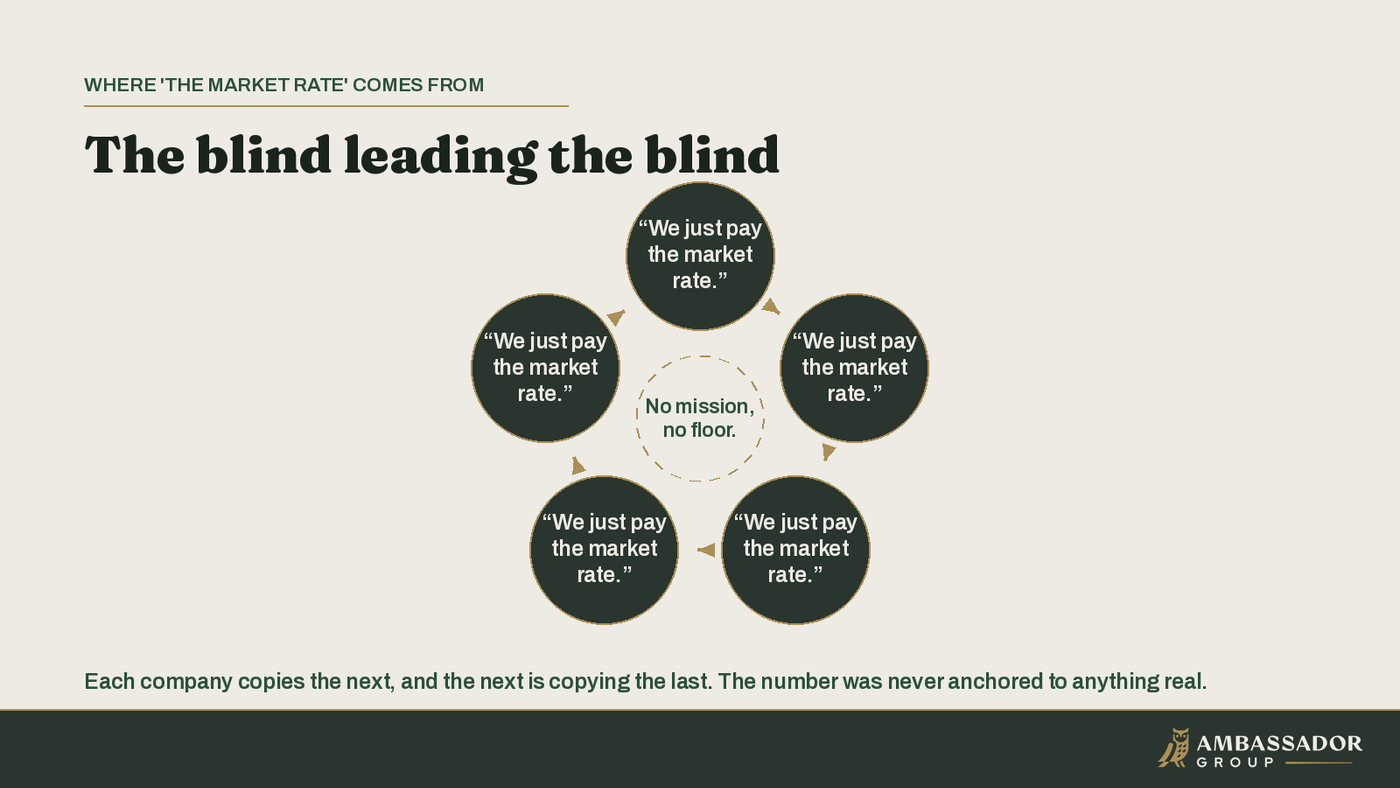
There is something circular about the whole exercise. The market rate you are chasing is just the number other companies landed on by chasing the market rate, and they were copying someone too. It is the blind leading the blind. Everyone points at everyone else, and no one points at their own mission or their own P&L. A survey can tell you what the crowd is doing. It cannot tell you what a person is worth to you. I counted eighty ways a salary survey misleads a hiring decision, sorted into ten failure modes, if you want the full account.
Mission is the anchor pay hangs from
The way out is to price compensation against your own mission, values, and P&L instead of against the market’s noise. Most companies I see have never done this out loud. They build roughly similar projects, plenty of fine custom residential and solid commercial work, and yet the real reason any one of them gets up in the morning is rarely written down or carried through the company. Being the biggest or the best is a goal. The mission is the reason you want it.
What you believe so strongly that you would be punished to keep it: that is what you organize pay around.
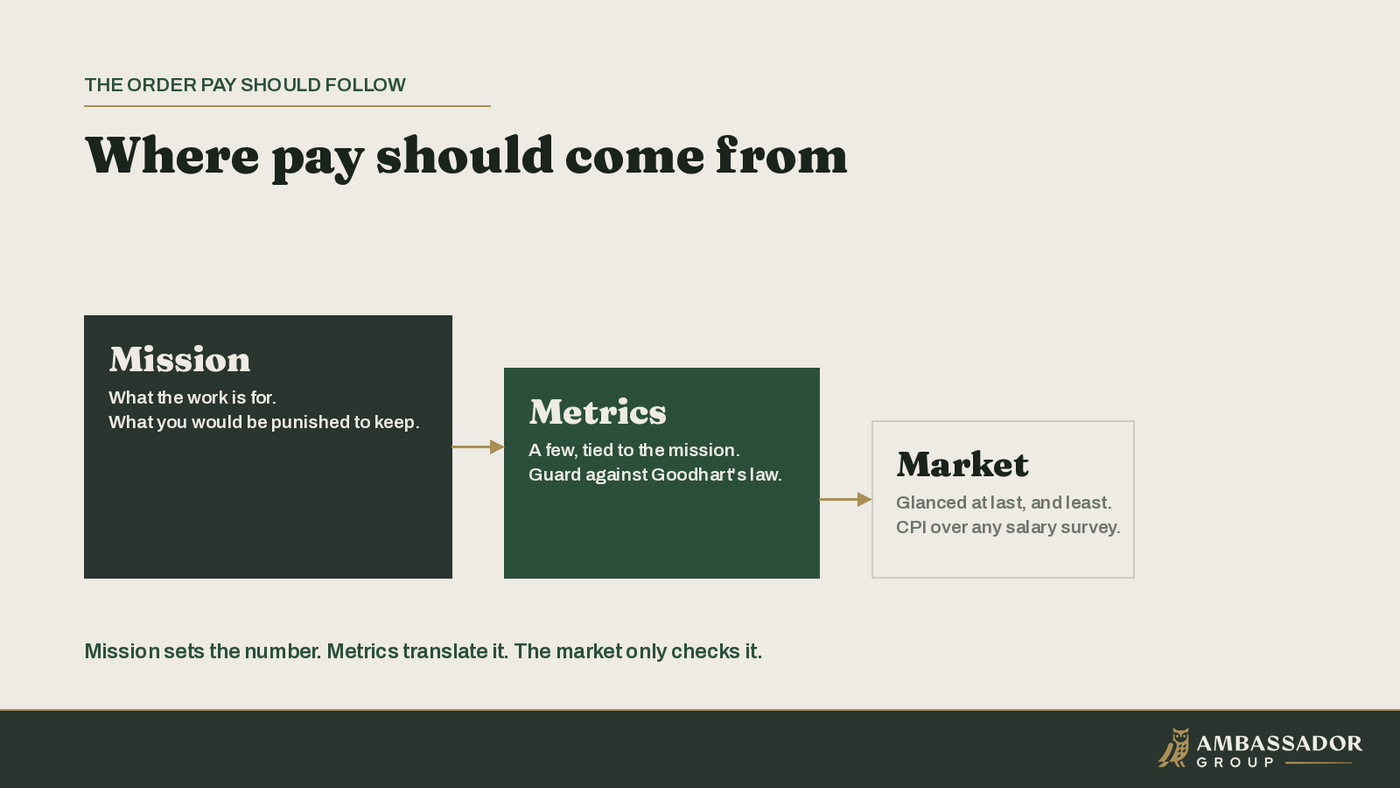
Once the mission is clear, the sequence is simple to say and hard to do. Mission first. Then a small number of metrics tied tightly to that mission, kept few on purpose. Watch for Goodhart’s law: the moment a metric becomes the target, it stops measuring what you wanted and people start gaming the number instead of serving the mission. Align the measures to the mission, and never let the measure become the point. Only after mission and metrics do you glance at the market, and even then the cost of living tells you more about what pay should be doing than any salary survey will.
Marginal utility decides what a person is worth to you
Economists have a phrase worth borrowing: marginal utility. A bottle of water in the desert is worth far more than the same bottle in your kitchen, and a person of a given talent is worth more to some companies than to others. I have no project that needs a superintendent today, so to me one is worth little. To you, on a large job with real margin at stake and a particular risk to guard against, the same person may be worth a great deal. The factors that set a fair number, the size of the job, the margin, the risk, the moment, all live inside your company, not in an aggregate. The most honest place to start pricing a role is your own P&L. The pie is exactly as big as your numbers say, and you are sovereign over those numbers.
This is not abstract. On a recent search for a custom-home builder, the useful question was never what the market pays a senior project manager. The candidate’s own stated range turned out to be a soft signal, shaped more by what he had accepted before than by what he could do. The real work was pricing the role against the builder’s own numbers and the value of the person on that specific project, then building an offer around his whole career and life rather than a survey midpoint. The number got easier to defend, and easier to say yes to, the moment it started from the business and the mission rather than the market.
The raise conversation you dread is a problem you built upstream
The pattern shows up in a familiar moment. A key person comes to you with an offer somewhere else for more money, and now you are pinched, mid-project, with a lot of inertia and a lot to lose. It feels like disloyalty. Usually it is something quieter. The mission was never clear, the values were never named, and the path to earning more was never drawn, so the only instrument that person had for a raise conversation was an outside bid. They had to go find one because no one ever handed them a map. I watch good people go shopping for an offer to stay at a company they would rather not leave, because their leadership never showed them how to grow in place.
When the chain runs the other way, the market sets your pay, your pay sets your pricing, your pricing sets your billing rate, and a survey you did not write is quietly running your business. The tail wags the dog. A clear mission breaks that chain, because the number starts with what the work is for and what your numbers can carry, not with what someone else decided to disclose.
What mission-driven compensation changes
A clear model turns the dreaded raise conversation into a good one. When someone asks for more, you have a rubric instead of a standoff: here is how you grow, here is what it takes, and I would like to see you get there. You can talk about merit together rather than haggle over who holds the upper hand. If you have overpaid or underpaid, the same mission-aligned rubric lets you correct it without making it personal, because you stop rewarding confidence and start rewarding contribution.
None of this lives on a spreadsheet. It lives in the culture, in every person being able to say the mission and mean it. That costs you time, energy, and steady communication, and you pay it for the life of the company. What you get back is a workforce whose interests genuinely overlap with the company’s, and a firm that stops lurching between reactive raises and reactive hiring.
You already own the numbers and the mission that should drive your pay. The only question is whether you will make them legible enough that the people carrying your work can see exactly how they win when you do.


