
An interview produces far more information than the decision it feeds. Six people talk to a candidate over three weeks. That is six transcripts, six sets of written feedback, a screening call, two reference conversations, an assessment, and whatever the candidate said in the hallway on the way out. Then a decision gets made, and almost all of it is gone.
None of it is lost by accident. It gets discarded on purpose, by people trying to be helpful. The record gets boiled down until one person can hold it in their head long enough to make a call, and the boiling down feels like diligence. It is the most expensive habit in hiring, and it is where a leader's judgment becomes visible. The fix is not a better candidate pool. It is a hiring authority who stops throwing away the evidence they paid to collect.
What compression costs
Watch how a debrief works. Six people gathered a lot. The meeting has forty minutes. So each person offers a headline and a rating, whoever states their read most confidently sets the framing, and the group converges on a summary that fits inside one paragraph.
That paragraph is what survives. Everything underneath it is now sitting in inboxes and recordings that nobody will open again.
I have sat in on more of these than I can count, and I still find it hard to hold the full picture when the interview team is large. That is arithmetic, and it applies to sharp people. A human can carry maybe five or six threads at once, so a process built around one human's capacity will produce a five-thread answer no matter how much material went in.
The dangerous part is that nothing looks broken. The meeting happened. The decision got made. Nobody in the meeting can see what was left out, which is exactly why the loss goes unbilled.
The part you needed most is the part you threw out
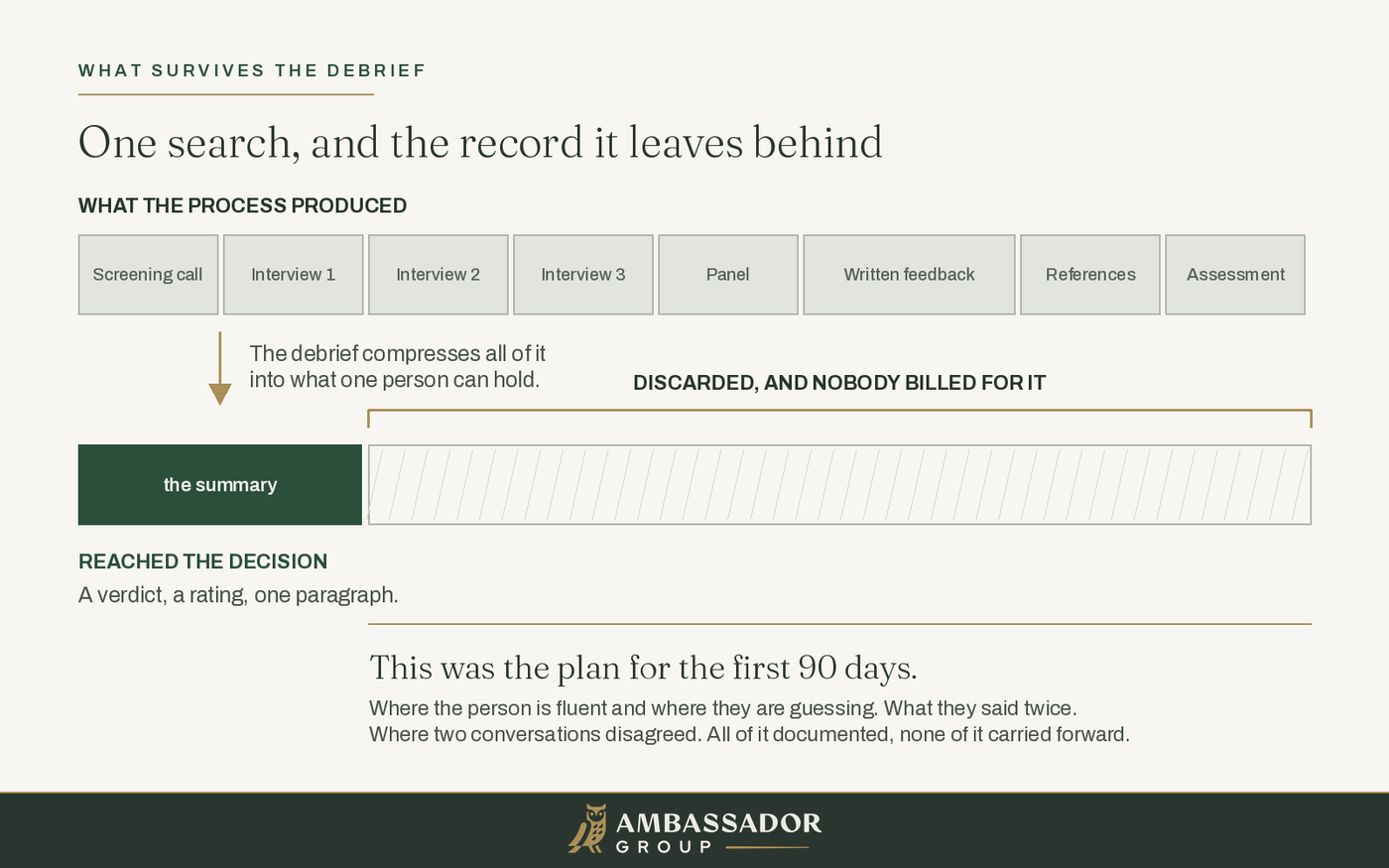
The boil-down drops a predictable category of material.
The decision only needs a verdict, so anything that does not push toward yes or no gets dropped. That means the reasons someone hesitated on the third question about scheduling conflict. The way the candidate described being managed at their last company. The estimator who said, twice, in two different conversations, that written scopes at their old shop were assumed rather than issued. The exact spot in a system where this person is fluent and the exact spot where they are guessing.
None of that changes a hire or no-hire call much. All of it is the raw material for leading the person once they show up. It is also where the risks you can still do something about live, and a hiring risk nobody named is a risk nobody managed.
That is the trade nobody prices. Compress the record and you protect the decision while destroying the onboarding plan. Six weeks later a manager is discovering the same gaps in production that three interviewers already documented and nobody carried into the summary. The training that would have taken an afternoon in week one becomes a performance conversation in month four.
There is a second cost, quieter. Divergence only shows up across the full record. A candidate who says one thing in a screening call and something meaningfully different in the third interview has told you something important, and you can only see it if both conversations are still on the table side by side. Compress each conversation separately and the contradiction dissolves into two reasonable summaries.
Underwriters answer complexity by building bigger data sets
Interviewing is risk underwriting. Identify the risk, manage it, reduce it, and above all make it conscious. That framing sits at the center of how hiring works when you treat it as underwriting rather than sales, and it has a practical consequence most leaders skip past.
Watch what an actuary does when a risk gets complicated. They widen the file, gather more, and build the analysis that lets a large body of evidence yield one decision without anyone having to hold it all in their head at once. The data set gets bigger and the answer gets sharper at the same time. That is the entire trick, and it is available to hiring.
Think of it as headlights. Some are dim, some light up the whole road. The road is the same road either way. Hiring is the most consequential thing an organization does, because every other decision runs downstream of who is on the team, and yet most leaders drive it on low beams and call the darkness bad luck.
Widening the record is now cheap. Interviews can be recorded and transcribed, written feedback can be required before any group conversation, and patterns can be pulled from the whole file by tools that do not fatigue at thread number seven. Recording and transcribing every interview is the upstream half of this, and it is table stakes. The half most companies never get to is deciding what to do with a record too large for one person, instead of shrinking it until one person can cope.
Interviewer skill is downstream of interview design
There is a reflex to blame the interviewers. Some of them do ask lousy questions, accept non-answers, and never follow up. All of that is real and worth fixing.
It is also not the top of the chain. Interviewer quality sits downstream of coordination, planning, logistics, and whether anybody treats building the record as a discipline in its own right. A great question asked into a process that discards the answer is wasted. My rough estimate is that having the right question is maybe 20 percent of the problem. The rest is what you do with the answer: how you follow up, how you relate it to your own operation, and whether it survives to the person who has to lead the hire.
This is the piece that transfers across every industry. What differs is the content of the questions, because you have to know that a certain thing happens on a job site to know it is worth asking about, and what you do not know is out to get you in an interview. What does not differ is the discipline of building the file, holding the whole thing, and making the risk conscious before you sign.
Where to start
Take your last completed search and try to reconstruct it. Find the written feedback, the screening notes, the transcripts if they exist. Then ask what the hiring manager was told, and compare the two.
The gap between those is your compression loss, and reading it once will tell you more about your process than another vendor pitch ever will. Then ask the harder question: of everything in that gap, how much of it was the plan for the person's first ninety days, and nobody knew it was sitting there.
You paid for all of that evidence. The only decision left is whether you are going to use it.
The short version.
- What does it mean to treat an interview as a data set?
- Every conversation in a search produces evidence: transcripts, written feedback, screening notes, reference calls, assessments. Treating it as a data set means keeping all of it intact and analyzing across it, rather than reducing each piece to an impression.
- What is wrong with summarizing interviews for the debrief?
- A summary is built to serve one question, hire or no hire. Everything that does not push toward a verdict gets dropped, and that discarded material is usually what the hiring manager needed to lead the person once they arrived.
- How does underwriting apply to hiring?
- An underwriter answers a complicated risk by widening the file and building the analysis that lets a large body of evidence yield one decision. Hiring can do the same thing, and most companies do the opposite by shrinking the record until one person can hold it.
- Is the fix better interviewers?
- Interviewer skill matters, but it sits downstream of interview design, coordination, and whether anybody treats building the record as a discipline. A well asked question is roughly a fifth of the problem. The rest is following up on the answer and getting it to the person who has to lead the hire.


