
People have been digging holes in the ground for thousands of years, and the digging never stopped. What changed was the tool. Bare hands gave way to sticks, sticks to iron, and iron to a machine with a hydraulic arm that moves in an hour what a crew used to move in a week. Nobody argues about that anymore. Run an excavation company without excavators today and you are not competing, you are closing up shop.
AI sits at that same point right now for the thinking work inside your company, and it is going to expose whoever is in charge. A machine with that much reach does not make a poor operator competent. It makes one easier to spot. The same thing is true of hiring: the process does not produce the quality of your team, you do, and a leader who cannot see their own limits clearly will not see a candidate's clearly either. Give a careless operator a bigger machine and you get a bigger mess, faster.
The advantage is mechanical, then intellectual
An excavator gives you mechanical advantage. The hydraulics do not care how strong you are. A person of average strength moves tons of material because the arm multiplies what the hands can do.
Artificial intelligence gives you the same kind of multiplication one layer up. Call it intellectual advantage. It reads faster than you, holds more at once than you, and drafts in seconds what takes an afternoon. That is real, it is measurable, and it is not going away. It also raises what a leader has to be, because AI keeps raising the bar for leadership faster than it lowers the bar for the work.
It is also early. The machines are clunky. They break down. They confidently produce work that is wrong in ways that take judgment to catch. That is what the first decade of any piece of heavy equipment looks like, and it is not an argument against buying one.
Most people get the next part backwards. When a green operator climbs out of the cab having torn up a job site, two conclusions are on offer. One is that the excavator is a poor machine. The other is that the operator has work to do. Only the second one holds up. I hear a version of "the AI could not do it" almost every week, and nearly every time the honest version is "I did not know how to ask." Everything turns on which of those two a leader says out loud. Blame the machine and you stay a shovel operator. Own the result and you start becoming something the market pays for.
You still hand dig around the gas line
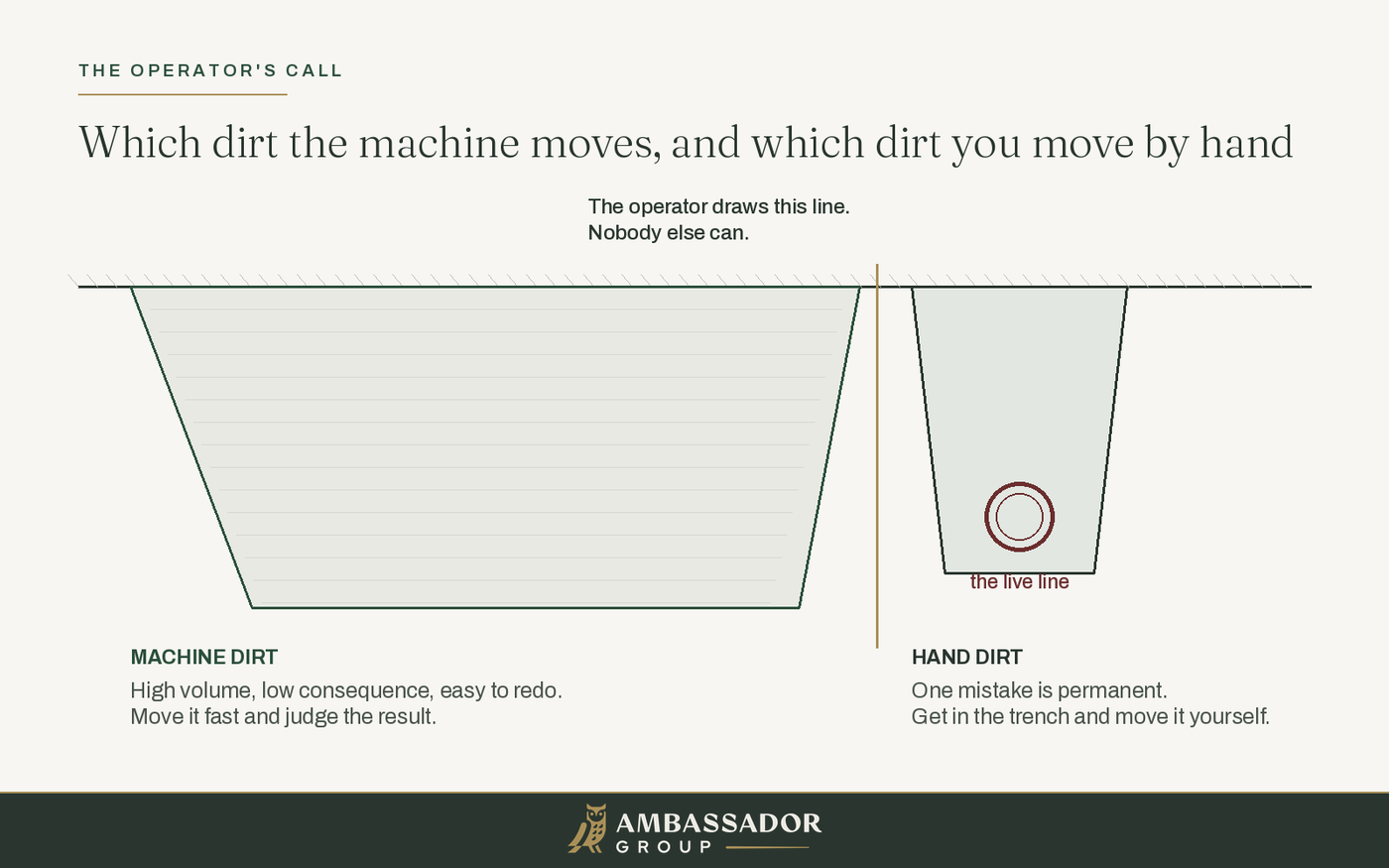
An excavator is a great tool for most of the dirt on a job site, and the wrong tool for some of it. Knowing which is which is judgment.
Nobody with sense puts a bucket in the ground near a live gas line. You get down there with a shovel and you move the dirt by hand, because the consequence of being wrong once is catastrophic and irreversible. Every trade has its gas lines.
Mine are the moments where a person's livelihood is on the table. A candidate deciding whether to move their family. A leader deciding whether to let someone go. A conversation where somebody needs to hear a hard thing from a human being who will still be there next month. I will use a machine to assemble the evidence for those decisions, the same way I would use one to take interview notes so a human can stay present in the conversation. I will not hand it the decision, and I will not hand it the conversation. Judgment, taste, values, and the willingness to be accountable to another person are not computational problems.
So the discipline is knowing which dirt is safe to move fast and which dirt you climb down into the trench for. Machine or no machine was never the question.
The limiter is your imagination
The most common way to waste one of these tools is to ask it for something small.
Imagine one of the most knowledgeable people alive follows you around all day and will do anything you ask. Most people ask that person to reformat a spreadsheet. The constraint is the size of the question you thought to ask.
An example from my own week. I was reading about a tool that turns documents into audio and wondered whether the articles I have written could become a podcast. That turned out to be a bad idea, but partway through it I found the real one: every article on the site could carry narration. By the end of the next day there were 56 hours of narrated audio on the archive, at a cost of about $150. There is no version of my week where I record 56 hours of audio. The idea was ordinary. Chasing it was the whole difference.
A second example, closer to hiring. A coordinator on my team with no recruiting background was reviewing a candidate's file and noticed the person had never said what an acceptable offer would look like. She fed that concern to the machine along with everything on record, and it connected the loose threads into a specific risk: the client was about to make an offer blind, into a live counteroffer setup. People with years more hiring experience had looked at the same file and moved on. She caught it with a good instinct and a machine that could hold the whole record at once. That is what an operator looks like. You do not have to be strong to dig a deep hole. You have to know what the controls do.
Where the hole goes, and how small it can be
There is a failure people fall into once the machine starts working. They discover they can dig, so they dig everywhere. Trenches with no plan, spoil piles in every direction, no infrastructure going in the ground. A moonscape. In this work it shows up as volume: 40 pages of analysis where four bullets were needed, produced because producing it was free.
Insight is the deliverable, and a large pile of output is the most convincing way to avoid producing any. A client with a business to run does not want the corpus of everything the machine knows about a candidate. They want the four things that will change what they do on Monday, and they want them at the top. Handing them the whole excavation and calling it thorough transfers your work onto them.
So the operator's real question is where exactly does this hole need to be, and how small can I make it. How big a hole can I dig was never the question.
That question has an edge on it. Cutting 40 pages down to four bullets takes more understanding than producing the 40 pages did. Compression is where the human earns their keep, and it is the part no machine has taken.
What AI showed me about my own leadership
I did not expect this next part.
Six months of trying to get precise work out of a machine has shown me something unflattering about how I lead. I do a great deal of synthesis in my head and almost none of it out loud. I hand people the conclusion and skip the reasoning, and then I am privately surprised when the work comes back off target. The machine does not let that slide. Give it a thin instruction and you get thin work, immediately and visibly, with no politeness in between. Give it the context, the constraints, and what good looks like, and the output changes completely.
People are exactly the same. They are kinder about it. A person will absorb a vague instruction, guess at what you meant, and quietly deliver something you did not want, and the feedback loop takes three weeks instead of thirty seconds.
That is the mirror in this, and it is the same mirror hiring holds up. Skill in either one climbs on the back of an honest read of your own limits, which is the whole argument of the four stages of hiring competence. I got better at saying what I meant. That was the only thing that changed. Every leader I know who has gotten serious about these machines has run into some version of that, and the ones who take the note become clearer with their people too.
So build something. Automate one task you do every week and accept that the first three attempts will be thrown away, because the thing you keep is what you learned building them. Skilled operators have never been out of work in the history of this industry, and they are not about to start now.
You already know whether you are in the cab or still down in the trench.
The short version.
- What does it mean to call AI an excavator?
- An excavator multiplies what a crew can move without making anyone stronger. AI multiplies what a person can read, hold, and draft without making anyone smarter. In both cases the quality of the result tracks the operator, not the machine.
- Where should a construction leader refuse to use AI?
- Anywhere the consequence of being wrong once is permanent. Use it to assemble evidence for a hiring decision, a termination, or a difficult conversation. Do not hand it the decision or the conversation itself.
- Why does output quality vary so much between people using the same tool?
- Most of the variance is in the instruction. A thin prompt produces thin work immediately and visibly. Context, constraints, and a clear picture of what good looks like change the output completely, which is the same thing that separates clear delegation from vague delegation with people.
- Is more output the goal?
- No. Producing volume is cheap now, and a client with a business to run does not want a forty page analysis. The discipline is cutting the excavation down to the few things that change what someone does on Monday.


