
This guide is about the distance between two leaders. One expects fit magic. The other builds a hiring system that produces fit.
Building a hiring system is difficult because it is a wicked problem. You can read more about that here.
Interviewing is the highest-leverage thing a leader does, and almost nobody is taught how. You're taught to run a project, manage a P&L, read a drawing set. Then you're handed a conversation that will price a $300,000 to $1,000,000 decision, and you're expected to wing it.

The mirror
The quality of a hire is principally driven by the leader. A leader's insight into candidates rises with their self-awareness. The recruiting industry has grown around a more enticing alternative: the illusion that candidate quality is the lever. The real lever is the mirror.
Every story, every template, every framework in this guide rests on that sentence. The structure we call the Ambassador Interview Method doesn't work because it produces better candidates. It works because it produces better interviewers. Lanes force you to see what you weren't going to probe. Independent written evaluations force you to see where your gut was reasoning from polish instead of evidence. Transcripts force you to see what you said compared to what you remember saying.
A good hire is luck. A good hiring practice is leadership.
How to use this guide
Read cover to cover if you want the whole argument. Skip to the part you need if you're working a specific problem. Print Appendix A and keep it in the interview room. The guide is short enough to finish on a flight to a project site and deep enough to reward rereading. Come back when you've been burned and want to understand why. Come back when a search is going well and you want to make sure you're not just getting lucky.
The five pillars this guide rests on
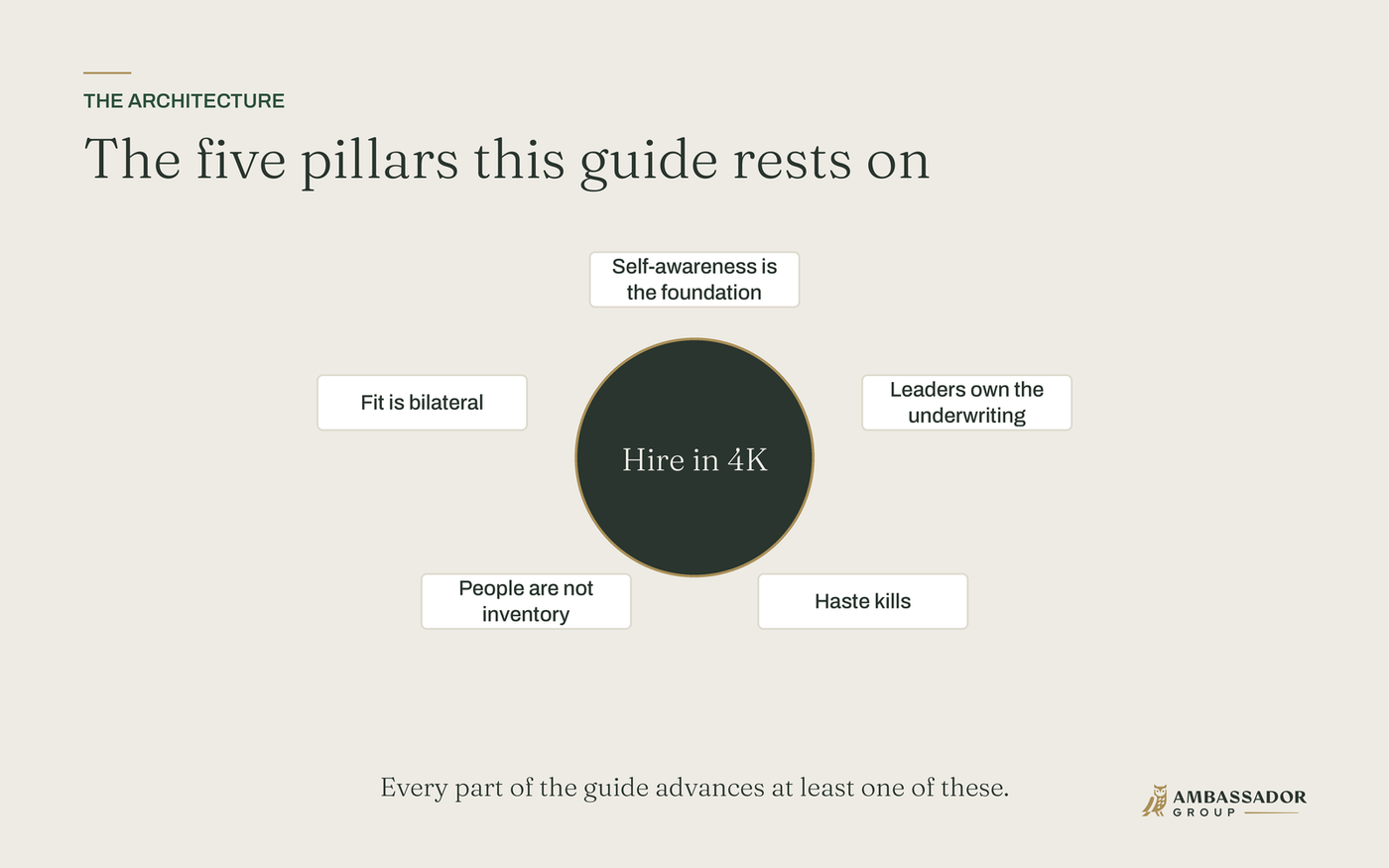
Ambassador Group's method rests on the five pillars set out in the Guidebook: self-awareness is the foundation, leaders own the underwriting, haste kills, people are not inventory, and fit is bilateral. Every part of this guide advances at least one of them. The ideas below are how those pillars show up in a hire; name them now so you can see the architecture as it unfolds.
- Self-awareness is the foundation. Leaders who don't know themselves cannot evaluate others. The Four Stages of Hiring Competence map how leaders move from confident incompetence to mastered humility.
- Judgment is the real target. Every wish list ("A-player," "rock star," "unicorn") compresses to one variable: judgment, the ability to read a situation and do the right thing. It is built from four factors (character, cognitive horsepower, experience, self-awareness), it multiplies rather than adds, and it is calibrated to your company. You cannot evaluate it until you have defined it in yourself, which is why it sits next to self-awareness.
- Leaders own the outcome. The hiring authority controls roughly 80 percent of the variables that determine whether a hire succeeds. Role clarity, interview design, process discipline, and accountability are leadership work, not HR work.
- Hiring is underwriting, not shopping. Every candidate carries units of risk. Your job is to identify the risk and choose to fill it through training, engineer around it through support, or walk away.
- Haste kills. "Need them yesterday" is the most expensive phrase in hiring. The coffin corner (too busy not to hire, too busy to hire well) produces eleven months to stability where the deliberate path produces two.
- People are not inventory. Every candidate carries a God-endowed nobility that cannot be commoditized. The better question is whether the job fits the candidate.
- Mission is the operating system. Without a clear belief at the center, every other element operates without a compass. Companies have either a mission operating system or mission theater. There is no in-between.
When you find yourself agreeing with a section, ask which idea it's advancing. When you find yourself resisting a section, ask which idea you're unwilling to pay for.
Hiring is underwriting
The central frame of everything we do is that hiring is underwriting. You aren’t checking boxes. You’re pricing risk on a long-dated, concentrated, high-consequence bet with limited information that decays the moment the interview ends.
An underwriter doesn’t look at a single data point and declare a risk. They gather patterns across exposure, history, behavior, context, and probability. They know what to weigh, what to discount, which combinations spell trouble. They write a decision that can be defended, reviewed, and improved. Most hiring is done with none of that discipline: a resume, a conversation, a gut feeling, a second opinion, a decision. No transcripts. No written evaluations against the JD. No post-mortem when it fails.
Most bad hires are underwritten badly, not chosen badly. The decision looked fine the day it was made; what failed was the work before it, the questions not asked, the terms left undefined, the references never run. Hire the person you enjoyed talking to instead of the person you would stake a project on, and you have underwritten charisma and ignored the loan.
An underwriter signs their name, and so does a hire. Every search needs one accountable owner, a Hiring Decision Leader who runs it from problem definition to offer and owns the result. Think of them as the general contractor for the hire. Not the only person on the job, but the one answerable for whether it stands. When everyone is responsible for a hire, no one is, and the call drifts to whoever is loudest in the debrief.
That ownership does not end at the offer. When a hire fails there are only four places to look: the candidate, the company, the market, and the circumstance. Trace any of them back far enough and you land on a leadership decision. Blaming the candidate for lying is not a diagnosis. It is a refusal to read your own underwriting, and it guarantees you write the same bad policy next time.
The interview is a risk management event, not a popularity contest. Behave accordingly.
The stakes nobody measures
Let's be precise about what's at stake. A hiring decision for a mid-level construction leadership role (a Project Manager, a Superintendent, a Regional Operations lead) conservatively touches $300,000 to $1,000,000 in first-year fully-loaded compensation, onboarding, training, indirect, opportunity, and ramp costs alone. That's before the projects they'll touch during ramp, the subcontractor relationships they inherit, the owner relationships they'll maintain or damage. For a VP of Operations, the blast radius of a bad hire runs into the tens of millions.
The data on which that decision is made is collected in a few hours of conversation. And then it's thrown away. There's no other domain in construction where this would be acceptable. A GC bidding a $50M project doesn't rely on the estimator's memory of the walkthrough. A PM running a complex job doesn't ask the owner to trust the team's recollection of a pre-con. There are meeting minutes, submittal logs, decision records. Hiring is somehow exempt. A professional who ran a project the way most companies run hiring would be considered a liability, not experienced.
Put a real number on the pain
Abstractions don't move leaders. Numbers do. Here are some of ours.
- A $110K PM who flames out in six months is a $150K+ mistake once you add lost productivity, rework, the team's overload during the gap, the training that walked out the door, and the interview calories burned on the replacement search.
- A superintendent role left empty on a $20M project drags $1,200 to $1,800 per day in schedule slippage and subcontractor drift. Every week you delay a good hire because you're "too busy" costs more than the hire would.
- Building your own recruiting function costs roughly $320,000 in year-one outlay, closer to $368,000 with fringe, before a single role gets filled. Leaders who want to "just hire a recruiter internally" almost always underestimate this by half.
- Re-work kills false speed. A "fast" contingent hire that flames out at month six puts you at eleven months to stability. A deliberate hire that takes eight weeks and sticks for five years gets you there in two. The "slow" way is nine months faster. Every time.
Risk units and blast radius
Every candidate walks in with a backpack full of what I call risk units. Some are obvious: gaps in experience, weak references, short tenures. Most aren't. They show up later as friction with a specific peer, an inability to handle a specific kind of pressure, a motivational mismatch with the day-to-day. The interview is your only chance to inventory those risk units before they become your problem.
A bad hire doesn't just cost you the hire. It costs you the projects they touch, the subcontractors who recalibrate their trust, the owners expecting the people you promised, and the quiet updates every other leader makes to their model of your judgment. Hiring under duress makes all of it worse: four risks spike at once: environmental (you take whoever's on the market), candidate (you skip the harder screens), process (you cut steps to save time), and onboarding (you have no foundation). Desperation is gravel in the cake mix. It ruins the texture of judgment.
The lie of easy hiring
The business world is obsessed with fast and simple. One-click applications. AI-written emails. Hiring that feels like swiping right. I'd be the first to sign up if the product worked as well as the pitch. It doesn't.
Hiring needs more friction, not less. More data. More accountability. More time. Tires need friction to grip the road. Clamps need friction to hold the wood. In hiring, process is friction. It's good friction, the traction you need to make a decision that sticks. When I slow a leader down to ask "Why do you really need this role?", that's friction. When I ask them them to look at data that contradicts their gut, that's friction.
In construction you'd never break ground on a $50M project without a plan, dig without a soil test, or frame without a blueprint. Yet most of us throw that discipline out the window when we hire. Poor hiring discipline is an honest skill gap. The system never taught us another way. Hiring is a project: budget, schedule, dependencies, stakeholders, risks, deliverable. If you're too busy to interview properly, you're too busy to lead.
Where performance really comes from: the 6 Boxes
When a hire underperforms, the post-mortem almost always lands on the person: bad fit, interviewed well and worked out poorly. That conclusion is comfortable because it points away from the leader. It is also usually wrong. Thomas Gilbert, the behavioral scientist who founded human performance technology, spent decades measuring where performance really breaks down and sorted the causes into two buckets. Environmental factors, the things the leader controls, account for roughly 75 percent: clear information and feedback (about 35 percent), the right resources and tools (about 26 percent), and incentives that mean something (about 14 percent). Individual factors account for the other 25 percent: knowledge and skill, raw capacity, and motivation. Three-quarters of underperformance traces to the environment, and the reflex to fix the person spends money and goodwill on the wrong quarter of the problem.
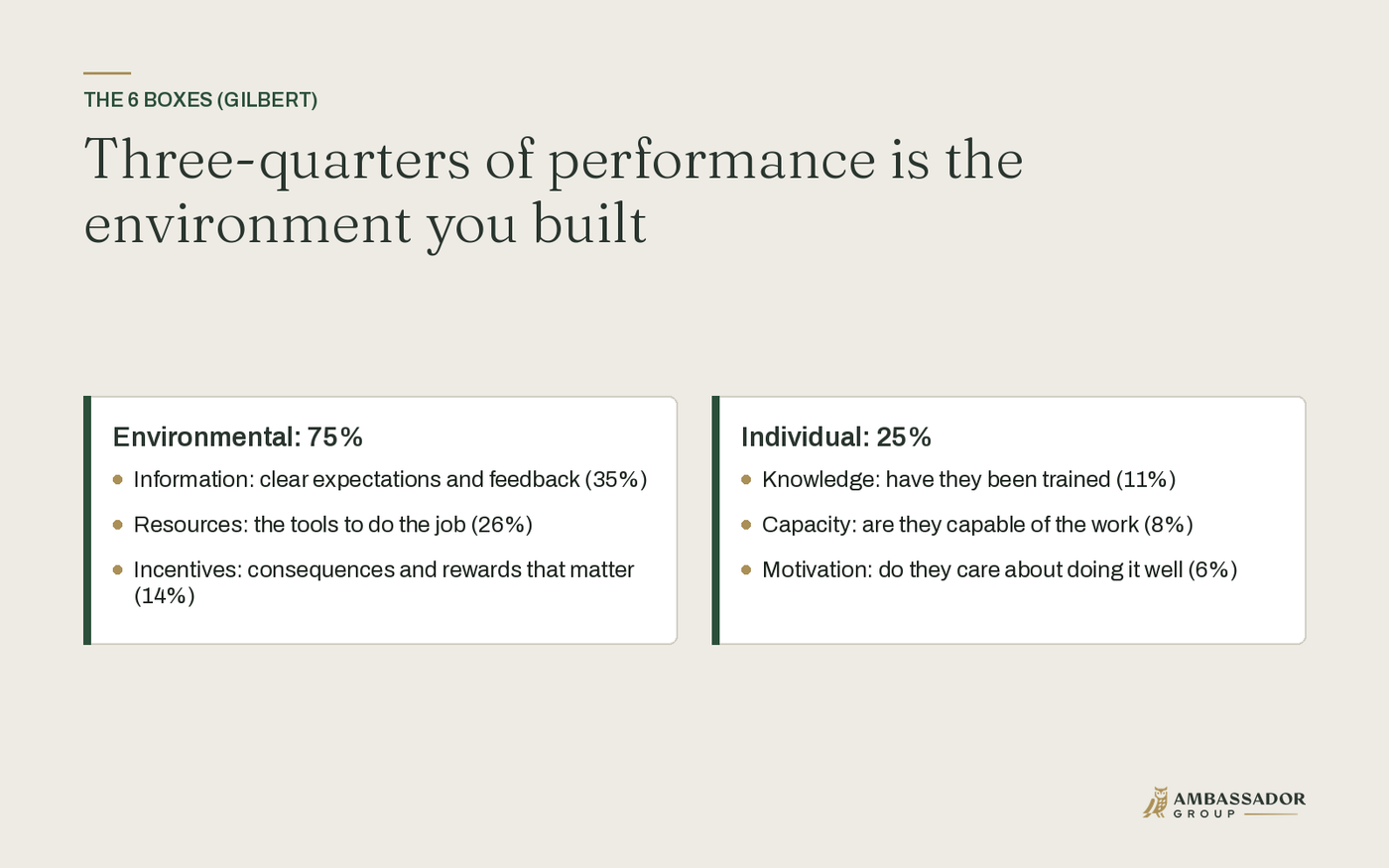
Read the boxes onto your own hiring and the picture is unkind. Information: are your interviewers aligned on what good looks like, and does feedback survive past the hallway? Resources: most interviewers are handed a resume and a calendar invite and nothing else, no guide, no scorecard, no prior data. Incentives: when no one owns the quality of a hire, quality becomes nobody's emergency. Knowledge: interviewing is treated as instinct when it is a trained skill. The fixes are the rest of this guide, lanes, transcripts, written evaluations, scorecards, AARs, made visible and owned. The seventy-five percent of the problem that lives in the environment is the seventy-five percent you built, which means it is the seventy-five percent you can rebuild.
Hiring is a mirror
The recruiter relationship is often your canary in the coal mine. The way your team hires is the way your team leads. If you micromanage the search, you're probably micromanaging your people. If you can't let an outside expert run point, you probably can't let an inside expert run point either. I've lived this pattern a hundred times. Here are two clients I worked with in the same month last year, looking for the same kind of hire.
The Controller
Tired of bad hires, wanted help fast. Then they began steering the ship. "Only local candidates." "Don't talk to candidates before we do." "Our team doesn't do structured interviews." They'd hired us for recruiting but wanted staffing on their terms. The result: a fractured process, mixed messages, broken feedback loops, stalled offers, strong candidates dropping out. The control mindset wasn't isolated to hiring; it mirrored how they led, and it showed in their turnover.
The Partner
Also wanted to avoid bad hires, but started by asking smart questions. How do you prevent mismatches? How do we know if we're part of the problem? They vetted our systems, then stepped back and let us run point. They used the feedback forms, adopted the strategy, listened to red flags. Their GM said it best: "We didn't just fill a role. We matured as a leadership team."
Some leaders treat hiring like a transaction and struggle with the same control patterns that wear down their team. Others treat it like a partnership and lead in a way that unlocks performance across the board. The way you run your interview loop is the best honest diagnostic of how you lead.
Every company is, to a remarkable degree, a painting of its leaders: the behaviors you see in the field trace back to the people at the top, through what they built and what they allowed. If poor judgment keeps surfacing in your people, the honest first question is what in your own leadership is producing it. That is the same mirror this guide opened with, and it is why hiring well and leading well turn out to be the same skill.
The leaders who'd benefit most from this guide are the ones most likely to resist it. They want speed. They want magic. They want a recruiter to show up with the candidate pre-approved, and to skip every discipline that would have produced that candidate. This part is about pushing rigor through that resistance, whether you're the recruiter convincing the client, the hiring leader convincing your team, or the HR director convincing the CEO.
Slow hiring is not caution. It is confusion.
Lead with this. Slow hiring is rarely about caution. It's usually a sign of confusion. Since 2017, across more than 200 matches, we have seen hard searches run long, and that is expected. The ones that drag without a reason usually trace back to a leader who can't make up their mind.
Fast searches aren't accidental. They happen when the leader is ready: the JD is clear, the interview team is assigned, success criteria are agreed in advance, and decision authority is unambiguous. Slow searches usually mean the leader isn't ready, and the search is exposing it. If your time-to-offer drifts past 45 days, the problem is almost never the candidate pool. It's that you're making the search carry the weight of your own indecision. Clarity is the accelerator. Structure is the accelerator. Everything else is drag. And candidates notice slow hiring: your hiring process is often the first taste of your leadership culture.
The "too busy to interview" trap
When a leader says they're "too busy" to interview properly, what I usually hear underneath is a leader who hasn't yet had the painful reps that force the conversion. Call it pre-conversion confidence. The correct response is patient and direct: if you're too busy to interview properly, you're too busy to lead. Hiring is one of the most critical leadership responsibilities you have. You wouldn't let your PM hand off a critical owner meeting because they were "too busy." To rush hiring is like building with balsa-wood beams on an unlevel foundation: the time you're trying to save is trivial compared to the damage you're compounding.
The skeptic-to-advocate path
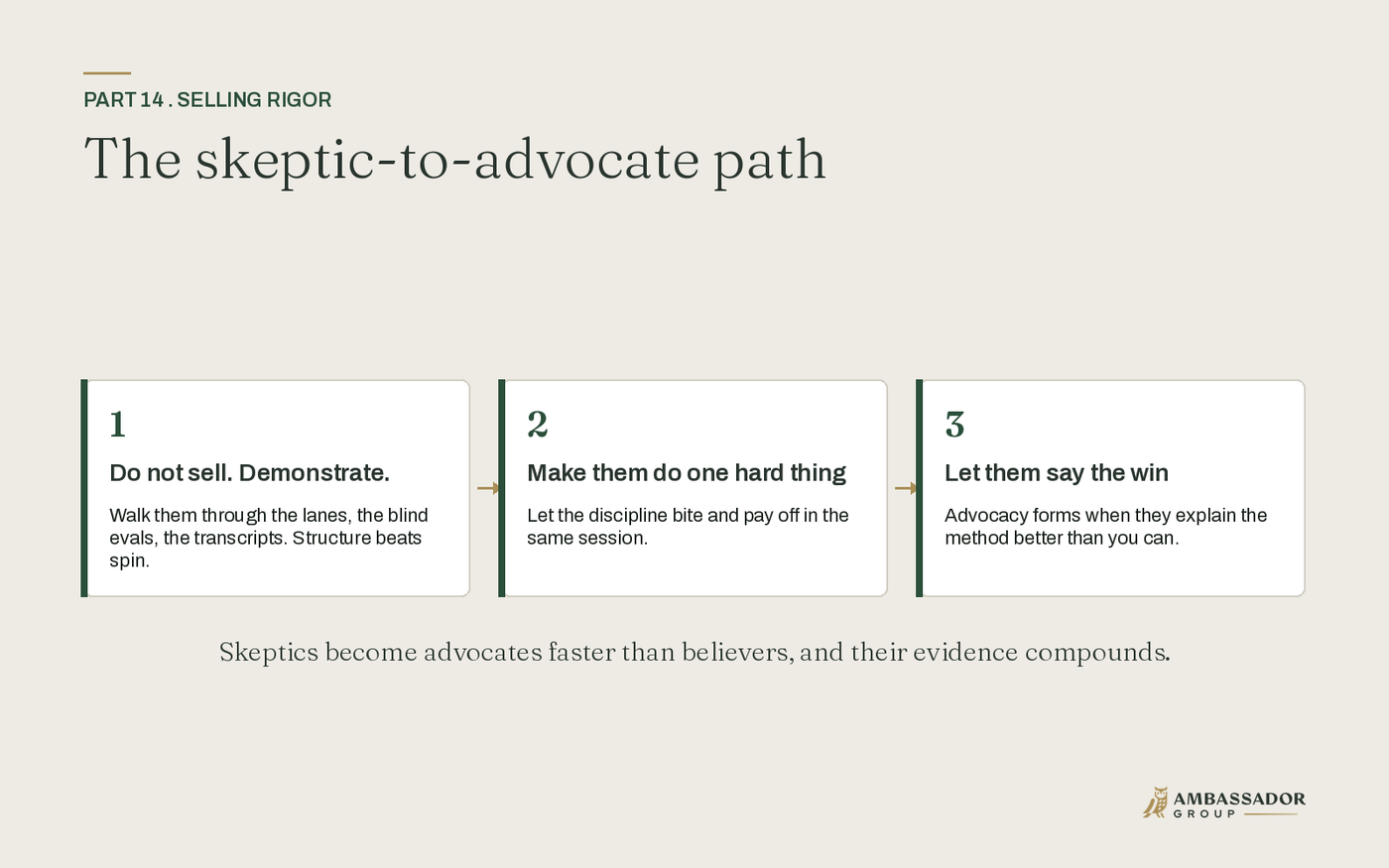
The good news: skeptics become advocates faster than believers do. A believer is easy to sell to and easy to disappoint. A skeptic who gets converted has been moved by evidence, and the evidence compounds: they tell their CFO, their board, the next GC they have lunch with. The path has three steps:
- Don't sell. Demonstrate. Don't pitch the method. Walk them through it. Show the lane assignment, the blind written evaluation, the transcript analysis. A skeptic's guard drops the moment they see structure instead of spin.
- Make them do one hard thing. For Crestwood it was "don't talk to Marshall between interviews." For you it might be "write your evaluation before the debrief." It has to feel at first like a minor indignity and then, on reflection, like the most important discipline in the process: the skeptic has to feel the discipline bite and pay off in the same session.
- Let them articulate the win in their own words. When the process produces the hire, don't take the credit. Advocacy is built when the skeptic can explain the method better than you can.
The financial case
If the leader in front of you is a finance person, don't lead with philosophy. Lead with the numbers from Part II: the 11-month-versus-2-month re-work equation, the $1,200 to $1,800 per day vacancy drag, the $110K PM who flames out into a $150K+ mistake, the $320K to $368K year-one cost of building in-house. The "slow" way is nine months faster than the "fast" way every time you run the math out the full arc. If the leader is an operations person, lead with the construction analogy: you wouldn't break ground without a plan, frame without a blueprint, or skip inspections. Hiring without structure is risk transferred into the future, where it compounds until it shows up in a project you can't save.
The mirror principle, revisited
The hardest conversation to have with a resistant leader is the one where the recruiter holds up the mirror: the reason the hiring feels hard is often the same reason the leadership feels hard, and the recruiter has been watching both. Most leaders don't want to hear it. A few do, and those are the ones who change. Some leaders will never be able to hear it. That's their right, and we walk away from clients who can't. It's not personal; it's just not effective for either of us. The leaders who can hear it use the interview process as a forcing function to upgrade their own practice. The search becomes a mirror. The mirror becomes a mentor. If you're trying to sell rigor to someone who isn't ready, here's the hard truth: you cannot want it for them. You can only present the evidence, offer the structure, and make it safe for them to change their mind.
Why the JD is the rubric

The Ambassador Interview Method rejects a premise most hiring teams never confront: that consensus and gut feel are the real indicators of hire quality. Whoever feels most strongly wins; whoever reads the panel best sets the outcome. Hiring the person the panel liked most is a popularity contest dressed in business-casual.
A job description is a detailed responsibility punchlist. The JD is the rubric. Every question, every evaluation, every debrief exists to determine whether this candidate can do the work the JD describes. Not whether they seemed smart. Not whether they felt like a fit. Whether they can do the job.
A rubric is only as good as what it measures, and most job descriptions measure the wrong thing. They name symptoms instead of the root problem. “We need a PM because projects are behind” is a symptom. “Our projects are behind because estimating and field execution stop talking to each other, so we need someone who can turn preconstruction assumptions into field accountability” is the problem. Score a candidate against the first and you learn nothing. Score them against the second and the interview writes itself. If you cannot name the problem the role exists to solve, you have not defined the job well enough to hire for it.
The other way a JD fails as a rubric is measuring tasks and credentials instead of outcomes. “Manages subcontractor schedules and maintains site logs” is a list of activities anyone can claim. “Owns field operations on a $10M job and delivers it ahead of schedule, with clean documentation and city relationships that hold” is something a candidate has either done or has not. Years of experience is the same trap. Ten years served is not ten years of judgment. Write what winning in the role looks like in plain English, and the rubric becomes testable.
If your JD can’t function as a rubric, the problem isn’t your interview process. It’s your JD. Fix that first.
The strongest JDs go one level deeper than the task list. They name which combination of the four judgment factors the role demands, and in what proportion. A PM coordinating twenty stakeholders across a complex build needs character and self-awareness above almost everything. A CFO entering a growth phase needs horsepower and the right experience. A first hire in a brand-new function needs character and self-awareness most of all, because no amount of domain experience prepares anyone for that much ambiguity. Get specific enough and the JD forces the trade-offs that end stat-maxing.
None of this makes the JD sacred. It is a rubric, not a cage. The best-defined roles are sometimes shaped around the person you can actually hire, and a genuinely new role names its ambiguity instead of faking a crisp punchlist. What you cannot do is skip the definition and let the panel’s gut fill the vacuum. Score against a role you have honestly defined, even when the honest definition is “we are figuring this out together.”
You would not break ground without drawings. The JD is the drawing set for the hire. It turns a vague impulse, “we need a superintendent,” into accountabilities specific enough to score against. And like a good drawing set, it keeps working after the build starts. The document that attracted the right person also maps their first ninety days and sets the baseline for every performance conversation after. If the person you hire could read it a year in and know whether they are winning, you wrote a rubric. If they could not, you wrote a wishlist.
"A-player" is a feeling, not a framework
Ask a senior leader what they want and you hear a version of the same list. Drives results. Strong communicator. Strategic thinker. High EQ. Culture carrier. Autonomous, but coachable. Ten years of experience, but still hungry to prove something. The leader usually knows the list is a fantasy while they are saying it. Compress the whole wish list down to one variable and you find the thing they truly want: judgment. A person who can read a situation, weigh the inputs, and do the right thing without having their hand held.
The failure is not in the aspiration. It is in the vocabulary. "A-player" is a feeling, not a framework, and leaders who hire on a feeling, even an experienced one, keep getting surprised by who they hired and who they lost. Before it is a hiring problem, it is a self-awareness problem: you cannot evaluate judgment if you have never defined what judgment means to you. This is the mirror again, pointed at the one quality every leader claims to want and almost none have written down.
The stat-maxing trap
When a role opens, most leaders build a mental profile of the ideal candidate, and the profile keeps growing. Every stakeholder conversation adds a requirement. Every painful memory of the last person adds a filter. By the time it is finished, the profile describes a human being who does not exist. Borrowing the term from video games, this is stat-maxing: every attribute slider pushed to 100, and then you wait for that character to walk through the door.
Real people are trait-budget allocations. More of one thing usually means less of another. The leader who is brilliant at synthesizing complexity often has little patience for operational detail. The rock-solid operator who never drops a ball often needs a clear lane and stalls in ambiguity. Neither is inferior. They are different processors built for different environments. Stat-maxing is how a leader admits, without meaning to, that they do not yet know what the role really needs. The fix is not a better candidate. It is an honest definition.
The four factors, in order
If the goal is judgment, it is built from four things, and they are not equal. Order matters.
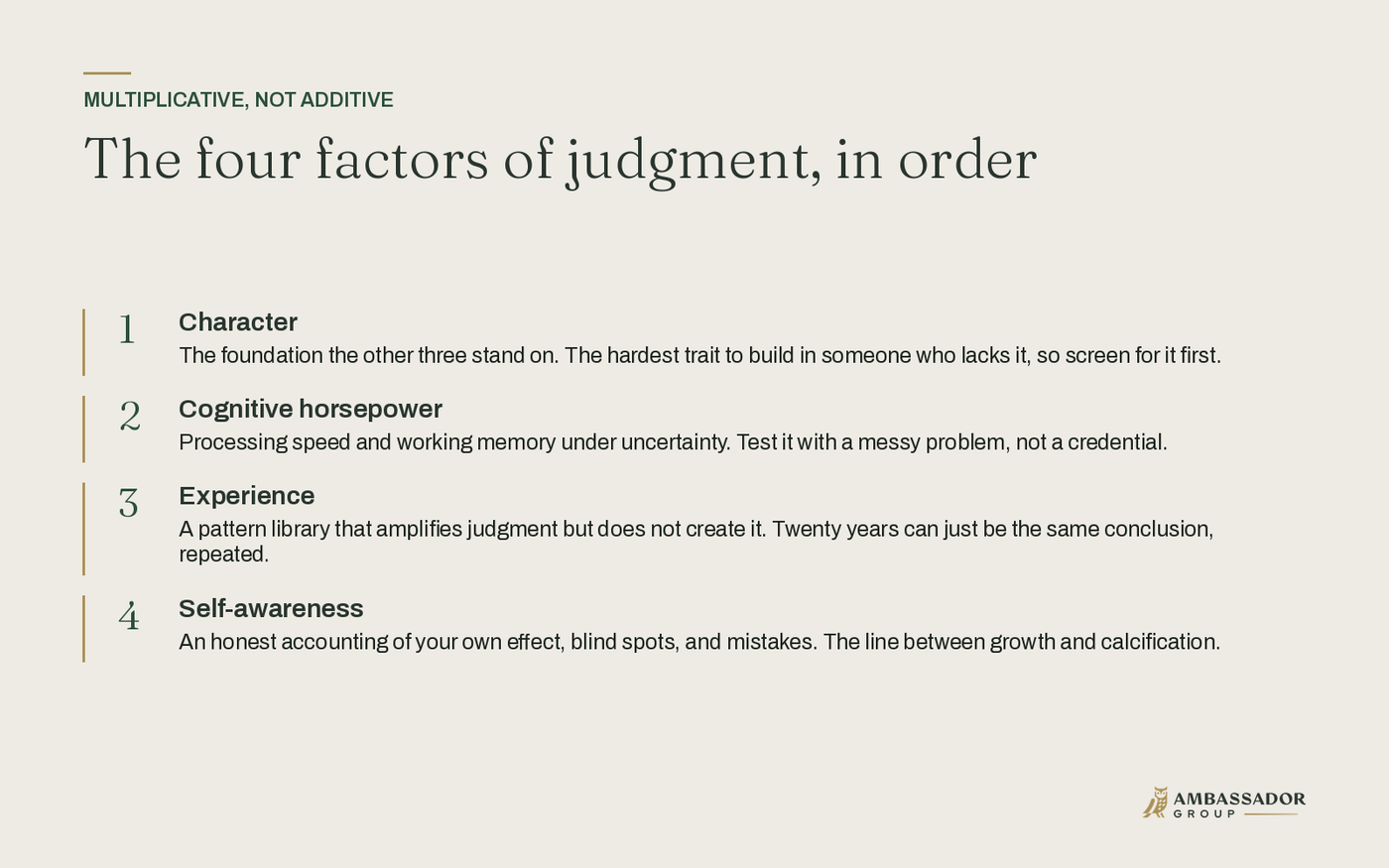
Character is the foundation. Everything else sits on top of it, and removing it makes the other three dangerous. Low character with high EQ produces a narcissist: someone who reads people perfectly and uses that read entirely in service of themselves. They interview beautifully. They perform early, while the incentives are visible. Then they hollow out trust over eighteen months, and by the time you see it your best people have already left to get away from them. Low character with high intelligence and low EQ produces something different and just as costly: brilliant, blunt, entirely self-oriented, right often enough that leadership defends them long past the point they should have been let go. Character is the hardest thing to build in someone who does not already have it. Frameworks, experience, and self-awareness are coachable. Integrity is not. Screen for it first, not as a feel-good principle but because the math does not work without it.
Cognitive horsepower is second: processing speed and working memory under uncertainty. Some people are built for complexity and hold competing ideas at once. Others are built for clarity and execute a defined lane beautifully. Neither is universally better; the error is putting the wrong processor in the wrong job. This is the factor leaders most often proxy through credentials, but degrees and brand-name employers measure prior access, not current horsepower. Test for it directly. Hand the candidate a messy, ambiguous problem and watch how they move, not whether they reach the right answer but whether they ask the right questions.
Experience is third: the pattern library someone brings to a new situation. Deep experience in the right domain lets people recognize signals others miss, because they have seen this before and know how it usually ends. But experience amplifies judgment, it does not create it. Twenty years paired with underdeveloped judgment is just more data points supporting the same limited conclusions. The opposite error is underweighting experience where pattern recognition is the entire job: a safety call on a site, a client relationship with a long history, a negotiation with a sub who has worked the market for thirty years.
Self-awareness is fourth. Call it EQ if you like, though the phrase gets stretched to mean too much. What you care about is whether a person sees themselves accurately: their effect on others, their blind spots, what they are optimizing for and whether they know it. Self-awareness is the difference between someone who grows and someone who calcifies. It decides whether feedback lands or bounces, whether failure becomes information or becomes someone else's fault. It does not require warmth. Some of the clearest thinkers are direct to the point of bluntness. What they share is an honest accounting of themselves: they know when they are wrong and say so before they are asked. That is the signal. Not charm. Accuracy.
The model is multiplicative
The four factors do not add. They multiply. A person with high character, high horsepower, and high self-awareness will pull more out of average experience than someone with thirty years in the field who is missing any one of the three. One factor at zero breaks the whole profile, and that is the real reason character comes first: it decides whether the other three are assets or liabilities. A highly intelligent, highly self-aware person with low character is among the most dangerous hires you can make, because they know exactly how to operate inside your blind spots.
Most teams read horsepower and experience reliably, because both show up in the work. Character and self-awareness hide in short exposures. A ninety-minute conversation is a constructed situation that people optimize for, and a smart high-character candidate and a smart low-character candidate can look nearly identical inside it. The signal you want lives where the performance breaks down: how someone behaves under ambiguity, in conflict, after failure, when no one is watching, and in the references they did not hand-pick. Building your interview and reference process around the four factors is not rigor for its own sake. It is deliberately gathering signal on the variables that decide the outcome, instead of defaulting to the two that surface on their own.
Good judgment is calibrated to your company
Here is what makes this hard: judgment is not universal. Every company defines good judgment against its own values, mission, and processes, so a decision that reads as wise in one firm reads as reckless in another. A candidate's judgment can be genuinely strong and still misfire inside your walls because it was calibrated to a different set of rules. That is why a construction professional with twenty years in the field can join your company and make poor calls from day one, and the resume never warned you.
Take a superintendent who finds a discrepancy between the structural drawings and the field conditions. In one company, good judgment means stopping work and routing the RFI before a dollar is spent. In another, it means proposing a fix and keeping the schedule moving while the paperwork catches up. Neither is wrong in the abstract. Only one fits your firm, and the candidate cannot read your mind about which. Until you can say plainly what good judgment looks like in your shop, and which of your own patterns it reflects, you are hiring against a standard you have never written down. Define judgment for your company first, then onboard, train, and hold people accountable to it. The clarity you build in yourself becomes the standard you can finally hold a candidate to.
Read the four by creating openings, not interrogating
You assess these the way you assess anything real in an interview: by making space for them to show, not by firing questions. Character shows up when you give someone the chance to talk about a mistake and ask why without backing them into a corner where shame is the only exit; you are watching for humility, honesty, and ownership. Horsepower shows up in how they handle a problem with shades of gray, whether they hold the nuance or flatten it into a rule. Self-awareness shows up in how honestly they account for their own part in a failure. Experience shows up in pattern recognition, in whether they can describe how a problem announces itself before it fully arrives, not in the year count. The mechanics of this, the open posture, the rule of two questions, asking why until you reach the belief under the behavior, are in the individual-interviewing and prepping sections that follow. The point here is what you are aiming those tools at.
Interview for time span
There is a second way to read judgment that titles actively hide, and it is one of the most useful questions you can bring to a senior interview. Every role carries a time horizon: the length of time before you know whether a decision was good. A laborer's trench is judged by the end of the day. A foreman's phase, in two to four weeks. A project manager does not know the job truly worked until the keys change hands, a year or two out. An executive sets a direction whose verdict takes five or ten years to arrive. This is time span, drawn from Elliott Jaques, and it measures the longest horizon a person can hold in their head and act on. Put a short-horizon thinker in a long-horizon role and the company stops growing; put a long-horizon thinker in a short-horizon role and they over-complicate the simple and grow bored.
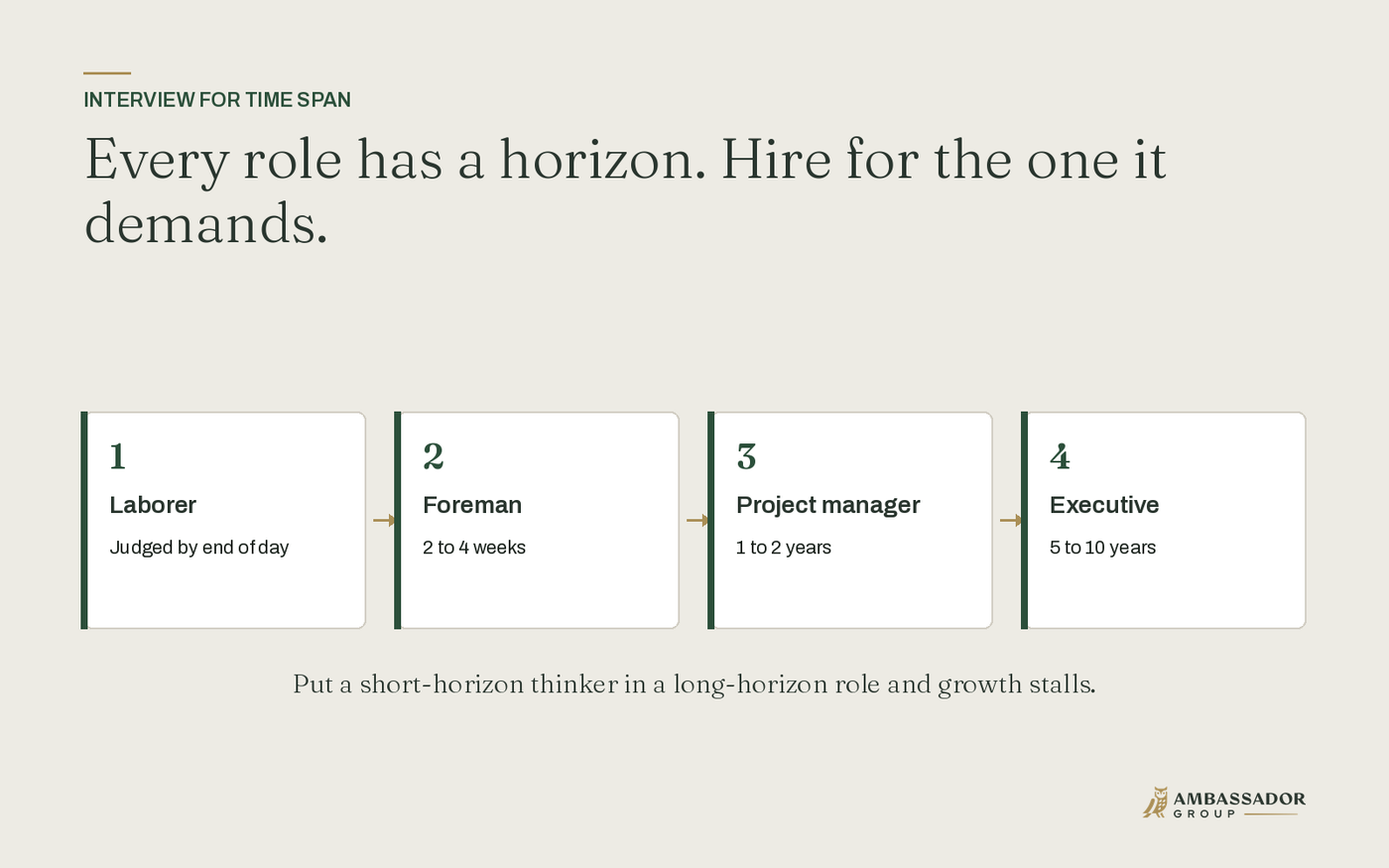
You interview for it by asking not what someone did but how long it took to know it worked. "What is the longest project or goal you set the plan for and then had to wait to see the result of?" A two-week answer is an operational leader; a three-year answer is a strategic one. Then separate the horizon from the credit, because candidates say "we" about things that were really the boss's call: "What part of that was yours alone? If it had failed, who would have been blamed?" Then layer performance on top, because holding a two-year horizon and hitting the goal are different facts: "At the end of those two years, did you hit it, and how did you know?" Time span tells you the level a person can operate at. The four factors tell you how well. You want both.
Two lenses, not one
The seven dimensions of fit, which come next, and the four factors of judgment are not competing frameworks. The seven dimensions are the axes of fit between a person and a role: can they do the work, succeed here, match the culture, connect with the team. The four factors are the ingredients of the judgment that makes someone good on those axes in the first place. Fit asks whether this is the right person for this role. Judgment asks whether this person can read a situation and do the right thing once they are in it. Hold the four factors as you walk through the seven dimensions, and the evaluation gets sharper.
Most interviewers evaluate "fit" as a vibe. Fit is a multi-dimensional question. If you don't know which dimension you're evaluating in a given moment, you're projecting. Every candidate should be assessed across seven dimensions. A candidate strong on one and weak on three is not a hire. A candidate moderately strong on all seven usually is.
Functional fit: can they do the work?
Technical ability, project experience, familiarity with the tools and workflows your company uses. The novice asks yes/no questions off the resume. The master simulates the work: "Walk me through how you'd approach this problem." Then listens for craftsmanship, not just competence.
Contextual fit: can they succeed here?
Context changes everything. A star at a massive ENR-ranked GC may fail in a boutique firm. A great operator in a mature division may flounder in a new market. Contextual fit is about company size, pace, chaos level, decision speed, communication norms, and the specific messiness of your current stage. The master uses the anti-sell: instead of painting a rosy picture, they describe the single most frustrating aspect of the role and watch for the flinch. Ten minutes of scaring the candidate with reality saves a costly mis-hire.
How much context transfers depends on how standardized your work is, and that varies more than people think. Highway construction is close to a solved problem: the engineering is mature, the method is refined, and success is largely a matter of executing a well-established process correctly. When one highway builder hires from another, the standardization of the trade absorbs much of the risk, because both firms do the work in recognizably similar ways. Finance behaves the same way, hemmed in by regulation. Large custom residential is the opposite. In the ten-million-to-one-hundred-million range, the finished home might look similar from firm to firm, but the path to it diverges almost completely: how a company estimates, structures contracts, runs a site, manages change orders and RFIs and the owner-architect-contractor relationship. None of it is constrained by a state spec, so each firm builds its own normal. The less standardized the work, the less context transfers, and the more the burden of judging fit falls on the interview itself.
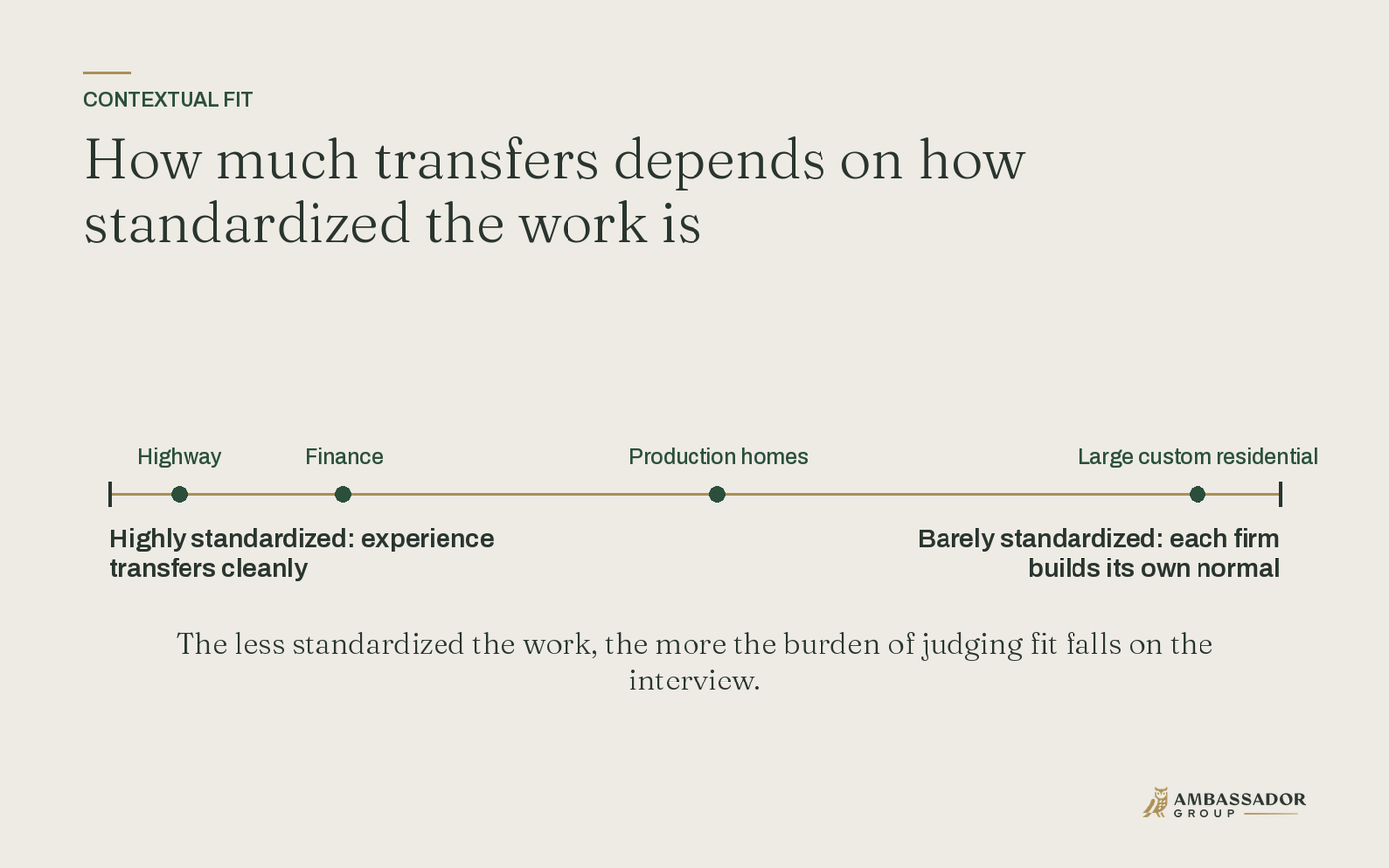
This is why titles deceive. A foreman at one company carries the authority of a superintendent at another. A project manager here owns scope that an assistant PM owns there. When that title lands on a resume, the unwary leader reads years and impressive projects and fills in the rest with assumption. The candidate did build the same kind of home and did carry the same title. The fit lives in the details nobody examined: what he believes about working with subs, how he runs a schedule under pressure, where he draws the line between protecting the relationship and protecting the margin. The master closes that gap by interviewing against their own operation on purpose, which means naming that operation first.
Cultural fit: do their values match how we behave when no one is watching?
Culture is what people do under pressure. The novice runs the beer test ("would I enjoy hanging out with this person?") and filters for likeability. The master probes for extreme ownership, humility, and self-awareness with high-tension questions: "Tell me about a time you had to deliver bad news to a superior."
Relational fit: how will they connect with the specific humans they must work with?
Work only goes as far as the team is good. Relational fit is about the specific personalities, management styles, and working rhythms of the people this hire works with every day. Tools like the ProfileXT surface specific friction points you'd otherwise learn the hard way.
Motivational fit: does the daily reality of this role feed what drives them?
People do their most durable work when the job maps to their unique ability. The novice sells perks. The master asks the candidate to color-code last week's calendar: green for energy-giving tasks, red for draining ones. If this role is 80 percent red for them, they'll burn out no matter how skilled they are.
Developmental fit: can this role stretch them without breaking them?
Every hire needs to fit where they are today and have room to grow into where you need them next year. The master assesses whether the candidate's growth arc matches the company's trajectory, and whether the company can support the development this person will need. Do not grow what you cannot lead.
Leadership fit: what kind of leadership will they need, and can you provide it?
Every hire comes with a leadership bill. Some need high-structure oversight; others need autonomy and trust. If you're a leader who disappears for weeks at a time, say so. Then ask, "I provide very little daily oversight. How will you handle that?" The worst move is hoping the new hire creates their own structure when you know in your gut that isn't realistic.
Two archetypes to watch for
Two candidate archetypes show up in almost every search, and confusing one for the other is how good hiring decisions go wrong. Know which one you need before you start. Trying to hire a Boy Scout with an Innovator-shaped JD produces a confused loop and a frustrated candidate. These archetypes are trait-budget allocations made visible. You are not choosing between a better and a worse person; you are choosing which allocation the role demands. Decide that before you start, or the search decides it for you, based on whoever interviews best.
The Boy Scout
Steady, coachable, reliable, low-drama. You get exactly what you paid for. They won't blow up your project, and they won't blow up your numbers either.
The Innovator
Smart, creative, sometimes difficult, occasionally brilliant. Can deliver a ten-bagger or cost you the project. You don't hire (or manage) them the way you do the Boy Scout.
Hire like Moneyball
One frame ties the seven dimensions together. In Moneyball, the Oakland A's could not outspend the Yankees, so they stopped chasing pedigree and studied what really drove wins, then assembled players who fit their system instead of the market's idea of a star. Hiring rewards the same discipline. The ego-driven playbook says hire the longest resume, chase the cream of the crop, assume the high price tag guarantees the result. But one company's A-player is another company's C-player, and the question that matters is not the label, it is the fit to your problem. A rising foreman hungry to step up can be a better hire than a superstar rolling off a fourteen-million-dollar job who arrives with the ego, the price, and the baggage. The catch is that the bet is never on the player alone. It is on your system's ability to unlock them, which means crystal-clear expectations, an aligned interview, and a leader willing to own their half of the hire. Scout for what your team needs, not for what the market prizes.
Lanes, not overlap
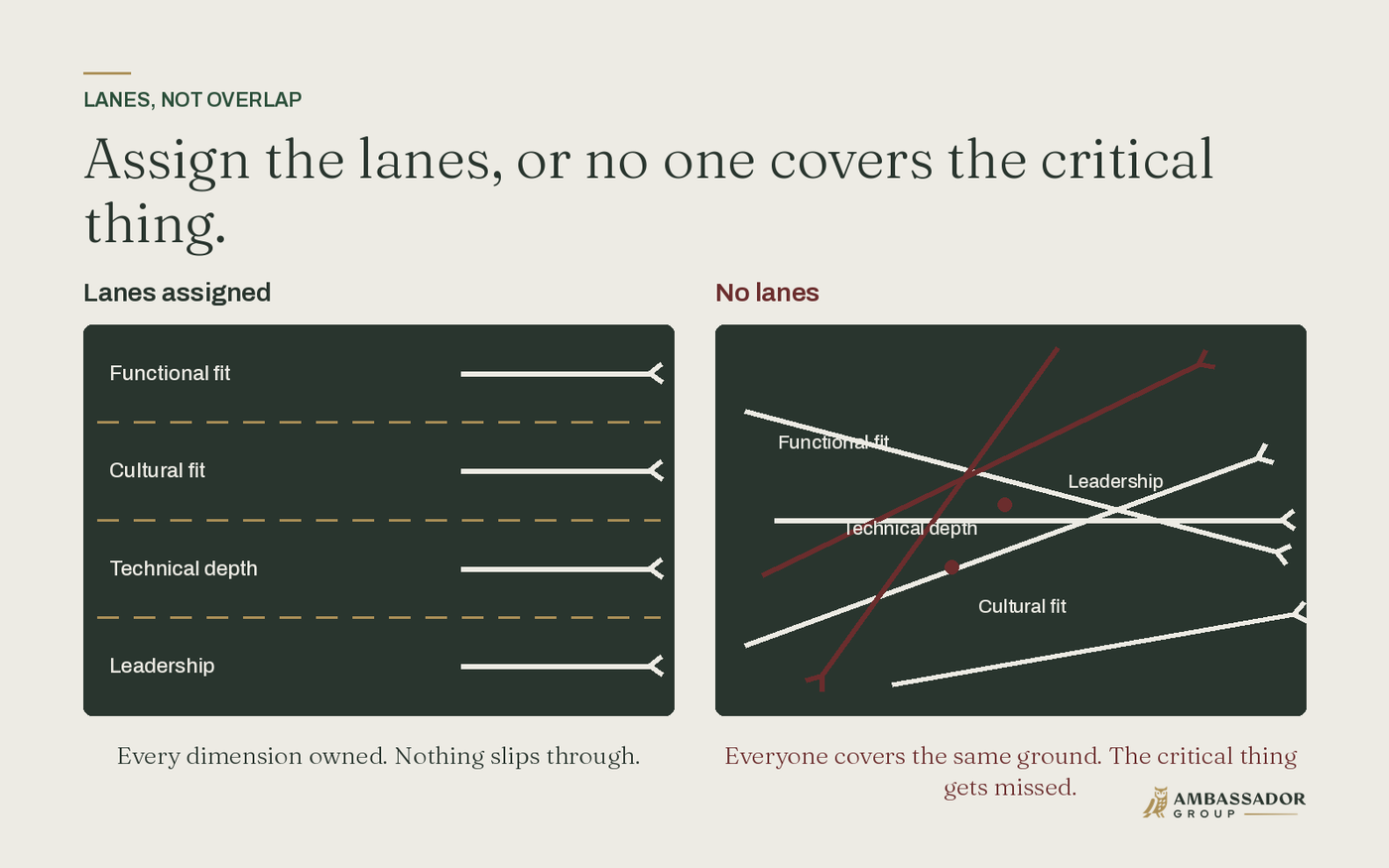
Team interviews without roles are like freeways without lanes. Chaos. Everyone covering the same ground, nobody covering the critical thing. Before the first interview is scheduled, pull up the JD, divide responsibilities into lanes, and assign each lane to an interviewer: "You're accountable for evaluating this candidate against these three line items. No one else is. If you don't probe it, no one will." This gives every interviewer a concrete job and makes coverage visible: at a glance you can see whether every dimension of the JD has an owner. The corollary: no "general vibe check" assignments. If someone can't articulate which lane they own, they shouldn't be in the loop.
Vulnerable interviewer leadership
The best interviewers on a team are usually the most willing to be wrong out loud. They say things like, "I went in convinced this candidate was strong on the operational side, and looking at the transcript, I never probed it; I was reacting to how confident they sounded." That public recalibration is gold. It models what you want everyone doing, legitimizes the process over the ego, and gives junior people permission to do the same. If you're the senior leader on the loop, make a habit of being the first to update.
Prep like you mean it
You prepare for every other professional interaction: client meetings, project launches, proposals, board meetings. Interviews deserve the same discipline. Before every interview, pull up the JD and the lane you own. Write down your three to five most important questions, tied directly to the requirements. Pre-write your follow-ups. Know what a strong answer looks like and what a weak one looks like before you hear either. Read the resume, the screening notes, the previous interviewer's transcript. Walk in with a hypothesis about where to probe, not a blank slate. And simulate the future: if this person joined, what would success look like, what leadership investment would they require, where would friction arise?
The Engineer A / Engineer B lesson
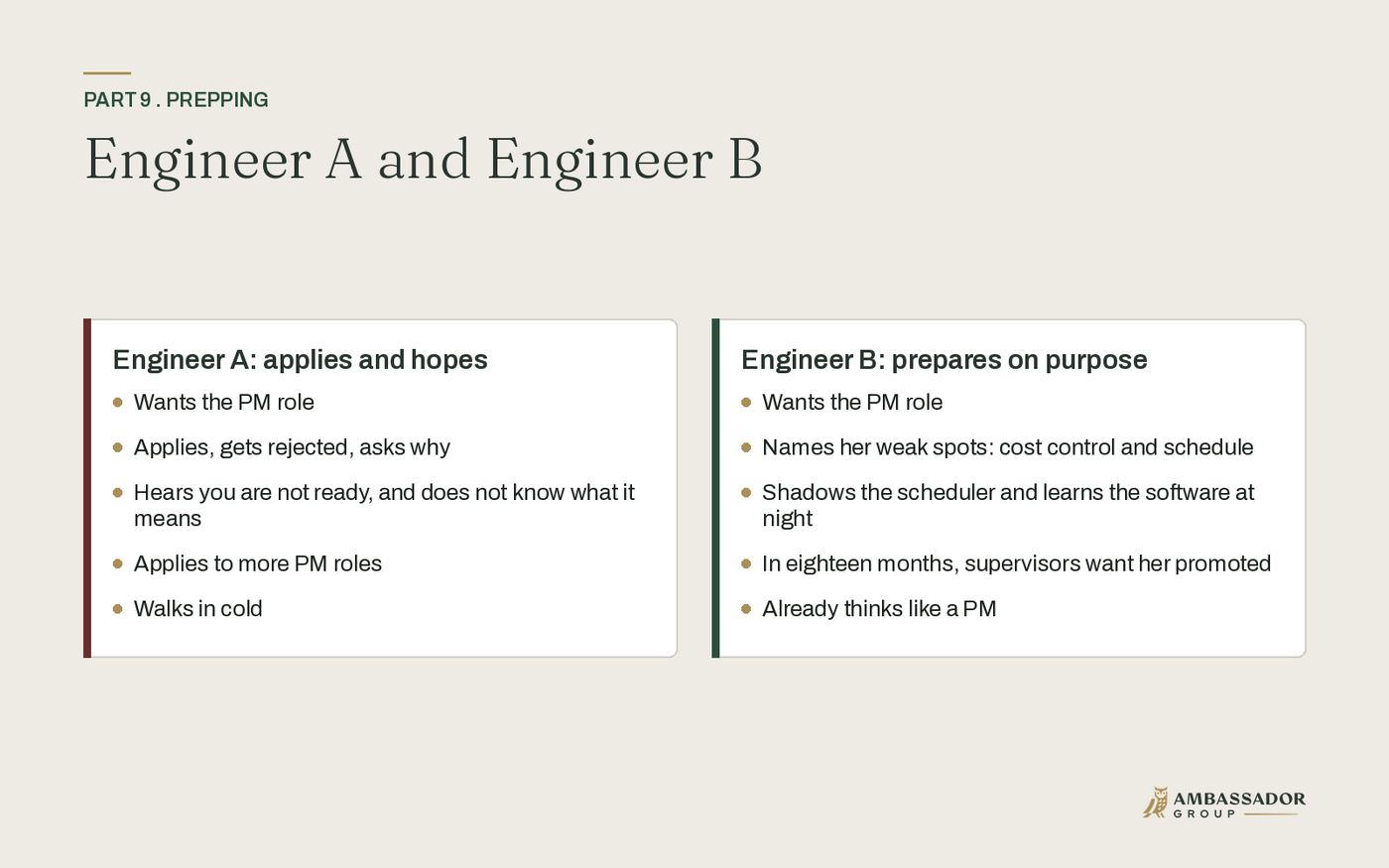
Engineer A wants to be a PM. She applies for PM roles, gets rejected, gets frustrated, asks why. Her boss says, "You're not ready." She doesn't know what that means, so she applies for more PM roles. Engineer B also wants to be a PM. She decides cost control and schedule analysis are her weak spots, asks her PM to walk her through budget meetings, shadows the scheduler, teaches herself P6 in the evenings. Within eighteen months she isn't just ready: her supervisors want her promoted, because she already thinks like a PM.
The lesson for interviewers: deliberate preparation compounds. Walking in cold is Engineer A applying and hoping. Preparing the lane, pre-writing the questions, reading the prior notes, forming a hypothesis is Engineer B. After twenty interviews that way, you think like a master.
Training a new interviewer
When you add a new interviewer, don't just drop them into a loop and hope. Spend 30 minutes before their first interview walking through the lane they own, the questions to ask, the signals to listen for, and the non-negotiables: warmth, no leading questions, no illegal topics, independent written evaluation before any team talk. Pair them with a veteran for their first three interviews, and sit down for 15 minutes after each to compare evaluations: Did they probe the lane? Go deep enough? What did they miss? Transcripts make this dramatically faster: you can point to a specific exchange and say, "Here's where you could have probed and moved on instead." Without transcripts, coaching is an opinion contest.
Set expectations before you walk in
Send the candidate an agenda the day before: who they'll meet, what each person focuses on, how long it runs. Give them a sense of what you're looking for so they can show you their best self, not their most nervous self. Internally, align the team on what this hire needs to be: "We're hiring for the person who can step in at 80 percent on day one," or "We're open to a developmental hire if we see strong fundamentals and high coachability." These upstream agreements prevent the downstream fight where one interviewer screened for readiness and another for potential.
Success is properly set expectations. Failure is improperly set expectations. Both parties have to commit to setting and understanding each other's expectations for a long-term relationship to be possible.
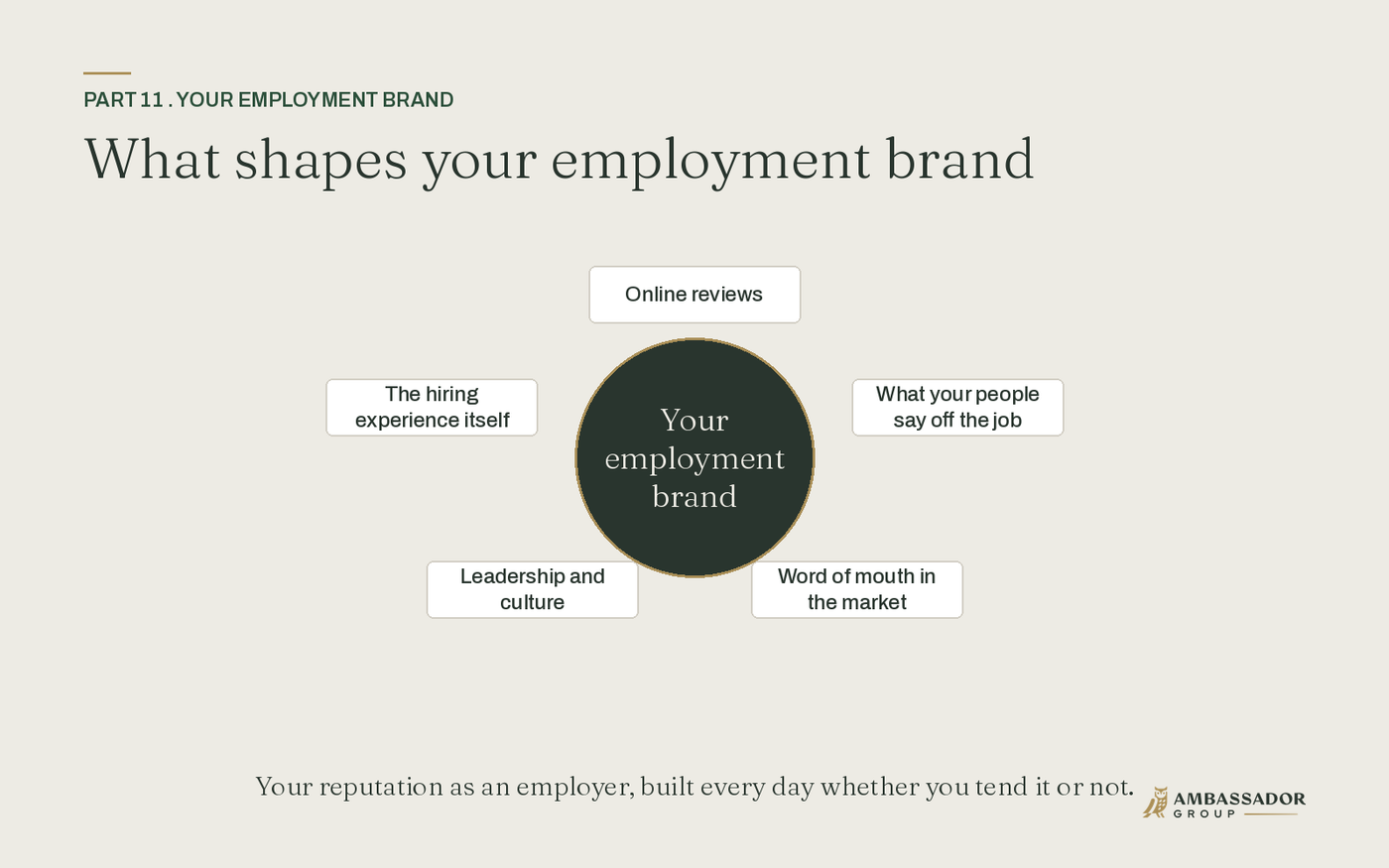
Every part of this guide so far assumes a pool to choose from. This part is about who is in that pool, and why. Your employment brand is what people think and say about working for you when your name comes up and you are not there to shape it. It decides who applies, who takes the recruiter's call, and who self-selects out before you ever learn they existed. It is not a marketing project. It is the visible residue of how you lead, which is why it belongs in a hiring guide and not beside one.
What you are, and what you are not
Pay, good projects, and a steady backlog feel like a pitch. They are the entry fee. The strongest people already have all three on offer somewhere, so none of it tells them why to choose you. A real employment brand names what is distinct about working under your roof, and answers the harder questions honestly: what do your best people love most about being here, what can someone grow into that they cannot get down the road, and does your leadership invest in people or just say so.
There is a tell for whether you have done this work. If you need a recruiter to sell candidates on the job, the job is not selling itself, and the brand is doing no work. The fix is the same discipline the rest of this guide asks for: be honest about what you are. Do not sell a high-rise GC culture if you run a tight residential shop. The clarity that loses you the wrong candidate is the clarity that earns you the right one.
Candidate experience is the brand
Everyone who touches your process leaves with a story, and they tell it. The screening call, the week of silence, the disorganized panel, the offer, the rejection: each one is the brand, broadcast to that person's whole network. The strongest candidates feel a slow, chaotic process first, because they are the ones with somewhere else to go.
A few commitments protect it:
- Treat the interview as a two-way decision, not a one-way audition. "If this role does not work for you, it does not work for me either" is honesty about how durable matches form.
- Move with urgency. Always know the next step, say it out loud, and do it. Interest is perishable.
- Reject people well. Keep it brief and professional, make it about the strengths of the person you hired rather than the gaps of the person you did not, and leave the door open. A clean rejection today is a referral or a candidate tomorrow.
Reputation and the market's scuttlebutt
Your current people are the brand. What they say off the job, what former employees tell their friends, whether subcontractors steer good workers toward you or away: that word-of-mouth is built every day by how the place runs, not by anything you post. Marketing cannot paper over it. If your team feels valued they refer their network and every search gets shorter. If they do not, no amount of outside recruiting effort holds the line.
The recruiter's reception is the canary. Outside help earns its keep on the hard, specialized searches, but if it is the only way you can hire, that dependence is itself a diagnosis: the firm is not well known or respected in its market, or the process is losing the people it most wants. The blunt question underneath all of it: when the most talented people in your trade consider who they respect, do they think of you, and can you say honestly why or why not.
Glassdoor, Indeed, and the public record
Most candidates read reviews before they ever apply. The published record is part of your hiring funnel whether you tend it or not. A short discipline keeps it honest:
- Be confident in your culture first. If you are not, fix that before you manage the page. Reviews are a mirror, not a billboard.
- Never ask for positive feedback. Ask happy people for an honest review and leave the choice to them. Engineered praise reads as engineered, and your team resents being asked.
- Time the ask around real milestones, after onboarding, a promotion, or a finished job, when goodwill is genuine. Do not flood the page; a sudden wave of five-star reviews gets flagged as exactly what it is.
- Respond to the negative ones. How you answer criticism in public tells a future candidate more than the criticism itself.
Invest in it on purpose
A brand decays in silence. The small negative perceptions accumulate, the best candidates drift elsewhere, and the leader blames the labor shortage. The alternative is a deliberate engine, built and maintained on purpose: a real presence where your industry pays attention, talking about the culture and the projects and the wins; referrals made a habit rather than an afterthought, with a program that rewards people for bringing in someone good; job descriptions sharpened until they are clear, honest, and specific to you; and a hiring process tight enough that it never costs you the strongest candidate.
Underneath all of it sits leadership development, because people rarely leave over pay; they leave the person above them. That is the deepest lever you have, and it is why the employment brand you wish you had is downstream of the leaders you choose to develop. Which returns us to the mirror this whole guide keeps holding up: if hiring feels like an uphill fight, look harder at the company the candidate would be walking into. That is a problem you can fix.
Sourcer vs. partner
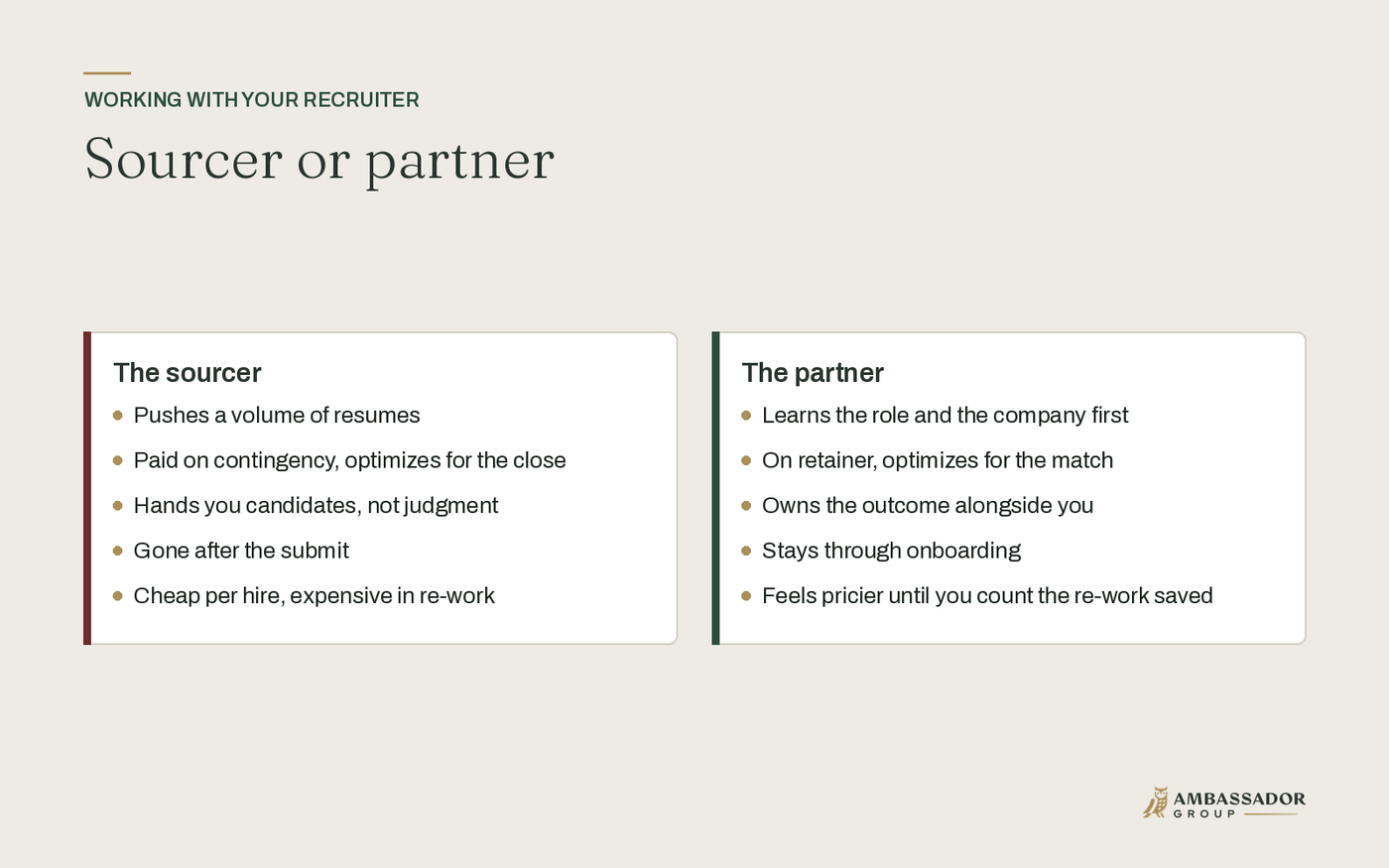
Not all recruiters do the same work, and understanding the difference is the single most important thing you can do to stop being disappointed by them.
The Sourcer
Business model: find a body, close the deal, collect the fee. Makes money when an offer is signed, then is gone. Doesn't dig into your JD, train your interviewers, or protect you from bad hires. Counts a closed deal as a win even if the person walks in six months. Most recruiters have never run a P&L; they don't know the pain of a bad hire.
The Partner
Business model: discovery, alignment, process, long-term success. Makes money when you build a team, not when a body lands in a role. Pushes back on bad JDs, tells you when a candidate is wrong, trains your interviewers, stays engaged through onboarding. Measures itself on 12-month retention, not 30-day close.
Most recruiters in the market are sourcers. A few are partners. The partners are almost always on retainer, and they almost always feel more expensive until you count the re-work cost of the sourcer model.
Three questions to ask any recruiter
If you want to know whether the person across the table is a sourcer or a partner, ask these three and watch what happens.
These three questions will tell you more about a recruiter than any reference check.
The #1 mistake leaders make with recruiters
Leaders often expect recruiting to work like law or accounting: hire an expert, hand them the problem, come back later to collect the result. Recruiting doesn't work that way. It's bilateral. A recruiter cannot complete the puzzle without your pieces. Expecting them to work like an attorney is the number one reason leaders feel burned by recruiters even when the recruiter is doing everything right. Your recruiter needs:
- Real context. The story of why the role is open, what the last person did well and poorly, what success looks like, who they'll report to and that leader's style, the team dynamics, and the business pressure behind the hire.
- Internal alignment. Your team has to agree on what you're hiring for before the recruiter can source for it. If the CEO wants a builder and the hiring manager wants a manager, no recruiter in the world can deliver.
- Real-time calibration. When the first batch of candidates arrives, engage. Tell them what resonated and what didn't. The first batch is how the recruiter learns your taste in the role.
- Accountability for the outcome. The recruiter doesn't make the hire. You do, and you live with it. Their job is to maximize the quality of the data and the integrity of the process. Yours is to make the call.
Hiring us means bringing in a partner, not delegating a task.
"It's like we are one company"
A client I respect deeply once left me what I think is the most profound and simple testimonial of our work together: "It's like we are one company." That's the goal. Not vendor. Not agency. Not staffing service. One company, for the duration of the search and through onboarding. If the recruiter you're talking to can't credibly offer that, they're a sourcer. Price them accordingly.
When to use a recruiter, and when not to
A recruiter isn't always the right answer. For entry-level or high-volume roles where the pool is deep and the criteria are clear, a good internal process is usually more efficient. For senior, scarce, high-consequence, or politically delicate roles, the calculus flips hard toward a retained partner. Rough rules of thumb:
- If the pool you need is passive (people not looking but who should be), you need a recruiter.
- If the role is hard to define and the definition will shift as you meet candidates, you need a recruiter who can facilitate that evolution.
- If the cost of a bad hire is north of $250,000 in blast radius, you need a recruiter whose incentives align with long-term retention, not first-offer signing.
- If the internal team is already overloaded and you're hiring under duress, a recruiter is essential: running a search badly yourself because you couldn't make time is how bad hires get made.
- If the role is politically charged inside the team, a neutral outside recruiter is worth the fee just for the unbiased facilitation.
And a data point on the alternative: building your own function runs roughly $320,000 in year-one outlay, closer to $368,000 with fringe, before a single role is filled, and before the vacancy drag of $1,200 to $1,800 per day on every empty superintendent role. The "in-house is cheaper" intuition usually doesn't survive the math.
What is interviewing?
Most interviewers walk into a room and do quality control on a human being. They ask, "Is this candidate good enough for us?" They treat the interview like a product inspection. That framing is wrong, and it's why most interview processes produce unreliable results.
Interviewing is a relational design exercise. You're not just evaluating a skill set; you're architecting the foundation of a working relationship. If your process feels one-sided, transactional, or hierarchical, don't be surprised when your hiring outcomes are one-sided, transactional, and hierarchical too.
Every system is perfectly designed to get the results it gets. Design your interview like a gatekeeping ritual and it will filter for people who perform well in gatekeeping rituals. Design it like a trust-building collaboration and it will surface the humans who can do the work.
Relationship building on hard mode
Here's the simpler frame. If you can hold a meaningful conversation at a coffee shop, you already have the fundamentals. Stay curious. Listen on purpose. Look for alignment. The difference is that the stakes are higher and the signals are compressed into a smaller window. A bad coffee chat costs you an hour. A bad hire costs you a quarter of your year and several hundred thousand dollars.
We recently worked with a construction professional who'd been stuck in the same role for eight years. He'd given up on the idea that good company culture existed. He decided it was a myth and resigned himself to showing up and doing the work. Then he saw one of our messages. Something in it spoke to what he cared about. He took a chance, interviewed, and found out the culture he wanted existed.
That's what a good interview process is for. Not gatekeeping. Creating the conditions where a person who's given up on fit can find it, and a leader skeptical of claims can verify them. On both sides of the table, interviewing is the only reliable bridge between hope and evidence.
Why this method exists
The default state of any hiring team is groupthink. Charisma, hierarchy, belief intensity, and social comfort beat careful evaluation every single time unless structure intervenes. The Ambassador Interview Method (AIM) is that structure. It starts the second the interview ends, when the most senior (or simply the loudest) person offers a quick take in the hallway: "I liked them." Or worse: "Something felt off." Once that anchor drops, every subsequent opinion bends toward it. The junior interviewer who saw something important softens it, or swallows it entirely.
The weight an issue receives in the discussion is almost always correlated with how strongly the interviewer is willing to feel about it, not with how important it is. Disagreeable people fight hard over minor things; agreeable people give ground on critical ones; seniority amplifies both distortions. Belief intensity, absent logic and evidence, is noise. A whispered, well-reasoned observation from the most junior person may be the single most important data point in the process. Any serious interview process has to make whispered wisdom audible and loud certainty accountable.
The four steps of AIM
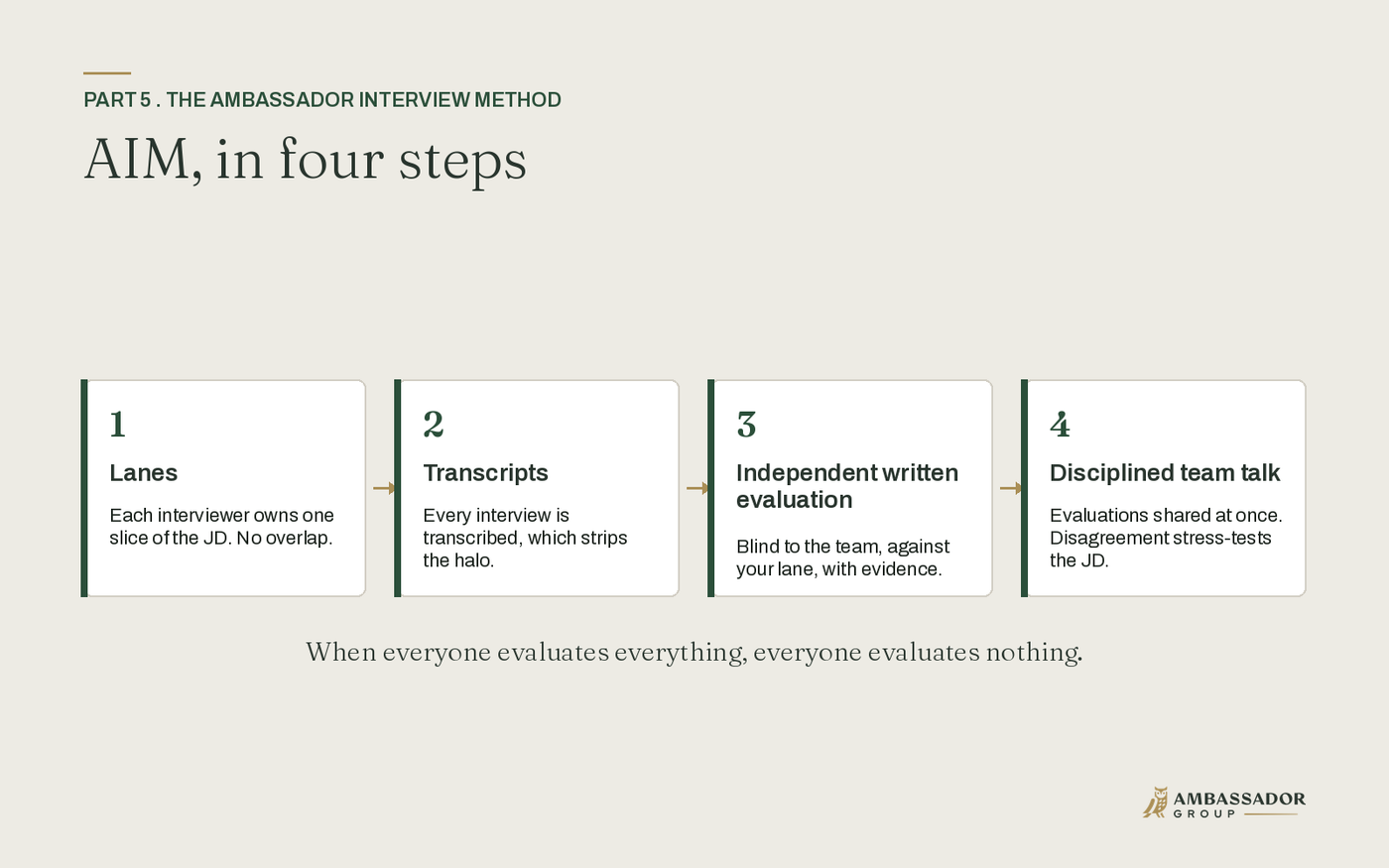
- Lanes. Before the first interview is scheduled, each interviewer is assigned a specific slice of the JD to evaluate. Technical depth. Leadership. Role-specific competencies. Cultural contribution. No overlap, no "general vibe check" assignments. When everyone evaluates everything, everyone evaluates nothing.
- Transcripts. Every interview is transcribed. This sounds mechanical; it's transformational. Transcripts strip out the halo of charisma, the recency bias of the last answer, and the memory distortion that sets in within hours. They let interviewers evaluate what was said, and they make evaluation auditable, which raises the standard for everyone.
- Independent written evaluation, blind to the team. Before any debrief, Slack message, or raised eyebrow, every interviewer submits a written assessment against their assigned dimensions, with evidence from the transcript and a recommendation. This is the single highest-leverage move in the process. It levels the voices: the junior interviewer's reasoned observation lands with the same weight as the senior leader's gut, and it produces a comprehensive overlay so nothing gets skipped because no one raised it.
- Then, and only then, the disciplined team talk. Evaluations are shared simultaneously. Disagreement is expected and welcomed; it means the process worked. The debrief's job is not to manufacture consensus. It's to stress-test independently-formed conclusions against the JD. When two thoughtful interviewers disagree, that's the most valuable signal in the debrief.
Crestwood, and the discipline of not talking
We started working with Crestwood Construction after their leaders had spent years being burned by recruiters. Tad Herrington, one of their principals, told me early on that his experience with recruiters had been annoying phone calls and emails that drove him crazy. His guard was up. What moved him wasn't a sales pitch; it was structure. After the first meeting, he said, he'd already changed his mind and was all in.
The real test came during the interview loop. Tad and his partner Marshall were explicitly told: do not talk to each other between interviews. No hallway takes, no Slack, nothing until both written evaluations were in. Tad's reaction is the most honest description of AIM I've heard a client give: he quickly realized that talking would taint the opinion, and that the summary of where he and Marshall aligned and differed sparked the most valuable conversation of the search. As Marshall put it: "Going through a process this rigorous, there's true buy-in." Independent evaluation, then stress test. Not the other way around.
The Four Stages of Hiring Competence
Most leaders assume they're good at hiring because they've hired a lot of people. Volume without feedback is repetition. Practice doesn't compound without correction. The Four Stages (built on Dunning-Kruger, applied to hiring) map the actual journey.
- Unconscious Incompetence. "I'm a good judge of people." Where most leaders start, and many stay. They haven't yet had a hire painful enough to question their own judgment. Most dangerous when most confident, because the confidence isn't yet backed by a feedback loop.
- Conscious Incompetence. "I don't know what I don't know." Usually arrives after a painful hire falls apart on the job. The most uncomfortable stage and the most valuable: the pain creates the opening for real learning.
- Conscious Competence. "I know and I'm working it." The leader applies structure: writing down questions, assigning lanes, running independent evaluations. It feels slow and mechanical because it is. But results get measurably better, and the leader starts to trust the method over the gut.
- Mastered Humility. "It's in my hands, and I still need the mirror." Fluent application combined with deliberate humility about what they still don't see. They write down evaluations before the debrief not because they have to, but because they know memory isn't a recording. Mastery is calibrated humility.
The journey isn't linear. Every time you hire for a new kind of role, in a new context, for a new team, you drop a stage or two. The best leaders never pretend they're at Stage 4 for every hire. They know which hires put them back at Stage 2, and they hire accordingly.
The Seven Levels of Interviewing Mastery
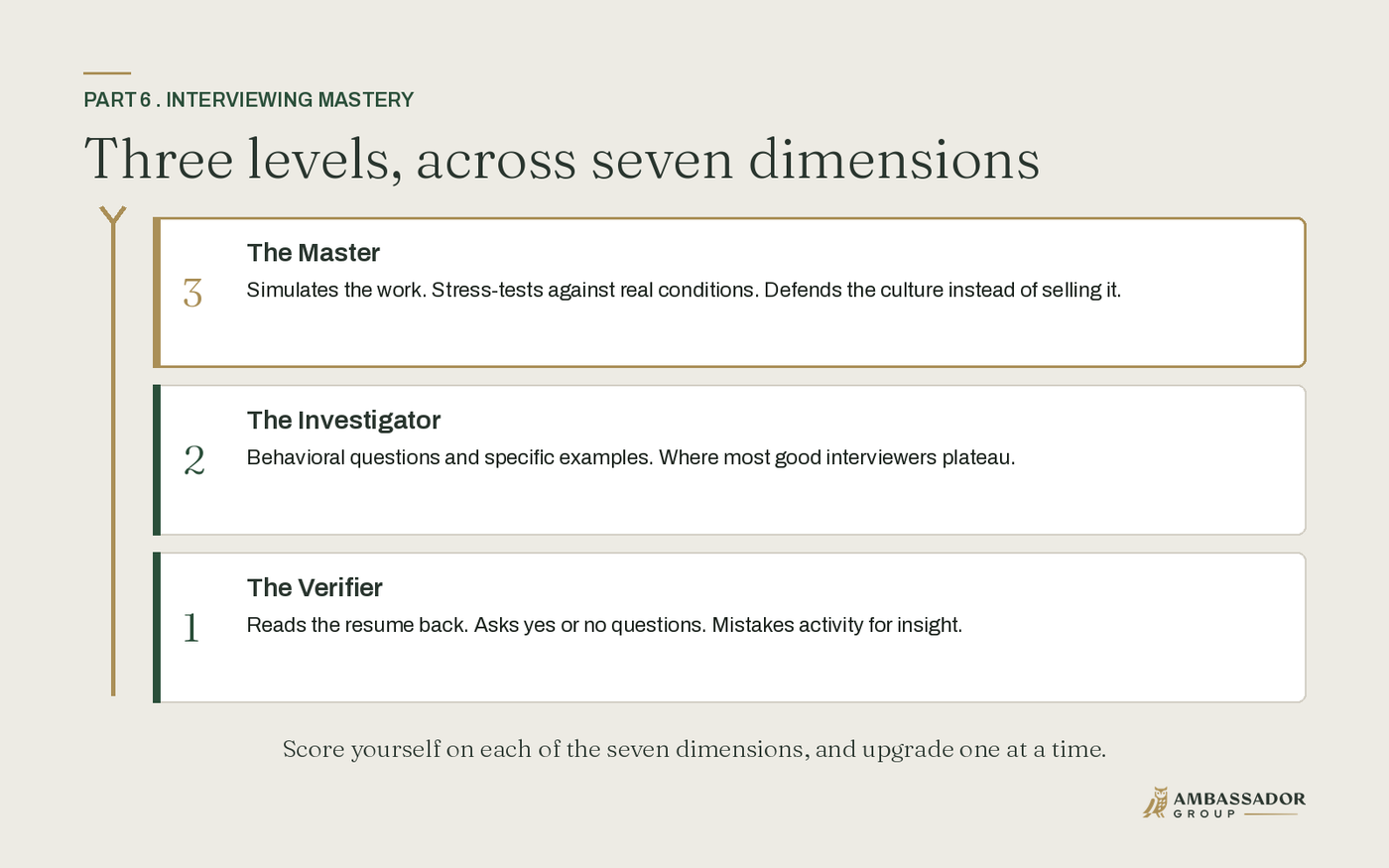
Interviewing is a craft. Most interviewers stay stuck in the shallows, verifying facts on a resume rather than uncovering truths in a human being. Across each of the seven dimensions of fit, an interviewer operates at one of three levels:
- Level 1: the Verifier. Reads the resume back to the candidate. Asks yes/no questions. Confirms what's already on paper. Mistakes activity for insight.
- Level 2: the Investigator. Uses behavioral questions. Asks for specific examples. Probes past performance to predict future results. Where most "good" interviewers plateau.
- Level 3: the Master. Simulates the work. Stress-tests against the real conditions of the role. Uses the anti-sell, the project autopsy, the energy audit, and real work samples. Defends the culture instead of selling it. Treats hiring as stewardship.
The goal isn't to become a master across all seven overnight. It's to know where you are on each and deliberately upgrade one dimension at a time. Novices focus on activity (asking questions). Masters focus on insight (understanding the human). Score yourself honestly with the matrix in Appendix B.
Six disciplines that separate average from masterful
- Curiosity over confirmation. Poor interviewers ask questions to prove their assumptions. Great ones ask to disprove them. They look for truth, even when it's inconvenient.
- Observation over impression. Judge patterns, not polish. How does this candidate listen? What do they do with feedback? What energizes them? What do they do when they don't know an answer?
- Structure over spontaneity. Spontaneous interviews feel conversational and produce shallow data. Structured interviews create consistent comparisons and protect against bias.
- Accountability over consensus. Every interviewer owns a lane and an independent judgment.
- Empathy over ego. Candidates sense when they're being assessed for rejection versus understanding.
- Long-term vision over short-term relief. Every hire shapes the next chapter of your company.
These disciplines are moral. They come from leaders who believe people deserve to be seen in full focus before being judged.
Warmth, hospitality, and the friendliest interrogator
Your presence in the interview is your brand. Candidates evaluate you as much as you evaluate them. Coldness signals disinterest or arrogance; warmth signals leadership maturity. Top talent has options, and if your interview feels stiff, they go where they feel seen. The best interviewers I've watched are the friendliest interrogators you'd ever want to work for: warm and hospitable, and inside that warmth they ask the hardest questions without making anyone flinch. If a candidate gets upset over a fair but tough question, that's a clue it's not a good fit, and you got that data for free.
- Greet the candidate by name. Smile. Offer water. For remote, log in five minutes early and mention something specific from their resume.
- Start soft: "How has your week been?" Say out loud: "This is a two-way street. I want you evaluating us as much as we're evaluating you."
- Eliminate distractions. Acknowledge that interviews are nerve-wracking; tell them they don't need to be perfect. Allow silence.
- Walk them out afterward, use their name, and send a thoughtful follow-up whether the answer is yes or no.
Every candidate leaves with a story about your company. The only question is whether that story is an asset or a liability.
Hunt your own process before a candidate does
You already know the interview runs two ways. What is easy to miss is how literally that cuts. A well-led company wants to be audited: it has nothing in its process it needs to hide. A company that does not want to be audited has just told the candidate something true about itself. The strongest candidates audit hardest, not because they are difficult, but because they have options to walk. Treat their hard questions the same way: as diligence, not friction.
So do the audit yourself, before they do. Sit in your own process and hunt for the tells a sharp candidate would find. Do your interviewers describe the role the same way, or does each one tell a different version? Do you have a clean answer for why the seat is open, or does the story shift depending on who is asked? Can anyone pin the responsibilities to actual outcomes, or do they stay vague on purpose? Do you talk about long hours as a badge of honor instead of naming them as a cost? Every one of those is a red flag on the job, showing up first, and smaller, in the interview. A process built to survive that scrutiny is the process that wins the rare, ready people.
The honesty green flag
When an interviewer says, "We're really struggling with our scheduling process right now," that sounds like a confession. It's a massive green flag: it means they're honest, self-aware, and not trying to trick you. Train your interviewers to do the same. Don't sell a Ferrari if you're offering a tractor: the candidate who shows up on day one expecting the Ferrari will be frustrated within a week, and you did that to yourselves during the interview. Tell the truth about the role clearly enough that the right candidate self-selects in and the wrong one self-selects out.
Optimistic skepticism
The mindset that holds the best interviewers steady is optimistic skepticism. You want this person to be the right fit. You're rooting for them. And you're also willing to disqualify them the moment the evidence stops supporting the hire. Both energies, at once. Pure optimism is sales: you stop probing the second the candidate smiles, and hire the person who made you feel good. Pure skepticism is a trial: you treat the candidate as a suspect and build a fortress of "nos" around what could have been a great hire. The middle path: assume the best until the evidence says otherwise, then follow the evidence.
Investigative vs. observational interviewing
Two modes belong in your toolkit. Investigative interviewing goes after specific answers: you have a competency or concern and probe with purpose. "Walk me through the last time you made a judgment call without a clear answer. What did you decide? Why? What happened next?" Observational interviewing creates conditions and watches what emerges: a job walk, a real-work sample, a scenario with no right answer, where you observe how they think and handle ambiguity. Alternate deliberately, and always know which mode you're in. Investigative alone gives you answers but not patterns. Observational alone gives you vibes but not evidence.
Building a scenario interview
Observational interviewing works best when the scenario is built, not improvised. Give the candidate a slice of the actual job: project materials, a team roster, a few emails, and a problem buried in the details they have to find themselves. Build three things in advance, every time: the candidate brief (what they receive the evening before and why), the assessor's card (who the character is, a skeptical owner or foreman, their temperament, and the two or three points where they push), and the rubric (what strong and weak look like on each dimension, written down before anyone sits in the room). Brief the candidate the night before. A surprise test measures how someone handles an ambush, not the job. A prepared candidate who still struggles has told you something true, and you lose nothing by giving them the runway a real assignment would.
Score the process, not the answer. Watch whether they get curious before they commit or jump straight to a fix. Watch whether they name who owns what across the other parties in the room. Watch whether they protect the budget while the plan is still moving, and whether they can walk a difficult stakeholder through bad news and keep the relationship intact. The right answer to the scenario matters far less than the path they took toward it.
A hypothetical asks someone to describe judgment. A scenario makes them use it, live, with incomplete information and somebody pushing back. Two hours here will show you more than a week of ordinary interviews.
Follow-ups, non-answers, and the rule of two questions
The active-listening follow-up is worth twice as much as the first question. People don't volunteer useful information until they understand you're listening. Always ask "why?" when a candidate makes a statement. Always ask "what happened next?" when they finish a story. Always ask "what would you do differently?" when they describe a success. And watch for the non-answer, almost always an avoidance signal. Be willing to ask the same question twice in a different way. If you didn't get a direct answer, you didn't get an answer.
Aim every question at the work
Every question you ask should trace back to how the candidate will do the job. Tie it to the work and it cannot wander into who they are. Three areas cover almost everything worth asking. Job ability: ask how they think and how they solve problems on real projects. Requirements: name the schedule and travel demands plainly, then ask whether they can meet them. Physical and safety demands: state what the role requires, then ask whether they can meet it, with or without accommodation. In each area the safe version of the question and the strong version are the same question.
This discipline does two jobs at once. It sharpens your read, because you are learning what the candidate can do instead of who they remind you of. And it draws the line where the real legal exposure sits: age, race, color, religion, sex or pregnancy, national origin, disability, and genetic information have no place in the room, however naturally a job site's easy rapport invites them in. One rule for the record: if a line is not about the work, it does not go in the notes.
The bias under the question
A question that drifts from the work is rarely malice. It is a bias reaching for confirmation, and naming it is how a leader catches it before the debrief does. Affinity bias warms you to the candidate who shares your background or your trade, and on paper a steady preference for people who resemble you reads like exactly what the last section exists to prevent. The halo effect lets you go easy on someone you already like and hard on someone you do not, so the two were never tested against the same bar. Cultural fit is the most dangerous phrase in hiring, because a team that cannot define it is really just hiring people like itself. Confirmation bias turns the interview into a hunt for evidence for the verdict you reached in the first five minutes.
Name the bias out loud, and the risky question tends to disappear on its own.
Memory is not a recording
Memory is a reconstruction. Ebbinghaus's Forgetting Curve established that within one hour we forget roughly half of new information; within 24 hours, 70 percent; within a week, nearly 90 percent. What remains is actively rebuilt each time it's recalled, distorted a little more with every pass. The interviewer writing feedback three hours later isn't documenting what the candidate said; they're documenting a story their brain has already begun editing. Details that confirmed a suspicion get sharper; details that complicated the picture drop out of the retelling.
This is why we record and transcribe every interview: not for surveillance, for rigor. You cannot evaluate what you cannot remember, or coach an interviewer on work you cannot see. If your organization isn't ready to transcribe, the minimum bar is notes taken in real time, written up within 15 minutes, and reviewed the next day. Any longer and you're documenting fiction.
Interviewing the destructive personality
The most expensive hire many leaders make does not fail on the job. They pass the interview, hit their numbers, and break the team around them for eighteen months before anyone names it. They do not show up as a villain. They show up as talent. Destructive personalities thrive in exactly the setting an interview creates, because it rewards what they are best at: polish, confidence, and a fast answer. A narcissist wins on charisma. A manipulator can perform empathy for forty-five minutes. The passive-aggressive resister nods along and shows you the truth months later, in missed deadlines and quiet sabotage. None of them reveal themselves in a single, frictionless conversation, because diagnosis comes from patterns, not snapshots.
Two cautions before the tells. First, separate rough edges from rot. An insecure new manager who micromanages is coachable; a controller who hoards authority to protect his standing is not. The difference is motive, progress or power, and innocent incompetence and malicious exploitation can look alike from across the table. Telling them apart is your job, not your gut's. Second, the charming narcissist did not beat your process. He walked through a door you left open, because charm only works on an interviewer who wants to be flattered. The lever, as always, is how rigorously you underwrite the risk in front of you.
What changes the odds:
- Ask for failure, not success. The honest answer requires admitting fault, the one move a person who has built an identity around never being at fault cannot make.
- Read the pattern in the career. One bad boss is bad luck. A string of departures all blamed on bad bosses and toxic companies names the common denominator.
- Introduce friction and watch the response. A missed follow-up, a shifting story, a late arrival: these are openings, not irritations. A humble candidate leans in and owns it. A manipulator turns the friction into a weapon, manufacturing confusion or pushing blame. That move is the tell.
- Watch how they treat the people who cannot promote them. Warm to the decision-makers and dismissive to everyone else is a preview of how they will treat your team.
- Check references like you mean it. Not "would you rehire them" but "how did they handle hard feedback, and what brought out their worst." The pause before the answer is the answer.
Keep it warm. The point is not interrogation, which only puts a good candidate on the defensive and rewards the polished performer. The point is to be kind and to require clarity at the same time, and to refuse to move on until the question is genuinely answered. If a person cannot handle accountability in an interview, they will not handle it on the job. And the harder discipline comes after the hire: the costly mistake is rarely missing the signs, it is tolerating them once they are plain. You set your culture's tolerance every day you stay quiet or speak up.
Assessments are flawed. They are also essential.
Let's start honest. Every assessment on the market is flawed. They reduce human complexity to scores, carry the biases of their authors, and can't predict behavior in contexts they weren't designed to measure. Anyone who tells you a particular assessment is the answer is selling you something. And yet, used correctly, assessments are one of the highest-leverage data sources in the entire process. They surface patterns an interview rarely catches: how someone handles ambiguity, where their energy lives, what environments they sink in. The same data would take months of on-the-job observation. An assessment gets you there in ninety minutes and a cup of coffee. Both things are true. Flawed and essential.
A 2D slice of a 3D person
The most important thing to understand about any assessment is that it's a two-dimensional slice of a three-dimensional person. Different assessments tell you different things about the same candidate, and the differences aren't contradictions; they're different cross-sections of the same figure. A behavioral tool like the ProfileXT tells you one thing; a values tool like VOPS a different thing; a cognitive test a third. None are wrong. None are complete. Your job is to integrate the slices into something closer to the whole person, and to remember even the integrated picture is still incomplete. Assessment results are a prompt. They tell you where to probe deeper, not what to conclude before the conversation.
Constrain your expectations, and calibrate
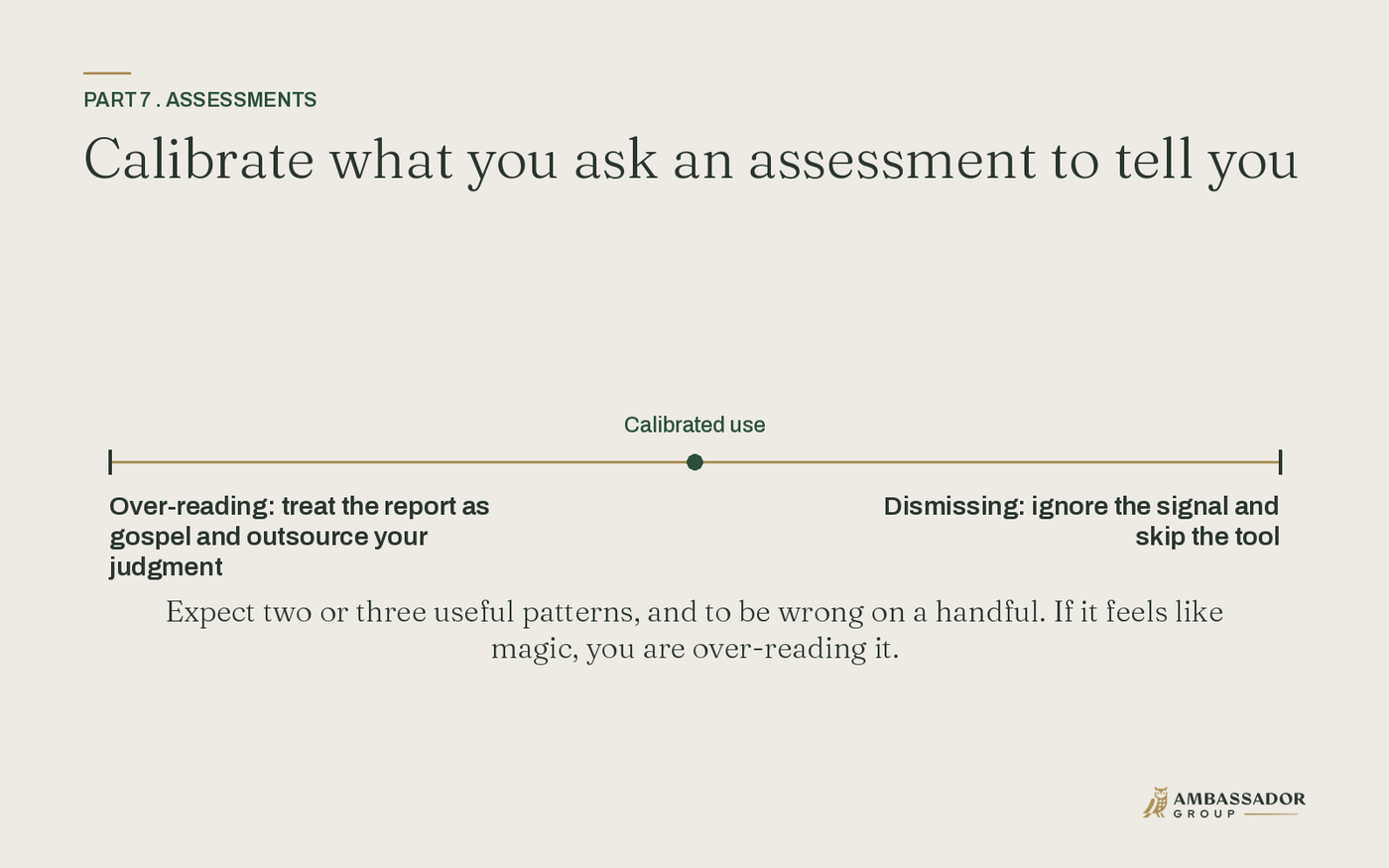
The single biggest mistake leaders make with assessments is over-reading them. A report comes back with bold language and color-coded charts, and the leader treats it as gospel: "The report says he's a 9 for autonomy, so I don't need to ask about oversight." Reading the report as a substitute for the interview is outsourcing your judgment to it.
The correct posture: constrain your expectations, then calibrate with reps. Expect the assessment to surface two or three useful patterns and to be wrong or incomplete on a handful of others. If it feels like magic, you're over-reading it. Then calibrate: use the tool on people you already know well (including yourself and your team) before strangers. Where the patterns match the person you know, the tool is giving signal; where they don't, it's noise or you're misreading. Either way you're learning. There are no shortcuts. You cannot read the vendor's manual and be competent. The leaders most effective with assessments have usually used the same instrument fifty or a hundred times.
Assessments add time and return more of it
The common objection is time: "I don't have an hour for another step." This is backwards. Assessments add time on the front end and pay it back on the back end, usually at ten-to-one. An hour of review before the final interview tells you exactly what to probe and what to trust. Without it you burn three hours in the final interview figuring out things the assessment would have told you, miss the one pattern that would have stopped a bad hire, and spend six months paying the cost. Time economics in hiring work like time economics in construction: the expensive part isn't the pre-con, it's the rework on what you skipped pre-con on. Assessments are pre-con for people.
Your job is to find the non-negotiables
Start with the role, not the assessment. The JD tells you what this person has to do; your experience of the role tells you what's most likely to break. Between those, name the non-negotiables: the two or three things that absolutely have to be right, because if they're wrong the person fails. For a Superintendent: decisiveness under pressure, comfort with autonomy, calibrated conflict tolerance. For a PM: follow-through discipline, ambiguity tolerance, interpersonal awareness. Once you know your non-negotiables, pick the assessment that identifies them with the highest certainty: not the most popular, not the cheapest. Sometimes one tool. Sometimes two used together. Rarely the first tool the leader heard about.
The four judgment factors are a useful checklist here. Your non-negotiables are almost always a specific demand on character, cognitive horsepower, experience, or self-awareness, and naming which one keeps you from buying a tool that measures the wrong variable well.
A good proctor is worth their weight
Wisdom in application is half the battle. An assessment read by a skilled proctor is worth five times one read by a novice. A good proctor knows the tool's quirks, the patterns that matter, what to discount, and how to translate the report into the specific questions you should ask next. If you're using assessments without someone in the room who has read hundreds of them, you're doing half the work and getting a tenth of the value. Find a proctor. Pay them. What you're paying for is calibration, not data.
A flat profile is a finding, not a null result
Most reports get read for the spikes: the high number that explains the strength, the low one that explains the risk. When every trait sits near the middle, leaders tend to read it as nothing to flag and move on. That reading throws away information. A profile with no extremes is a specific result, and it can mean three different things.
It can describe someone genuinely balanced, whose performance will be set almost entirely by the environment you build around them, which hands the prediction back to you rather than answering it. It can describe someone who took the instrument carefully, managing the impression it would produce rather than revealing much about themselves. Or it can mean the tool is asking the wrong question of this role: some jobs turn on a trait the instrument barely measures, and a flat read is what a mismatch looks like from the outside.
Treat a flat profile the way you would treat a candidate who gave you no strong answers in an interview: as a prompt to probe harder, not a signal to relax. Ask what produced the flatness before you decide what it means.
My favorites (so far)
My two favorites right now are VOPS (by Scale Architects) and ProfileXT (by Wiley, often called PXT). VOPS is particularly strong for values and motivation: it surfaces what someone cares about, which matters enormously for senior hires where motivational fit is the hidden variable. ProfileXT is strong for behavioral and cognitive patterns: how someone processes information, handles pressure, interacts, adapts. I use them as complements when stakes are high. There are many other excellent tools. If you have one you trust and have done the work to calibrate it, use it. The tool matters less than the discipline with which you use it.
Take many assessments yourself
The fastest way to get good at reading assessments is to take a lot of them yourself, and have your leaders do the same. Compare notes. Ask which insights feel most valuable, most wrong, most actionable. A carpenter who's never used a hammer on their own wood cannot teach you to use one. A leader who's never been measured by the instruments they're measuring candidates with cannot calibrate their read.
The resistance signal
Be careful about people who resist taking assessments. Not people who push back, ask good questions, or want to understand what the tool measures before committing; those people are doing exactly the right thing. I mean people who flatly refuse, or find a dozen reasons not to engage. In my experience that resistance almost always means one of two things: either they're hiding something they're afraid the assessment will reveal, or they're not on a journey of self-awareness. The first is a risk unit you can probe. The second is far more dangerous: a senior leader who isn't growing in self-awareness will calcify in their blind spots and take the team down with them. Resistance reveals a posture, not an instrument problem. The leaders I most trust take the test, read the results, and come back saying "this is mostly right, and here's the part I think is wrong and why."
References that are useful
References are not a formality. They're a final data layer that confirms or contradicts your interview impressions: one of the highest-leverage, lowest-cost moves in the entire process when used well, and a checkbox when used badly. Six principles:
- References are good for good candidates. Not a witch hunt: a chance for strong candidates to be vouched for by people whose vouches carry weight.
- Who the reference is matters as much as what they say. A glowing review from a distant colleague is worth a fraction of a nuanced review from a direct manager.
- No honest reference is entirely positive. Everyone has growth edges. If a reference can't name one, they're either not close or not being honest.
- If the reference won't provide depth, they're implicitly saying they can't give a good-faith reference. Take that as data.
- Transparency indicates professionalism. A reference willing to say "here's what I love and here are the two things that will frustrate you" is doing you a favor.
- The point is perspective, not verdict. References suggest what to ask next or what to watch in onboarding. They rarely flip a decision.
One more: if a former employer won't provide any reference or insight, it's typically a trust issue. Where there's real trust, even with someone who's moved on, former bosses provide enthusiastic support. Silence from a former manager is almost always a data point worth taking seriously.
Written first, talking second
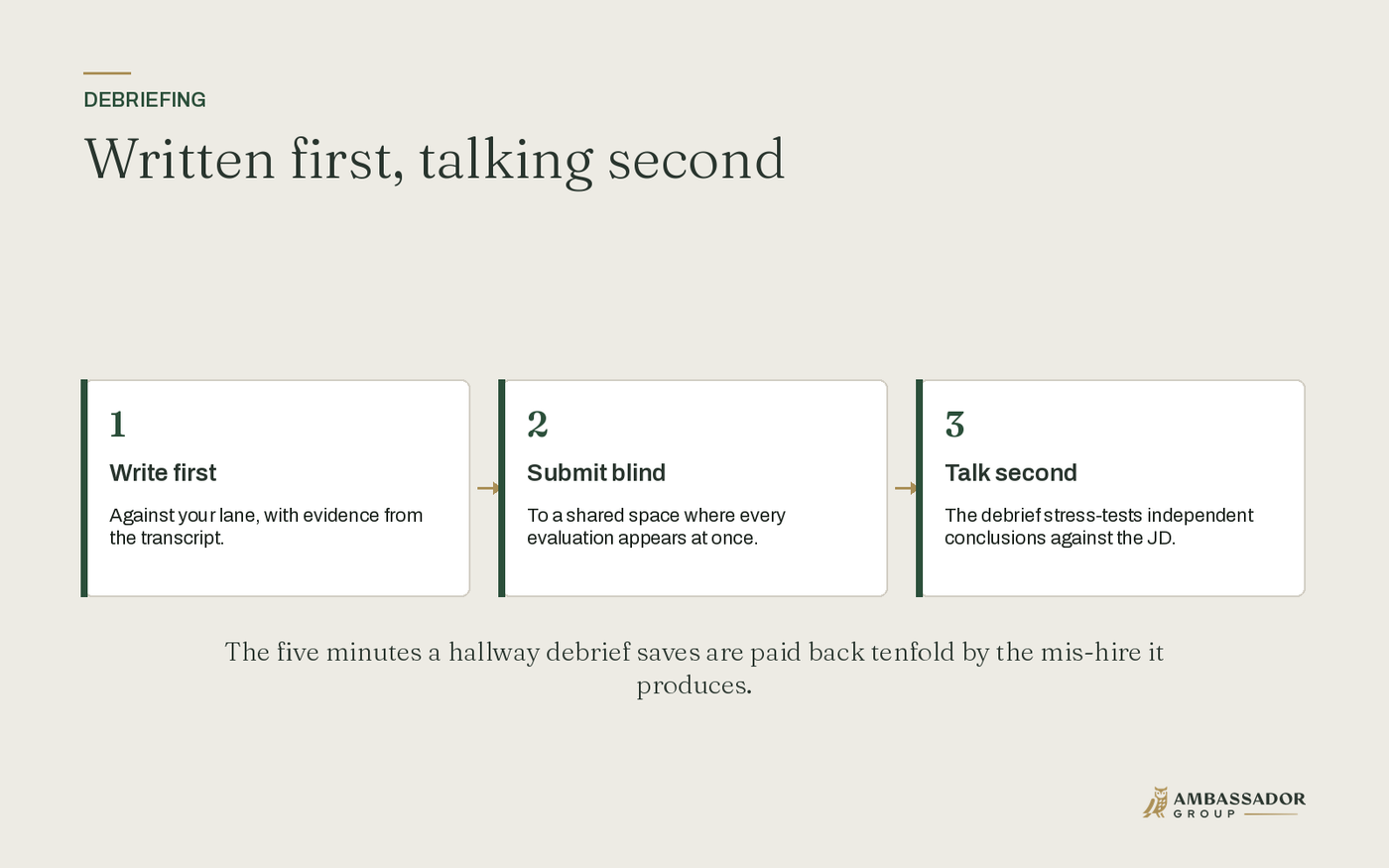
No debrief happens until every interviewer has submitted a written evaluation. Not a Slack message. Not a hallway "so what did you think?" Not a quick thumbs-up in the text chain. A written evaluation, against the assigned JD lane, with evidence from the transcript, submitted to a shared space where every submission is visible simultaneously. This is the rule that levels the voices and surfaces whispered wisdom, and the rule everyone will try to break because it feels slow. Don't let them. The five minutes saved by a hallway debrief are paid back tenfold by the mis-hire it produces. When Crestwood's partners were forbidden from talking between interviews, they both thought it was overkill; within one round, both realized it was the most important discipline in the entire process.
The debrief is a stress test, not a vote
Once every written evaluation is in, the team convenes. The debrief's job is not to manufacture consensus; it's to stress-test independently-formed conclusions against each other and against the JD. Go in order of dimension, not interviewer. Don't ask "what did you think of the candidate?" Ask "what did we see in functional fit? In cultural fit? Where did our evaluations converge and diverge?" The divergences are the most valuable signal in the debrief. When disagreement surfaces, don't rush to resolve it. Ask each interviewer to show their evidence. Transcript quotes beat gut feelings. Sometimes the answer is "we need another conversation to resolve this specific question." That's fine. That's the process working.
The reflection questions a fast debrief misses
After any substantive interview loop, walk through reflection questions designed to catch what a fast debrief would miss. Appendix B has the full curated list, grouped by purpose. For now, the non-negotiables:
- Can this person do the work described in the JD, at the level required, on day one? What specific evidence supports that?
- What concerns surfaced that I could not fully investigate? What did I fail to probe that I wish I had?
- Did I find myself selling the role more than probing the candidate? Why?
- Is my positive impression supported by specific evidence, or is it a vibe I'm retroactively narrating as judgment?
- If this hire fails, what will the failure mode most likely be? Am I hiring for who this person is, or who I hope they'll become?
Keep the record whole, even after the debrief settles it
The debrief runs on a compressed view, and it should. But the compression happens before that meeting, when five evaluations and a stack of transcripts get boiled down to the reflection questions above, and the compression loses in one direction. What survives is the material that answers hire or no hire. What falls out is the material that answers a different question nobody in that room is asking: how do you get this person's best work once they start. The interviewer who noticed he goes quiet when he disagrees with someone senior. The one who noticed she asked for written scope before committing to a date. None of that moves the decision. All of it moves the first ninety days, and none of it is written down anywhere the new manager will ever see it.
Do not let it go cold once the offer is signed. Keep the transcripts and the written evaluations past the decision, and before the new hire's start date, pull them and write a short brief for whoever will manage them: how this person works, what conditions produced their best answers, what they go quiet about. That handoff is where the interview stops being only a gate and starts paying for itself twice. Chapter 8 picks up the landing from here.
Seven things to confirm before the offer letter
Before you send the offer, confirm these seven. Any one unresolved is a future problem.
- Compensation alignment. The number being discussed is the number the candidate will accept. Verify it. Write it down. No surprises.
- Start date realism. The date works for your business and their life. Confirm no pending family, medical, or financial events that could derail them.
- Counter-offer exposure. Has the candidate discussed the move with their employer? How will they respond to a counter? The honest answer is the single best predictor of whether the offer closes clean.
- Decision authority. The candidate has made the decision themselves, with full buy-in from the partner or spouse they consult on major moves. Offers that die between signing and start date almost always die because a decision made alone ran into someone at home who wasn't consulted.
- Reference signal confirmed. Any concerns from references have been explored or explicitly deprioritized. If you're sending despite a yellow flag, say out loud what you're accepting and why.
- Leadership bill accepted. You know what investment this hire requires and have a plan to provide it. If you don't have the plan, don't send the offer.
- Onboarding plan ready. Their first day, week, and 30 days are mapped. An offer without an onboarding plan is a recipe for a six-month failed hire.
Reading counteroffer intent
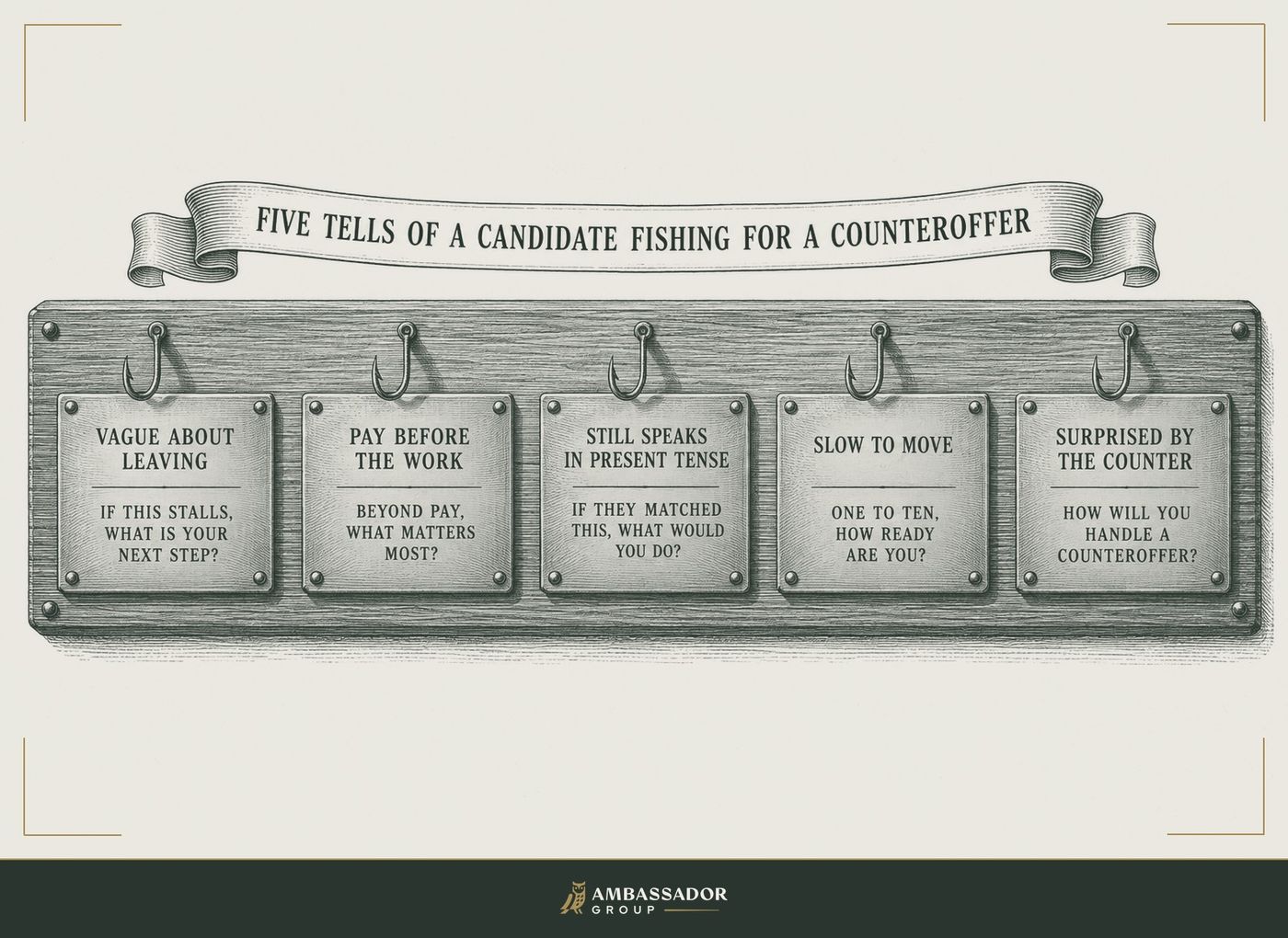
One pre-offer risk deserves its own underwrite, because it passes every interview: the candidate who is not interviewing for the job but for ammunition to take back to their current boss. They are polished, available, and agreeable, because they are not moving. They are appraising their market value, and you are the appraisal. In a field where the people you want are already employed and rarely looking, this miss costs you the weeks and the better, more committed person you stopped looking for. Five patterns give it away, and each has a question that surfaces it early:
- Vague about why they are leaving. Fog usually means they are not dissatisfied. Test: "If this doesn't move forward, what is your next step?" "I'm not actively looking" is your answer.
- Fixated on compensation before the role, the work, or the people. Test: "Beyond pay, what matters most in the next move?" A struggle to answer means the number was the point.
- Still mentally inside their current company, talking about it in the present tense. Test: "If they matched this offer, what would you do?" Hesitation is the tell.
- Reluctant to move at any real speed, rescheduling and stalling. Test: "One to ten, how ready are you to move if this is right?" Below an eight earns a second look.
- Acts surprised by a counter, then takes it. Test, in the first conversation and not the last: "How will you handle a counteroffer?" A serious person says they are ready to move on; a fisher says they would have to think about it.
This is the underwriting posture from the start of this guide aimed at intent rather than capability. Ask the hard question early, and treat a soft answer as information rather than an inconvenience. You can read every one of these in week one if you are willing to ask the question that risks ending the conversation.
The number gets decided too late in most companies, and by the wrong person. By the time a finalist is sitting across the table, the leader who waited for that moment is already negotiating from one specific human being's specific ask, which is the worst position from which to set a number.
Price the role before you know who will fill it. Define what the outcomes in the job description are worth to the business, decide what mission and the P&L can support, and only then go looking for the person who can deliver it. The finalist's number is data. It is never the starting point.
Mission-driven compensation
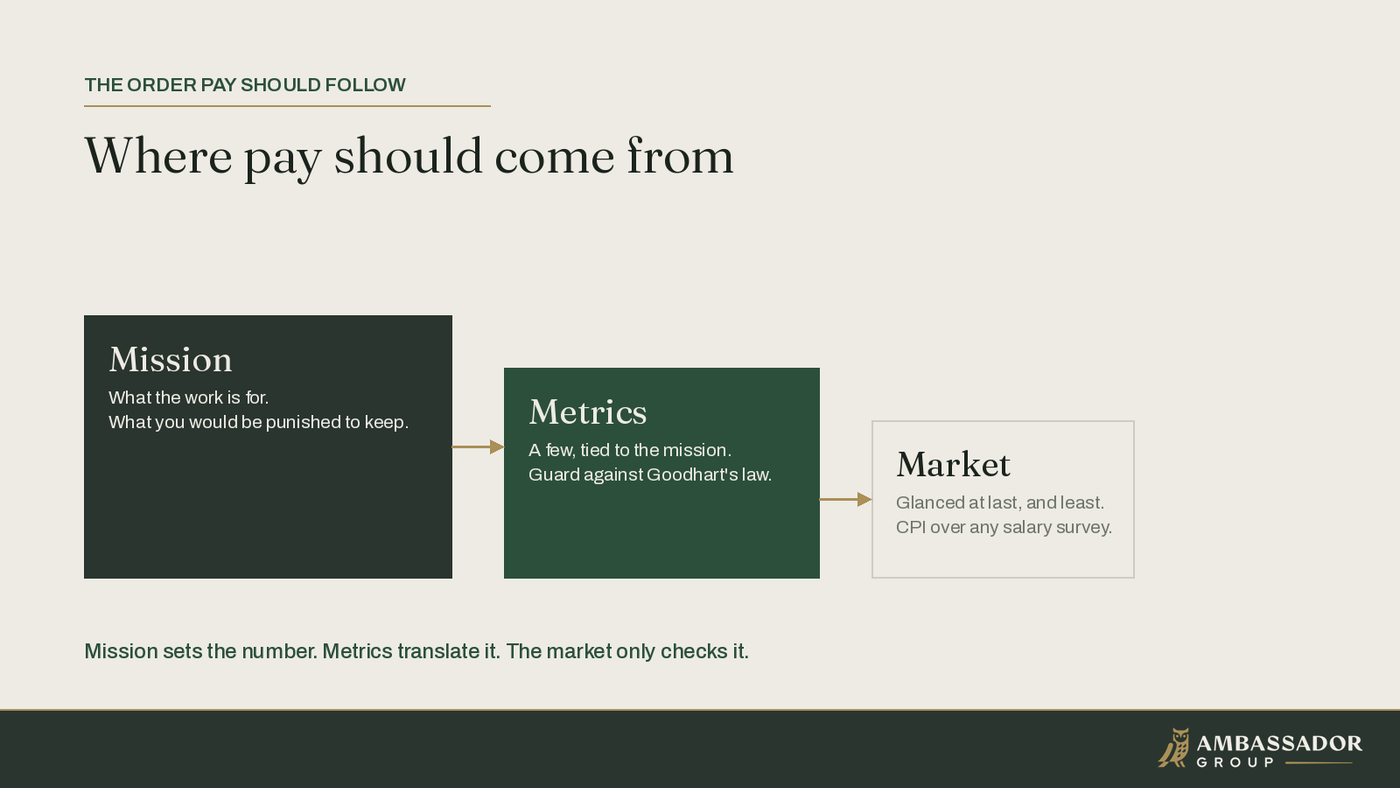
By the time you are drafting an offer, the number should already be settled in your own logic, not discovered in a salary survey. The most common way leaders price an offer is to look up the market rate and match it. That hands one of your highest-leverage decisions to self-reported, year-old data blended across companies that have nothing to do with yours. Price the offer the other way around, from your mission, your values, and your own P&L.
The sequence is simple to say and hard to live. Mission first, the reason the work exists and the thing you would be punished to keep. Then a few metrics tied tightly to that mission, kept few on purpose so no one games the number instead of serving the mission. Only then do you glance at the market, and even there the cost of living tells you more than any survey will. A person’s worth is not an average. It is marginal: the same superintendent is worth little to a company with no project, and a great deal to one with real margin and real risk on the line.
Do this work before the letter goes out, and the dreaded raise conversation changes character. When someone asks for more, you have a rubric instead of a standoff: here is how you grow, here is what it takes. The alternative is the chain most firms live in, where the market sets the pay, the pay sets the billing rate, and a survey no one wrote runs the business. The long version of this argument lives in Mission-Driven Compensation.
A recent custom-home-builder search showed how this plays out. The candidate’s stated salary range was a weak anchor, shaped more by what he had accepted before than by what he could do. Instead of matching that range or a market midpoint, the offer started from the builder’s own P&L and the value of the role on a specific project, then optimized for the candidate’s whole career and life rather than a single number. It got easier to defend, and easier to say yes to, once it began with the mission and the business rather than the market.
The market answers a different question
A salary survey tells you what other companies paid people who held a similar title last year, blended across firms with different margins, different risk, and no relationship to your mission. Match that number and you have delegated a pay decision to a spreadsheet nobody in your building wrote. Read it as a floor if you must, never as an answer.
The same reasoning is what makes a counteroffer legible when one shows up mid-search. A number built from mission and outcomes has a ceiling you can explain, so when a candidate's current employer suddenly finds more money, you know whether to hold and can say why. A number copied from a survey has no ceiling, only a fear of losing, which is the exact position a counteroffer is designed to exploit. Chapter 6 covers how to read the intent behind one. This chapter is what lets you answer it without flinching.
Onboarding as extended interviewing
The interview doesn't end when the offer is signed. It just changes form. The first 90 days are the most information-rich stretch you'll ever have with this person, and the stretch where most leaders stop paying attention. Treat the first 30 days like a continuation of the interview: watch how they learn, how they handle their first unclear moment, how they ask for help, how they show up when no one's looking. Compare what you see to what the interview predicted. Where the interview was right, mark it down; where it was wrong, mark it down harder.
At 30, 60, and 90 days, run a structured check-in. Not just "how are you doing?" but: what's working? what's frustrating? what did we oversell? what did we undersell? what do you now wish you'd known before you accepted? The answers are the only honest audit you'll ever get of your own interview process. Write them down and feed them back into the loop. Onboarding never ends, because alignment never ends, but the first 90 days are where the real relationship is built, and where your interview process either proves out or unravels.
What the first 90 days must produce

A landing plan is a sequence of outcomes, the same ones the job description already promised, produced in the order the role can bear. The first 30 days build context: the jobs get walked, the trades get met, the way this company runs a buyout or a change order gets learned before anyone grades the work. By 60 days there is a real handoff, one project or one scope the new hire owns outright, with the leader near enough to catch a stumble and far enough back for the ownership to be real. By 90 days there is a defined win, specific enough that both people can look at the same result and agree the landing held.
The leader owns the design of that sequence. The new hire owns the work inside it. Skip a stage and the plan collapses backward: a new hire handed real ownership in week one has no context to make good calls, and one still shadowing at day eighty has learned, without anyone saying it, that the company does not trust them yet.
Who owns the landing
The landing plan belongs to the hiring leader, the same person who wrote the job description, sat in the debrief, and decided to extend the offer. HR and the recruiter who ran the search can support the plan. Only the hiring leader can own it, because only the hiring leader has the standing to say what winning looks like and the authority to clear what is in the way.
That ownership starts earlier than most leaders assume. The job description already named the outcomes. The interview process already flagged the risks worth watching and the gaps worth coaching. The offer should not go out until those become a dated plan with a named owner, because a landing plan written after the start date is an apology in advance for the 90 days nobody designed. A recruiter can advise on the sequence, and HR can build the paperwork around it, but neither one sat across from this candidate through the whole process, and neither one can tell a new hire what winning looks like in a way that holds up by month three.
The landing plan closes out, and a different kind of work begins, one with no finish line. Pay stops people from leaving angry. It has never once made a good employee stay, and treating it like a retention strategy is how leaders spend real money buying loyalty a paycheck cannot manufacture. Once the 90 days are behind you, almost everything that keeps a person in your company sits inside your own authority: the quality of your supervision, whether growth is visible, whether the culture is one worth staying inside. The market sets the temperature. You decide whether anyone has a reason to stay in the building.
Two factors: what prevents quitting and what builds commitment
The hire does not end the work; keeping the person does, and retention has its own two-part structure worth naming. Frederick Herzberg found that satisfaction and dissatisfaction are not opposite ends of one scale but two separate forces. Hygiene factors (fair and competitive pay, job security, safe conditions, clear policies, decent supervision, a livable schedule) do not create loyalty. They only prevent people from leaving. Get them wrong and your best tradespeople walk; get them right and you have merely stopped the bleeding. Motivators (growth and a real career path, recognition, meaningful work, genuine responsibility, a team worth belonging to) are what truly build commitment. The two do not substitute for each other. Pile on motivators while pay lags the market down the street and people leave anyway; fix the basics and offer no growth and they coast, then drift.
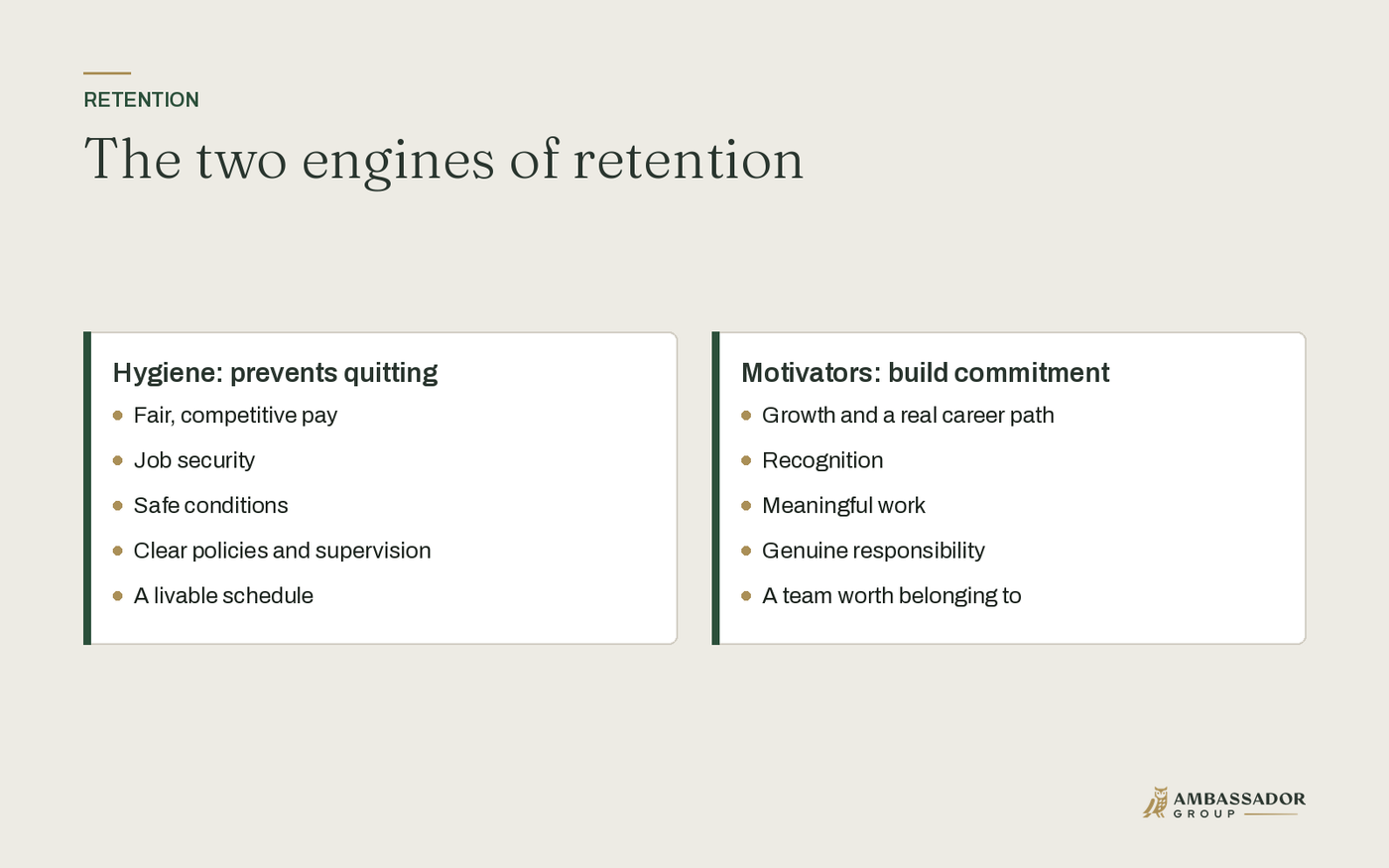
The order is the lesson. If turnover is high, audit hygiene first, because a missing basic is a deal-breaker no amount of culture overcomes. Once the foundation holds, drive retention with the motivators, which is also where the leadership bill you accepted at the offer comes due. This is the same point onboarding made, run forward: the interview predicts the relationship, and the relationship is kept or lost on whether the daily reality delivers what the work promised.
The nine-box, after the hire
One tool extends the same honesty into the team you already have. The nine-box grid plots each person on two axes, performance today against potential tomorrow, and sorts them into nine cells from low-low to high-high. Its value is not the labels. It is the conversation the grid forces: who is consistently over-delivering and ready for more, who is reliable now but near their ceiling, who is struggling and why, and where your blind spots in development sit. Sketched on a whiteboard and compared against a trusted manager's read, it does for your current team what independent written evaluations do for a candidate. It replaces a fuzzy mental map with something you have to differentiate and defend.
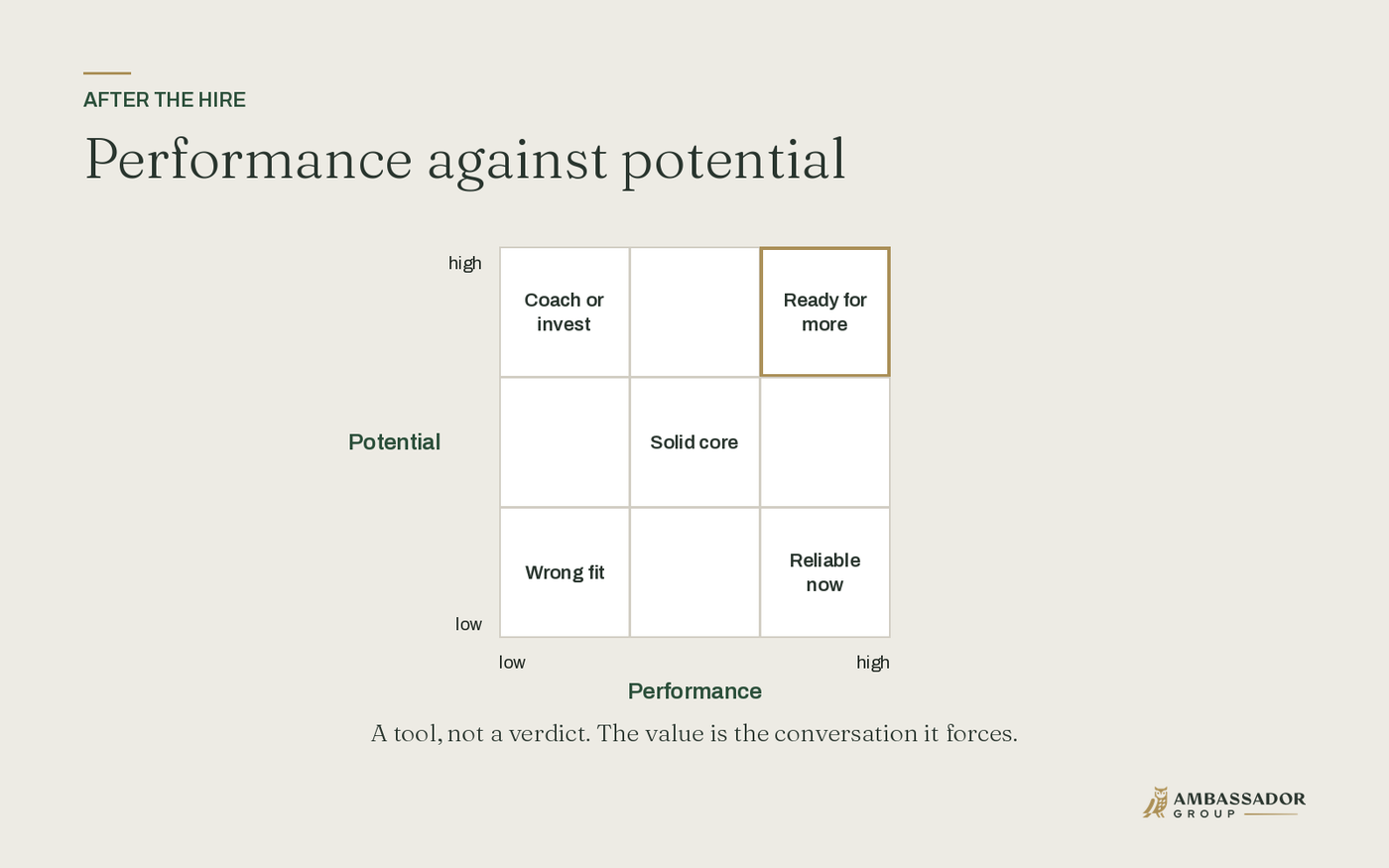
Two cautions carry over from how this guide treats assessments. It is a tool, not a verdict; people do not sit in one cell forever, and a low score on potential is sometimes a reflection of leadership that failed to invest. And it works only with humility, because the grid will sometimes tell you the steady hand you under-recognized is more valuable than the charismatic high-potential who is not delivering. Used as a living conversation rather than a static judgment, it turns the same disciplined seeing you brought to the interview into the ongoing work of stewarding the people already in your care.
Retention becomes succession
Run this well for long enough and retention stops being about keeping people and starts being about who can carry the company after you. A leader who develops nobody has built fragility and called it strength. Start before it is needed: expose people to real decisions early, hand out small ownership so it can grow into large ownership, and treat leadership itself as a skill you train rather than a title you award.
Write down what only lives in one person's head, and practice stepping back often enough that someone else learns to decide without you. When the next role opens, look inside first. An outside hire arrives without your history, and history is exactly what a successor needs most. Technical skill is common. Alignment with what your company is for is rare, and it is the harder thing to hire for at the exact moment you can least afford to guess.
A failed hire looks like a verdict on the person. It is a data point on the process that produced it: the job description that was or was not built around outcomes, the interview that did or did not stress-test judgment, the landing plan that was or was not run. The person is gone either way. The process is still yours, still running, and pointed at whoever you hire next. The useful question is which part of the system produced this result.
Diagnose before you decide
Before any decision, look in four places. Start with the original transcripts and the independent written evaluations from the interview: what did the panel predict, and where did the months since agree or disagree with it? That comparison alone tells you whether the miss was in the read or in what happened after the read. Second, check whether the landing plan from the previous chapter ran as written, with a named owner and a date, or whether the new hire was handed a badge and left to find the walls alone. A plan that was never run cannot be blamed on the person it was written for.
Third, work backward through the six boxes before you reach the person, environment first: information, resources, incentives. Did they know what success looked like, in specifics? Did they have the access and the tools? Was good work rewarded, ignored, or punished? Only once those are clear should the individual boxes, knowledge, capacity, and motivation, get asked. Fourth, name the gap that is left: skill, fit, or will.
That name decides everything downstream. A skill gap is coachable: name it, date it, give it a real chance. A fit gap (values, tempo, the wrong manager) calls for reassignment before it calls for an exit. A will gap, someone who could and chose not to, is the one where the decision belongs to you and not the system.
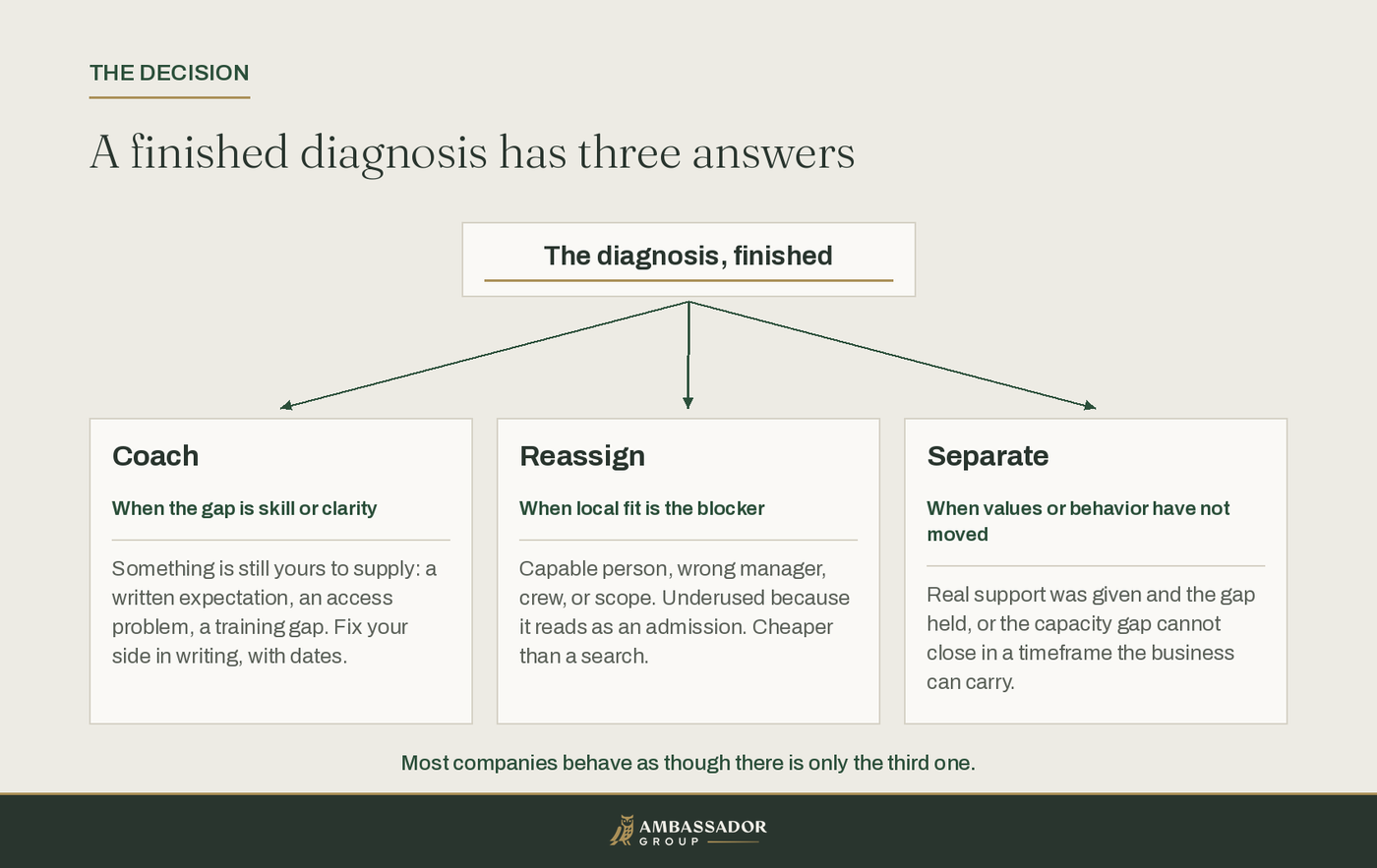
Separating justly
When the diagnosis lands on separation, the sequence matters as much as the decision. Decide on evidence, not on the story that is easiest to tell in the truck on the way home: the written evaluations, the dated coaching, the specific gap that did not close. Tell the person the truth early and plainly, in a conversation that does not negotiate and does not soften into ambiguity, because a surprise firing is proof the leader let the problem run past the point where a fair warning was still possible.
Protect their dignity and their next job on the way out. Offer a reference if you can give one honestly, and pay everything owed without making them ask for it twice. That is the standard you would want applied to you, and your team is watching to see whether it holds when it costs you something.
Then, before the role reopens, run the after-action review.
Hiring AARs (after-action reviews)
Every hire, good or bad, is an opportunity to upgrade the system. At the 90-day mark, run a hiring AAR: pull the original transcripts and written evaluations and ask what we predicted, what we missed, what the data showed that we ignored, what question we failed to ask. At 12 months, run a second one: was our assessment accurate, where was it right, where wrong, what pattern does this add to our institutional knowledge?
When a hire fails, resist the rationalization that "they lied in the interview." That's the psychologically comfortable answer and it's almost always wrong. The honest question is: what did our process fail to surface, and why? Without this discipline you'll repeat the same mistakes until you get lucky or go out of business. With it, your interview process compounds over time into a genuine institutional asset.
Retconning: the story both sides rewrite
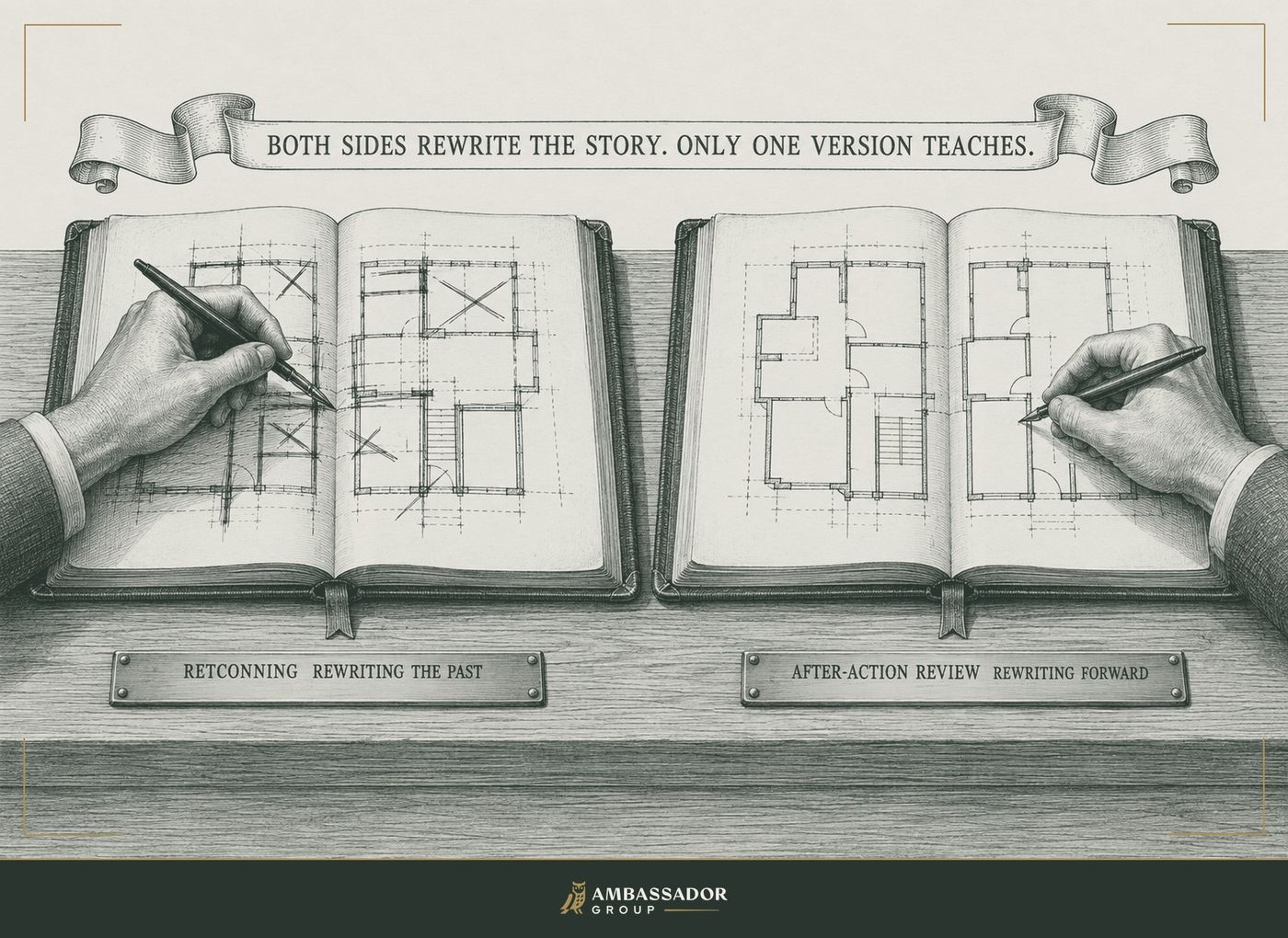
The AAR has an enemy, and it has a name borrowed from comic books: retconning, revising the backstory so the present makes sense. When a hire goes wrong, both sides do it. The employer says, "We always knew this person wasn't the right fit." The hire says, "I was never given the tools to succeed." Both can hold partial truth, and both can be convenient rewrites that protect identity while burying the lesson. The leader who retcons never confronts the gap in the interview or the onboarding. The result is a story that explains but does not teach.
Catch it the way you catch any bias: name it, then ask the growth question, does this version help me improve or only protect me? Hold both sides, because few outcomes are one-sided. Then rewrite forward instead of backward: better preparation, clearer expectations, more honest feedback next time. Retconning is not a moral failing. It is a signal that something missed expectations and the mind is scrambling to explain why. Honor the instinct, then move past it into accountability. That is the difference between an AAR that compounds into institutional knowledge and one that launders the same mistake.
If you remember nothing else, remember the five pillars in the Guidebook and these habits that put them to work.
- The real lever is the mirror. The quality of a hire is principally driven by the leader, and insight rises with self-awareness. Everything else is in service of that sentence.
- You are hiring for judgment. Name what it means in your shop, in the proportions this role demands, before you go looking for it. "A-player" is a feeling; judgment is a framework.
- Interviewing is relationship building on hard mode. Same fundamentals as a good coffee-shop conversation. The stakes are just higher.
- Hiring is underwriting. Price the risk. Preserve the evidence. Audit the reasoning. Build institutional knowledge over time.
- The JD is the rubric. Not the vibe. Not the hallway take. Not whoever feels most strongly.
- Structure beats groupthink. Lanes. Transcripts. Independent written evaluations before any team talk. Then stress-test against the evidence.
- Memory is not a recording. Record. Transcribe. Write up your evaluation within 15 minutes.
- Warmth and rigor are not opposites. Be the friendliest interrogator anyone would want to work for. Hospitality creates honest data.
- Optimistic skepticism wins. Root for the candidate and follow the evidence.
- Your recruiter is a partner, not a vendor. If they can't tell you about a time they told a client not to hire a finalist, they're a sourcer.
- Onboarding is the final round of the interview. Watch. Compare. Audit your own process.
We are passionate about honoring the God-endowed nobility of our clients and candidates by promoting durable relationships with meaningful work so they can live happier lives.
Read that slowly. Better hires, faster searches, cleaner process: those are the means. The end is happier lives, on both sides of the table. A leader who hires well gets a team they can lead, a calendar they can manage, and the rare experience of waking up on Monday trusting the people they'll work with that week. And underneath the business outcomes, they get to like their job again. A candidate matched well gets work that draws out what they're good at, in a place where they're wanted, with a leader willing to lead them. They get to be more of themselves, not less, while earning a living for their family.
The rigor this guide argues for is not for its own sake. It's for the Superintendent who finally gets to work for a company that respects the craft. It's for the Project Manager who finally gets out of a role that was wringing her out. It's for the team that finally has the leader they deserve. All of that is on the other side of the discipline this guide describes.
We won't always get it right. Nobody does. But we can stop getting it wrong for the same reasons over and over. We can stop letting charisma substitute for evidence. We can stop hiring in the fog and calling it intuition. If you're ready to do that work, the tools are in the appendices. The method is in the parts you just read. The mirror is yours to pick up.
If you are reading this from the other side of the table, the candidate's version of this guide is Build to Last, where the note for candidates now lives: how to audit a company while it audits you, how to spot a toxic one before you accept, and why honesty is the only strategy that survives contact.
Everything in this appendix is lift-and-use. Copy into your own doc, adapt to your role, and deploy.
JD-to-lane assignment worksheet
Use this before the first interview is scheduled. One row per interviewer. No overlap.
| Interviewer | Role on panel | Assigned dimensions | Sample behavioral question |
|---|---|---|---|
| [Name] | Hiring Manager | Functional + Leadership Fit | "Walk me through the last $20M project you ran from GMP to closeout." |
| [Name] | Peer | Relational + Cultural Fit | "Tell me about a time you disagreed with a peer about a project approach. How did it resolve?" |
| [Name] | Direct Report (shadow) | Leadership Fit | "Describe your first 90 days leading a team that didn't report to you." |
| [Name] | Skip-Level | Contextual + Motivational Fit | "What draws you to our size of company vs. the larger firms?" |
Rule: every line on the JD must be owned by at least one interviewer. If a line is not owned, assign it or cut it.
Lane assignment checklist (printable)
Prefer a checklist to a table? Print this and fill it in by hand before the loop.
ROLE: _______________________________________
SEARCH LEAD: _________________________________   DATE: ____________

FUNCTIONAL FIT
[ ] Owner: ___________________________________
[ ] Key responsibilities to probe:  1. ______  2. ______  3. ______
[ ] Behavioral questions drafted (3+)?            Y / N

CONTEXTUAL FIT
[ ] Owner: ___________________________________
[ ] Anti-sell moment scripted?                    Y / N

CULTURAL FIT
[ ] Owner: ___________________________________
[ ] High-tension question drafted?                Y / N

RELATIONAL FIT
[ ] Owner: ___________________________________
[ ] Assessment results reviewed in prep?          Y / N

MOTIVATIONAL FIT
[ ] Owner: ___________________________________
[ ] Energy audit question drafted?                Y / N

DEVELOPMENTAL FIT
[ ] Owner: ___________________________________
[ ] Growth arc question drafted?                  Y / N

LEADERSHIP FIT
[ ] Owner: ___________________________________
[ ] Leadership bill named?                        Y / N

COVERAGE CHECK: Is every line of the JD owned by someone?   Y / N
Rule: if no one can own a line, the JD is not yet clear enough to run the loop.
Independent written evaluation form
Every interviewer fills this out before any team talk. Submit to a shared folder. Nobody reads anyone else's until all are in.
CANDIDATE: __________________   INTERVIEWER: __________________
DATE: _____________   ASSIGNED JD LANE: ___________________________

1. ON MY ASSIGNED DIMENSIONS, WHAT DID I SEE?
   (Cite the exchange, not your impression.)
   Dimension 1: ________   Evidence: ________   Rating 1-5: ____
   Dimension 2: ________   Evidence: ________   Rating 1-5: ____
   Dimension 3: ________   Evidence: ________   Rating 1-5: ____

2. WHAT CONCERNS SURFACED THAT I COULD NOT FULLY INVESTIGATE?
   (These become probe targets for the next round.)

3. WHAT DID I FAIL TO PROBE THAT I WISH I HAD?
   (Be honest. The most valuable question on the form.)

4. IF THIS HIRE WORKS, WHAT WILL IT LOOK LIKE IN 6 MONTHS?
   IF IT FAILS, WHAT IS THE LIKELY FAILURE MODE?

5. MY RECOMMENDATION:
   [ ] STRONG HIRE   [ ] HIRE   [ ] NO HIRE   [ ] STRONG NO HIRE
   REASONING (evidence-based, not vibe-based): ________________
Debrief stress-test agenda
For the meeting that happens after all written evaluations are in. Run it in this order, every time.
- Coverage check (2 min). Did every JD dimension get probed by at least one interviewer? Flag any gaps.
- Dimension-by-dimension walk (15 to 25 min). Go by JD dimension, not by interviewer. Read the relevant evaluations aloud. Mark convergences and divergences.
- Divergence deep-dive (10 to 15 min). Where interviewers disagreed, each shows their evidence. Transcript quotes beat gut feelings. Genuine interpretive disagreements get named and explored, not resolved quickly.
- Gap closure plan (5 min). For anything unresolved, decide: another conversation, reference check, work sample, or accept the ambiguity with a documented risk note.
- Decision check (5 min). Is the team ready to make a call? If yes, make it. If no, name what has to happen first.
- Capture (5 min). What did we learn about our own process this loop? Add it to the hiring retrospective folder.
Reference call script
Use this verbatim. Adjust names and role.
"Hi [Reference], thanks for taking the time. We're considering [Candidate] for a [Role] position. I'm not looking for a pass or fail; I'm looking for perspective that helps me set this person up for success if we hire them. Everything you share stays between us. Is that frame okay with you?"
- How long and in what capacity have you worked with [Candidate]?
- What is [Candidate] most talented at? Where have you seen them shine?
- What are the inherent weaknesses that come with those strengths?
- What is it like when you and [Candidate] disagree? A specific example?
- When did you last not see eye to eye, and how did it resolve?
- How helpful is [Candidate] to others on the team? Who relies on them?
- Would you hire [Candidate] again if you could?
- On a 1 to 10 performance scale (please avoid 7), how would you rate them, and why that number?
- If [Candidate] joined us, what should their next manager invest in?
- Where do you see [Candidate] in three years?
- Is there anything I should have asked that I didn't?
- How can I be helpful to you?
30/60/90 onboarding check-in
Use at the 30, 60, and 90 day marks with every new hire. The answers feed the hiring AAR.
HIRE: __________________   ROLE: __________________
CHECK-IN AT:   [ ] 30 DAYS   [ ] 60 DAYS   [ ] 90 DAYS

1. WHAT IS WORKING?            (Good fit so far? Evidence?)
2. WHAT IS FRUSTRATING?        (Harder than expected? Where's the friction?)
3. WHAT DID WE OVERSELL IN THE INTERVIEW?   (No penalty for the truth.)
4. WHAT DID WE UNDERSELL?      (Sometimes the job is better than we described.)
5. WHAT DO YOU NOW WISH YOU'D KNOWN BEFORE YOU ACCEPTED?
6. WHAT DO YOU NEED FROM ME THAT YOU'RE NOT GETTING?   (The leadership bill.)
7. ON A 1-10 SCALE, HOW WELL DID THE INTERVIEW PREPARE YOU FOR THE
   ACTUAL JOB? WHY THAT NUMBER?
Hiring AAR (after-action review)
Run at 90 days and 12 months for every hire, good or bad.
HIRE: __________________   ROLE: __________________
AAR AT:   [ ] 90 DAYS   [ ] 12 MONTHS
OUTCOME:  [ ] EXCEEDING   [ ] ON TRACK   [ ] AT RISK   [ ] FAILED

1. WHAT DID WE PREDICT?   (Pull the original written evaluations and read them.)
2. WHAT DID WE GET RIGHT? (Which predictions held up?)
3. WHAT DID WE MISS?      (Where has reality diverged? Be specific.)
4. WHAT QUESTION DID WE FAIL TO ASK THAT WOULD HAVE REVEALED THIS?
5. WHAT WILL WE DO DIFFERENTLY NEXT TIME?   (One concrete process change.)
6. WHAT PATTERN DOES THIS ADD TO OUR INSTITUTIONAL KNOWLEDGE?
A menu of interview formats
Most teams lean on one or two formats and call it a process. The loop gets sharper when you choose formats on purpose, matched to what the role has to do. Mix and match.
- Technical / work sample. Assess real skill by simulating the work: a takeoff and mock bid for an estimator, a blueprint read for a PM, an equipment run for an operator. Best where craft is the job.
- Behavioral. Past behavior to predict future performance. "Tell me about a time you handled a difficult subcontractor." Best for almost everyone.
- Situational. A hypothetical with no clean answer. "A sub refuses to follow the safety plan, what do you do?" Best for supers, PMs, safety leads.
- Peer / shadow. The crew or future peers spend time with the candidate. Best for surfacing relational fit the hiring manager cannot see.
- Leadership / management. Probes coaching, conflict, and results. "How do you coach an underperforming foreman?" Best for supers and senior PMs.
- Cultural. Alignment with how you behave under pressure, not likeability. Best for any long-term hire.
- Safety-focused. Risk mindset under real conditions. "Describe a time you stopped work over a safety issue." Best for any field-critical role.
- Client-facing. Communication with owners, architects, and vendors. Best for BD, PMs, owner's reps.
- Negotiation. Contracts, pricing, change orders. Best for estimators, procurement, senior PMs.
- Panel. Multiple decision-makers at once. Use sparingly, and only with lanes assigned, or it becomes the groupthink AIM exists to prevent.
- Stress. Deliberate pressure to see the response. Powerful and easy to misuse; never let it tip into a gotcha.
A gap between the format you run and the skill the role needs is where candidates get judged on the wrong thing. If you cannot evaluate estimating without a work sample, build the work sample.
Seven Levels of Interviewing Mastery: self-score
For each dimension, find your honest level. Not aspirational. Actual.
| Dimension | L1 · Verifier | L2 · Investigator | L3 · Master |
|---|---|---|---|
| Functional | Yes/no questions from the resume | Behavioral questions for past examples | Simulates the work; watches how they think |
| Contextual | "Construction is construction" | Describes the environment, checks alignment | Uses the anti-sell; watches for the flinch |
| Cultural | Likeability / beer test | Lists values, asks for reaction | Probes extreme ownership under high tension |
| Relational | Relies on chemistry | Asks about management-style preferences | Uses data (ProfileXT) to find friction points |
| Motivational | Sells perks and the title | Asks about long-term goals | Maps job to unique ability; audits energy |
| Developmental | Hires to plug a hole | Asks about coachability and potential | Assesses growth-arc match and what they'll need |
| Leadership | Looks for a "self-starter" | Explains structure, asks management style | Names the leadership bill; ensures they can pay it |
Scoring. 5+ Level 1s: you're early. Shift from verification to investigation. 4+ Level 2s, few 3s: you're in the large middle where most "good" interviewers plateau. Pick the highest-stakes dimension and move it to Level 3 this quarter. 3+ Level 3s: you're doing rare work; your leverage is coaching others.
Four Stages of Hiring Competence: where am I?
For the next hire you make, answer these five questions honestly.
1. Have I ever made a hire I was sure about that failed for
   reasons I didn't see coming?                              Y / N
2. When the last hire failed, did I examine my own process
   or blame the candidate?                          PROCESS / BLAME
3. Do I write my evaluation down before I talk to the team?  Y / N
4. Do I still use the method when the stakes feel high and the
   pressure to shortcut is strongest?                        Y / N
5. For this role, have I hired this type before, and did I get
   feedback on how it went?                                  Y / N
Scoring. All "No": Stage 1, Unconscious Incompetence. You might be a painful hire away from finding out. Yes to 1, no to most: Stage 2, Conscious Incompetence, the most uncomfortable and most valuable stage. Yes to 3 and you use structure deliberately: Stage 3, Conscious Competence. Keep going; the fluency comes. Yes to 4 or 5 and you still ask what you're missing: Stage 4, Mastered Humility. Nobody stays at Stage 4 for every kind of hire.
Seven Dimensions coverage map
Before your next loop, fill this out. If any cell is empty, the dimension is not being probed.
| JD dimension | Interviewer responsible | Questions planned | Evidence target |
|---|---|---|---|
| Functional | |||
| Contextual | |||
| Cultural | |||
| Relational | |||
| Motivational | |||
| Developmental | |||
| Leadership |
Reflection questions, grouped by purpose
Use these at the end of every interview, not just loops with a decision pending. Write the answers down.
Evidence audit: am I reasoning from evidence or impression?
- Can I cite a specific exchange to support my positive impression? My concern?
- Did I document what they said, or what I remember feeling?
Gap detection: what did I miss?
- What did I fail to probe that I wish I had? What part of my lane did I not fully explore?
- What did they say that surprised me, and did I follow up on it?
Leadership readiness: am I ready to lead this person?
- What leadership investment will this person require from me personally? Am I prepared to make it?
- If I'm not, am I hiring out of desperation instead of readiness?
Candidate reality check: am I hiring a fantasy?
- Am I hiring for who this person is, or who I hope they'll become?
- What will this candidate's worst-case day look like? Can I live with it?
Process audit: is my own interviewing getting better?
- Did I talk more than 30 percent of the time? Did I sell more than I probed? (If yes to either, I did it wrong.)
- What would I ask the candidate if I could go back? What would I ask myself?
TJ Kastning · Founder, Ambassador Group · a recruiting and hiring consultancy for construction companies · Est. 2017