
Every hiring decision in this industry is a bet on judgement. The hiring manager you sit across from is trying to predict whether your future calls will hold up when the schedule slips, the sub goes bankrupt, or the owner panics. They use different shorthand for that bet, but they're all pricing the same thing.
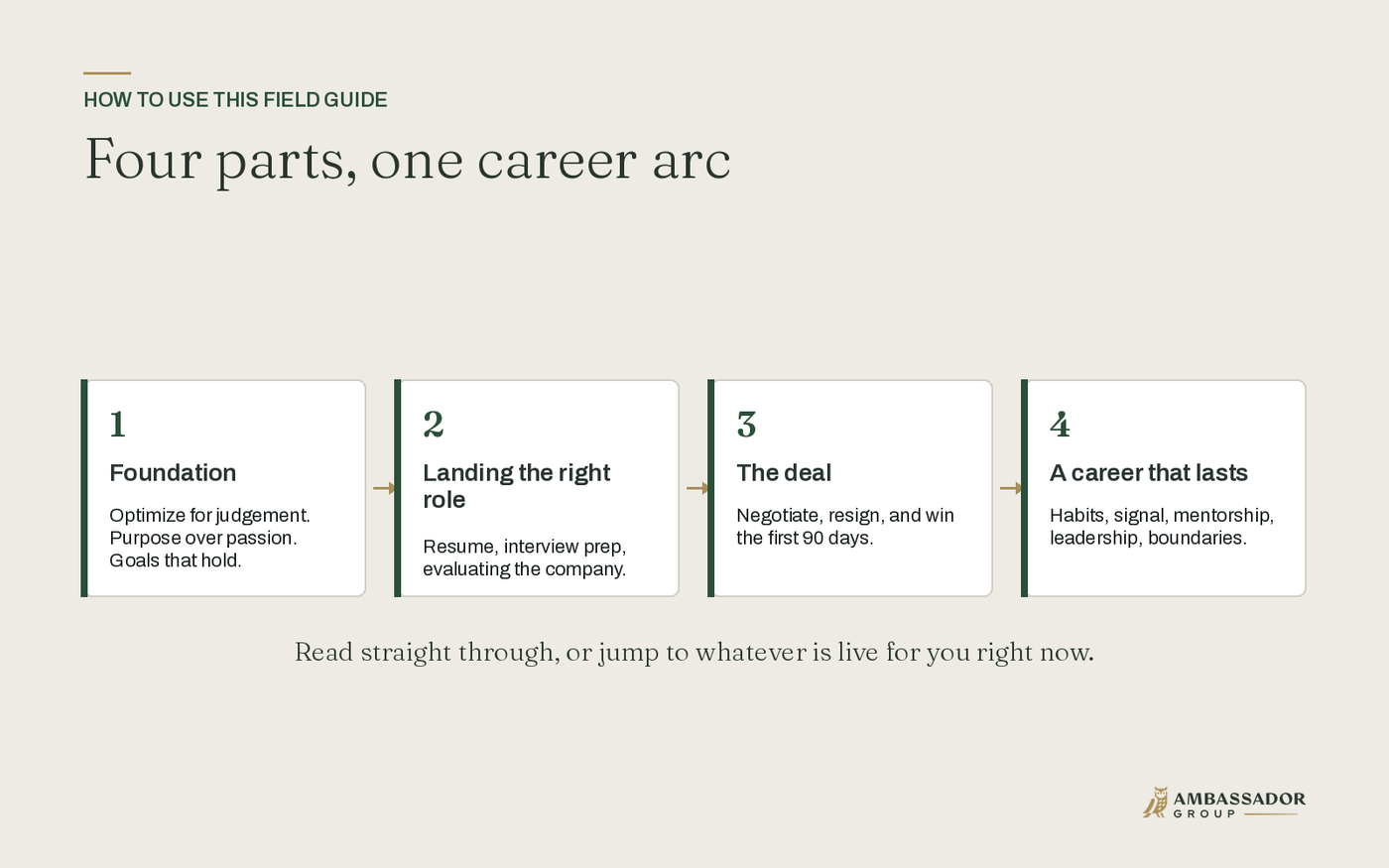
This field guide is the long version of how to optimize for that bet, on both sides of the table. The short version is the Pillar post; this one carries the rebar behind the recommendations. Read it straight through if you have an hour. Otherwise jump to whatever's live for you right now.
If you want to understand what hiring managers are really buying, start with §1 (hiring optimizes for judgement).
If you're job hunting, work through §6 (resume), §7 (interview prep), §10 (evaluating the company), and §11 (the seven dimensions of fit). If you're about to accept an offer, §10 and §11, then §14 (negotiation) and §15 (negotiate the raise where you are). If you're about to resign, §17 (the honorable resignation). If you just started a new role, §18 (the first 90 days).
If you're a few years in and feeling stuck or plateaued, §2 (passion vs. purpose), §3 (career goals), and §25 (career resilience). If you're a senior PM or super being pulled toward leadership, §20 (character and skill) and §23 (leadership before the title). If you're burned out, go directly to §24 (stress and the boundary problem).
Hiring optimizes for judgement
Every company has a different way of saying it. "Fit." "Leadership presence." "Executive maturity." "Trustworthy under pressure." "The right kind of operator." Different shorthand, same underlying bet. They are trying to predict whether your future decisions will hold up when conditions get hard. That prediction is what they are buying.
The thing they call judgement breaks into four variables.
- IQ. Raw cognitive horsepower applied to the technical problem. How fast you read a set of plans, catch a sequencing error, or run a scope analysis under time pressure. Largely fixed by adulthood. The malleable part is what you direct it at. A super who knows curtain wall details cold outperforms a smarter super who never specialized.
- EQ. Reading rooms. Regulating yourself when a sub is escalating. Knowing what an owner needs before they say it. The most underrated and most teachable of the four. Trainable through deliberate exposure to high-stakes conversations and explicit feedback loops.
- Experience. Time-bound, but the quality is yours to control. Two PMs with ten years can have radically different experience portfolios. The ones who take the recovery jobs, the contentious owners, and the cross-sector projects build a richer library than the ones who ride one easy assignment for a decade.
- Character. Whether you make the right call when no one is watching. Built through repeated small choices: ownership when something fails, honesty when a lie would be easier, showing up for people when there is no payoff in it for you. Without it, the other three variables actively burn trust over time.
A few years ago I matched a PM whose IQ and experience were genuinely off the charts. Eighteen months in, the client called: "He's brilliant. We're moving him out." His EQ couldn't carry the room when projects went sideways, and his character couldn't admit it. Two of four variables maxed. The other two near zero. The math caught up with him. I should have read it earlier.
Why optimize beats maximize. You can't push all four to maximum at once. EQ takes time you could spend studying for IQ. Character means choosing the harder path, which sometimes slows experience accumulation. The work is balancing the four against each other so the sum keeps climbing.
How the variables compound across a career
- Years 0 to 5. IQ and experience accumulate naturally just by showing up. EQ and character are the actual differentiators between PEs who get tapped for stretch projects and PEs who don't.
- Years 5 to 15. Experience compounds. Character starts opening doors that pure skill cannot. EQ determines who survives leadership transitions and who gets passed over.
- Years 15+. Judgement is what firms hire for at this level. Pure-IQ or pure-experience plays become liabilities; every region has a story of a brilliant operator who imploded for character or EQ reasons. The ones who optimized all four are running things.
Concrete moves to optimize each
- IQ. Thirty minutes a week of deep technical study in your highest-impact area. Depth over breadth.
- EQ. One peer feedback loop per quarter. Ask: "Where do I read situations wrong?" Listen without defending. Most people never ask.
- Experience. In the early years, prioritize variety over prestige. Take the recovery job. Volunteer for the difficult sub.
- Character. A written commitment audit once a quarter. Where did I keep my word? Where did I dodge?
The rest of this guide is the operational version of this equation. Resume crafting, interviewing, evaluating companies, negotiating, resigning, onboarding, leadership: each is a chance to demonstrate judgement under specific conditions, or to develop the variable behind it.
Passion vs. purpose
Follow-your-passion is one of the most recycled career slogans in the industry. It sounds empowering. It collapses under load.
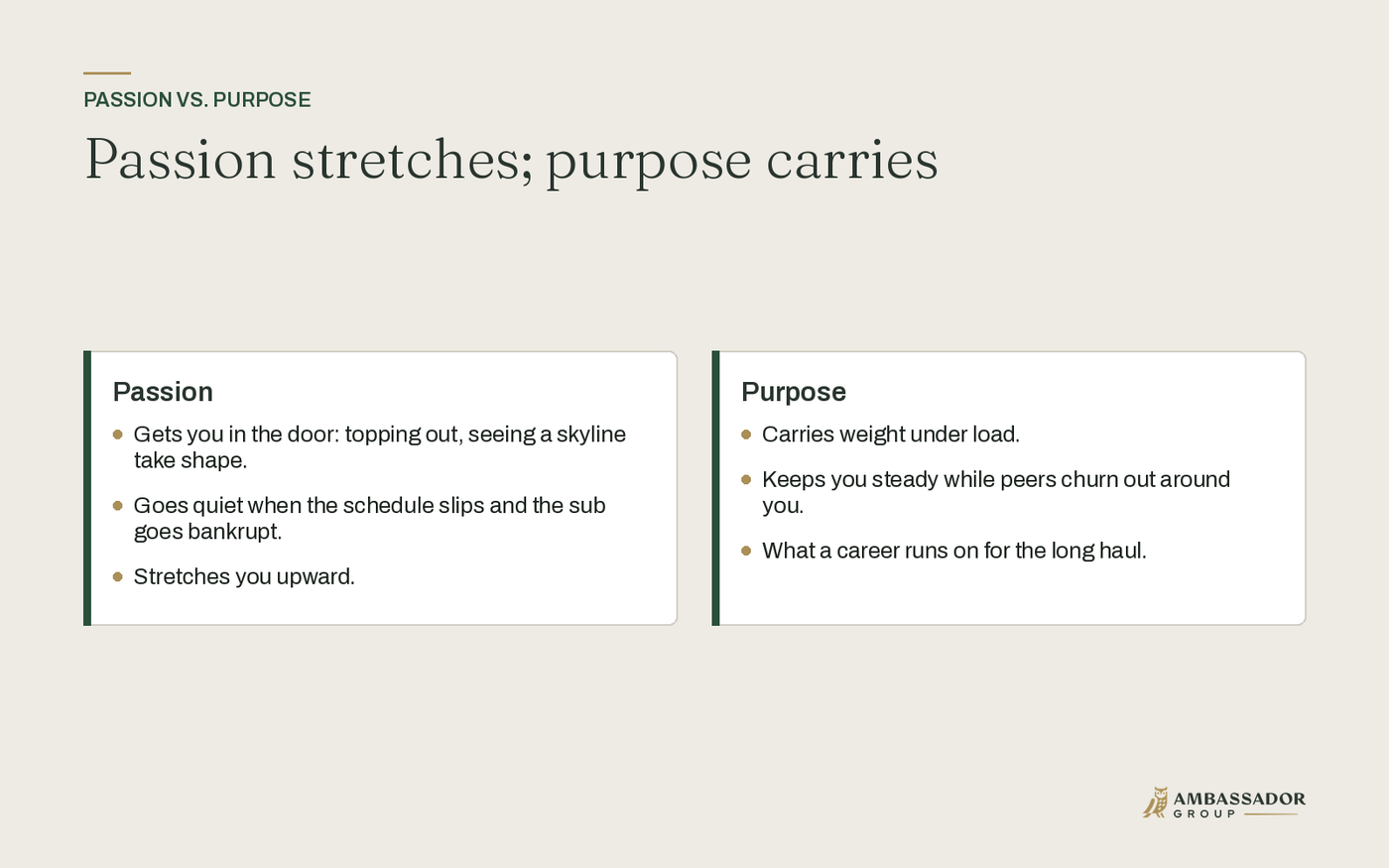
Passion gets you in the door: the thrill of topping out a building, the pride in seeing a skyline take shape. Passion does not pay when the schedule slips, the sub goes bankrupt, and your role keeps you stapled to an office you hate.
Marcus, a super I matched to a mid-tier multifamily GC two years ago, turned down a marquee high-rise to take a hospital project closer to home. Less glamorous. He passed on roughly $40K to do it. Eighteen months later, his old peers on the high-rise had churned through three supers. Marcus is about to be promoted.
The pattern: passion stretches you upward, purpose carries weight under stress. A career needs both.
Three questions to run on yourself this week
- What are the tasks that drain me no matter how much success I have?
- What environments let me perform under load?
- Am I being seduced by prestige (title, project, company) at the expense of alignment?
If you can't answer the third one honestly, ask someone who has watched you work for at least two years. They can see what you can't.
Career goals as feasibility study
"Set big goals" is half the story. Ambitious visions sell themselves. Without smaller reinforcements they collapse like a sketch with no rebar.
I've watched two PEs with the same end goal go in opposite directions. One told everyone he wanted to be a PM in two years, then spent his days grinding daily logs and waiting to be tapped. Two years later, still a PE, frustrated. The other identified cost control and schedule analysis as her gaps, asked her PM to walk her through budget meetings, shadowed the scheduler, taught herself P6 on her own time. Eighteen months later her supervisors were pushing for her promotion before she'd asked.
Same starting point. Different career. The first chased the title. The second built the rebar that made the title an obvious next step.
The three-tier blueprint
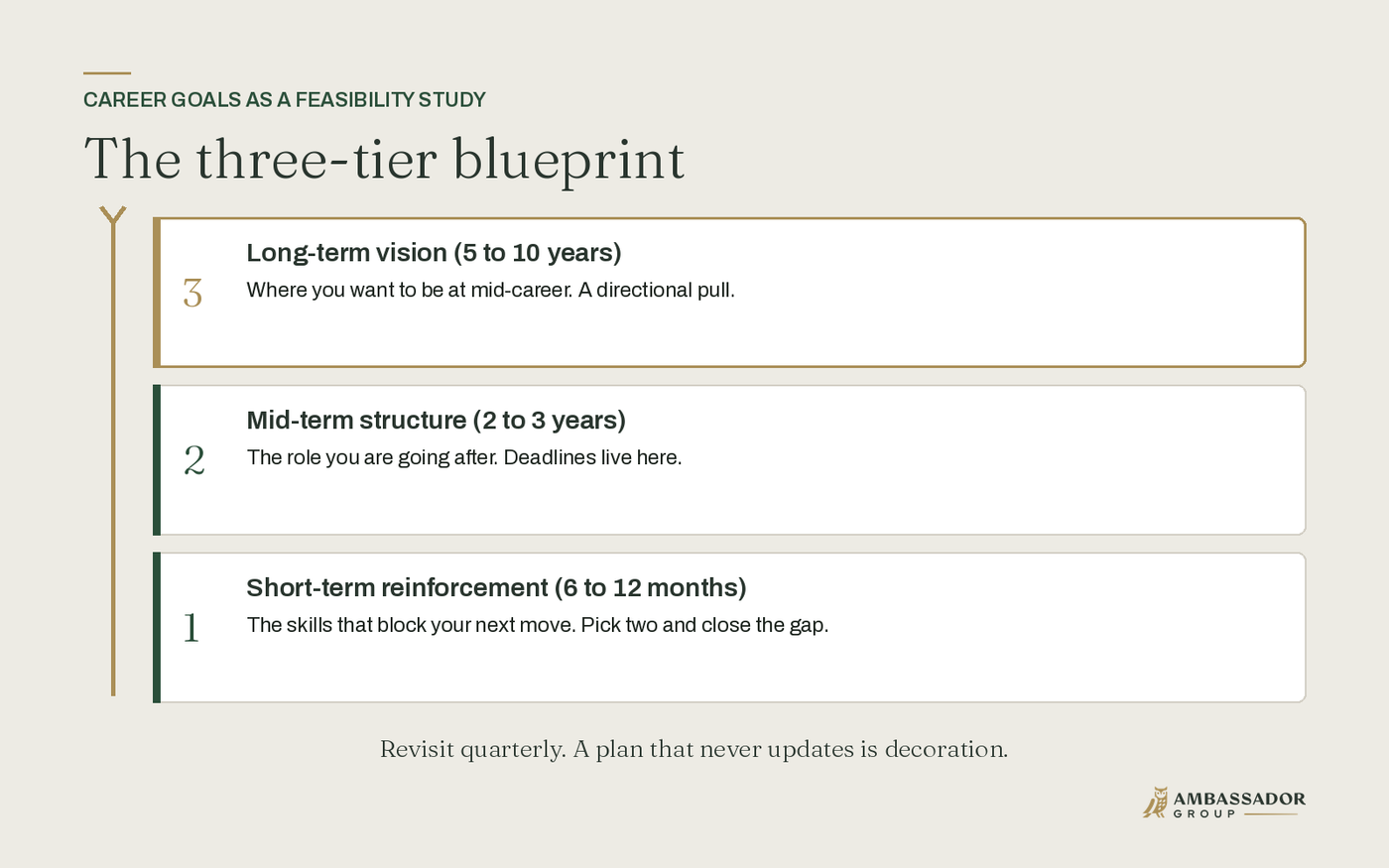
- Short-term reinforcement (6 to 12 months). The skills you don't have yet that will block your next move. Scheduling. BIM. Financial fluency. Conflict negotiation. Pick two and close the gap.
- Mid-term structure (2 to 3 years). The role you're going after. Senior estimator. Project manager. Superintendent on a different sector.
- Long-term vision (5 to 10 years). Where you want to be when the second half of your career hits. Executive. Owner. Niche specialist. The vision is a directional pull. Deadlines belong to the mid-term tier.
Revisit the blueprint quarterly. Treat assumptions like a project schedule: revise them when conditions change. A career plan that doesn't get updated is decoration.
One stress test before you set a goal: do you have the soil conditions to support the foundation? Mentorship, training, financial stability, personal bandwidth. If the soil is weak, shore it up before you start pouring.
Sometimes the lateral move accelerates you faster than the promotion. A "lesser" role at a high-quality firm beats a flashy title at a shaky one. The industry is full of people who jumped for a title and got stuck for five years inside a dysfunctional firm.
Should you move at all?
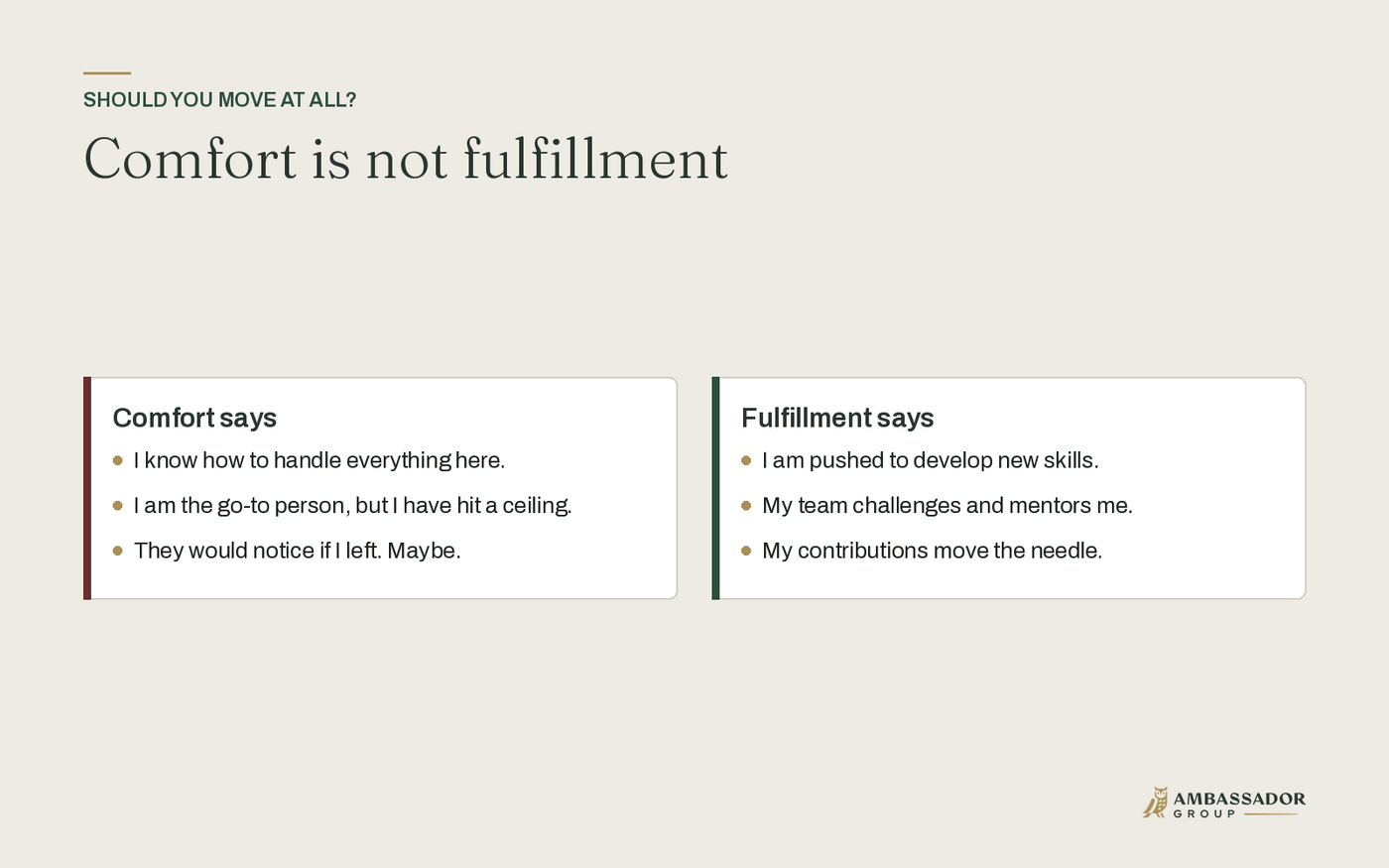
Most construction professionals who are not looking are not thriving. They are comfortable. Comfort is the quietest career risk in this industry, because nothing is wrong enough to force a decision. No red flags, no burnout, no micromanaging, just enough ease to silence the voice that asks whether this is really it.
A lack of pain is not the same as growth. Run the check honestly:
- Learning. Are you developing new skills, or do you already know how to handle everything here?
- Ceiling. Are you growing, or are you the go-to person who has stopped climbing without noticing?
- Impact. Do your contributions move the needle, or would they barely notice if you left?
- Energy. Is the day-to-day energizing, or just tolerable?
If you answered with the comfortable version more than twice, you may be settling, and settling shrinks your future options.
Now the other side, because moving is not always the answer and the industry gets this wrong as often as it gets comfort wrong. A young carpenter I know had a clean exit in front of him: a nightmare project with weather delays, a hostile neighborhood association, and constant budget pressure, against a cleaner job across town for slightly more money. He stayed. What he learned by staying, how to calm frustrated neighbors, navigate city politics, and hold subs accountable without blowing up relationships, no easy job could have taught him. Within a few months the company tapped him for assistant superintendent. He earned a trajectory that could not have been bought.
The quality of a career, like the quality of a hire, is not principally driven by the offer on the table. It is driven by what you commit to and the leader who earns that commitment. Career growth is chaotic, and the crucible projects rarely arrive on schedule. Loyalty is what keeps you present when they do. So before you polish a resume, answer two questions. Are you leaving because you have outgrown this, or because something shinier caught your eye? And is the hard thing in front of you a reason to leave, or the exact thing that would make you worth more anywhere? You do not need a crisis to move. You do need a reason better than restlessness.
Never interview from desperation
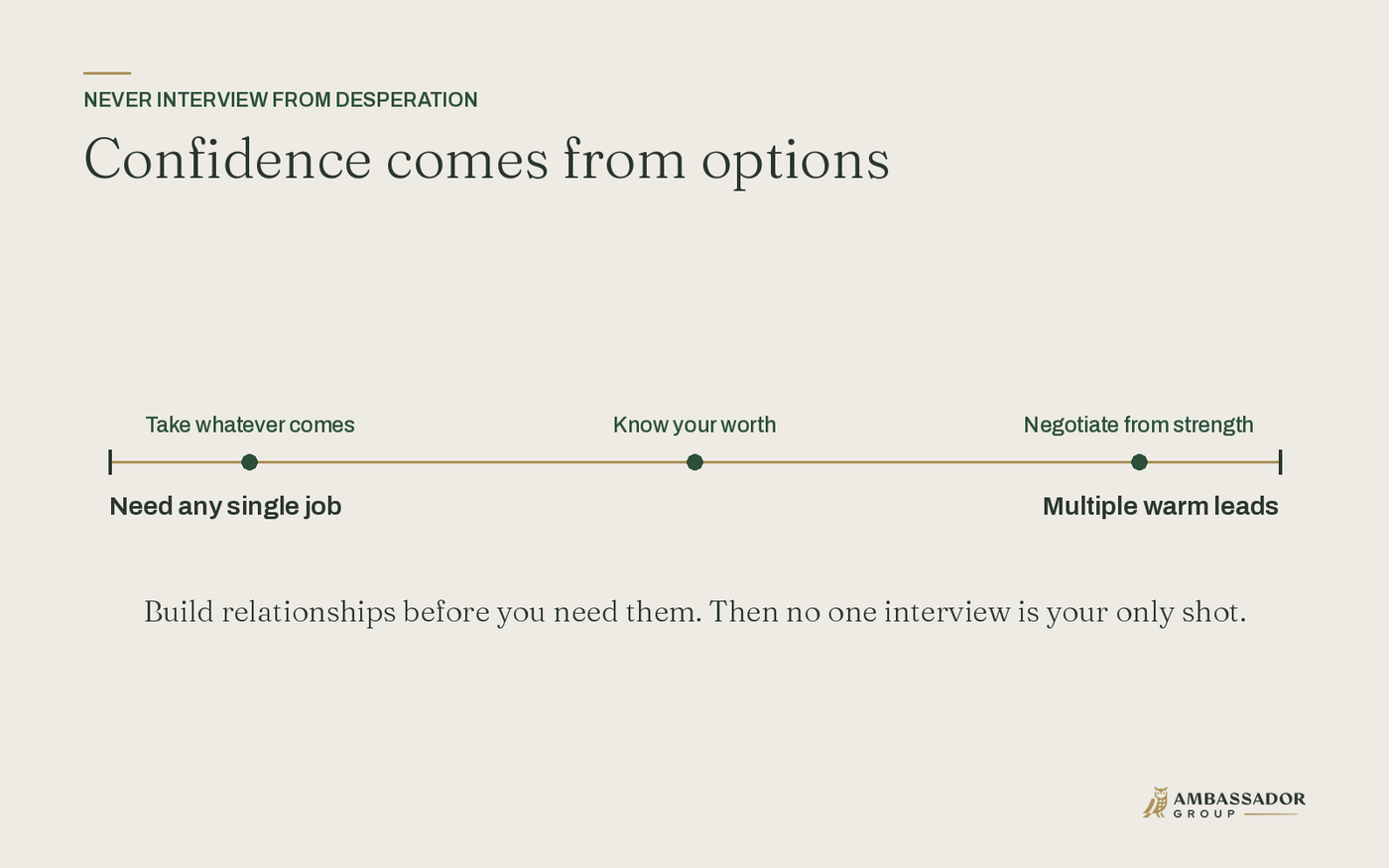
Walking into an interview needing the job is the fastest way to lose your judgement. Desperation leaks. Hiring managers feel it, and it weakens your position before the first question. The fix is not a breathing exercise in the parking lot. It is making sure no single job is ever your only option, and that work starts long before you need it.
- Build relationships before you need them. Jobs come from trust, not resumes. Stay close to old colleagues, managers, and subs. Reach out to people you respect before they have an opening. When you finally need a move, you want warm leads where the manager already trusts you.
- Keep options open even when you are content. Know the market and know your worth, even when you are not looking. The candidate with three conversations going negotiates from a different place than the candidate with one.
- Keep a cushion. Financial pressure makes a mediocre offer feel like a rescue. A few months of runway buys you the patience to say no.
- Treat the interview as a conversation, not a test. It runs both ways. You are deciding too.
An estimator I worked with kept a standing habit: coffee with one former colleague or sub every couple of weeks, for years, with nothing to sell. When his firm lost its backlog and let half the office go, he had three conversations going inside a week and an offer inside a month. The colleagues who waited until the layoff to start networking were still looking in the spring.
Confidence is not a performance you summon for an hour. It is the quiet knowledge that you will be fine either way. Build that, and the nervousness solves itself.
Your resume is a spec sheet
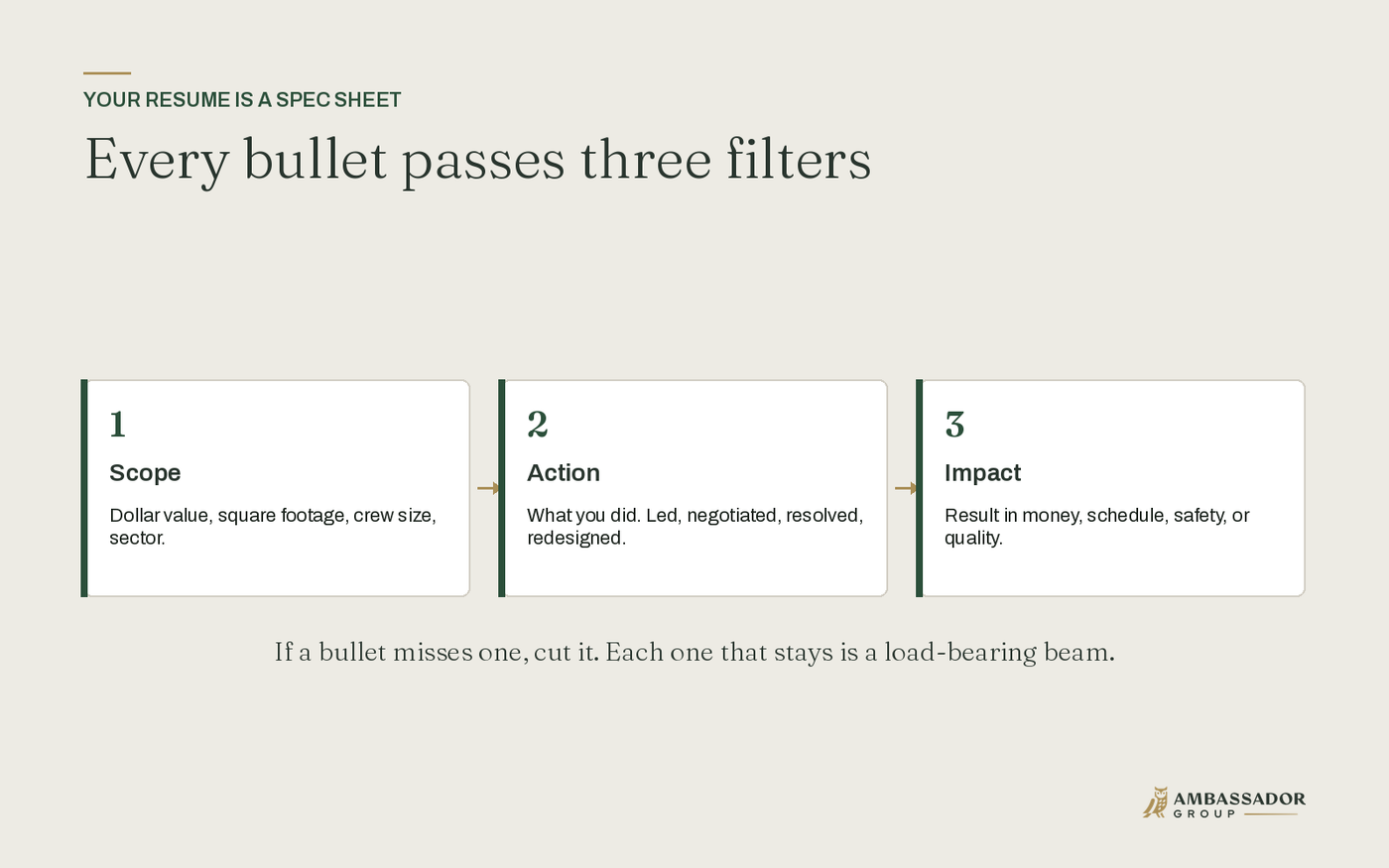
Treat your resume as a spec sheet. Hiring managers in construction skim dozens at a time, often under a minute each. They want scope, project type, measurable wins, and evidence of leadership at a glance. Buzzwords get cut. Numbers get read.
Compare:
- "Oversaw multiple crews, coordinated with subs, delivered projects on time."
- "Led a 60-person crew on a $25M healthcare facility, delivered three weeks early, zero recordables, $400K in cost savings."
The second one gets the call. Every time.
The three-tier filter, applied to every bullet
- Scope. Dollar value, square footage, crew size, sector.
- Action. What you specifically did. Led, negotiated, resolved, redesigned.
- Impact. Result in money, schedule, safety, or quality.
If a bullet does not hit all three, cut it. Less is more when each remaining bullet is a load-bearing beam.
One warning: construction is a small-world, long-memory industry. Exaggerations get cross-checked with the subs and vendors who were on the same job. The real cost of a fudged number is the reputation hit that follows you for the next ten years. The rejection is the small part.
Interview mastery, part one: preparation
An interview in construction is a bid meeting. The hiring team is pricing risk. If your preparation is shallow, smooth talk doesn't close the gap.
I sat in on a debrief once where the hiring PM said the candidate "felt confident but hadn't done his homework." He didn't know the firm's two flagship projects, didn't have a question about backlog, and answered every behavioral question with a vague "I always try to..." line. The other candidate they'd seen that week had pulled the firm's last three press releases, knew the project size of their current high-rise, and asked about their approach to labor shortages in Q4. That candidate got the offer. They hadn't even checked his references yet.
There is a second reason to prepare this well: the recon that lets you answer their questions is the same recon that lets you judge them. How a company runs its interview is the clearest early signal of how it runs everything else, a thread this guide picks up in evaluating the company before you accept.
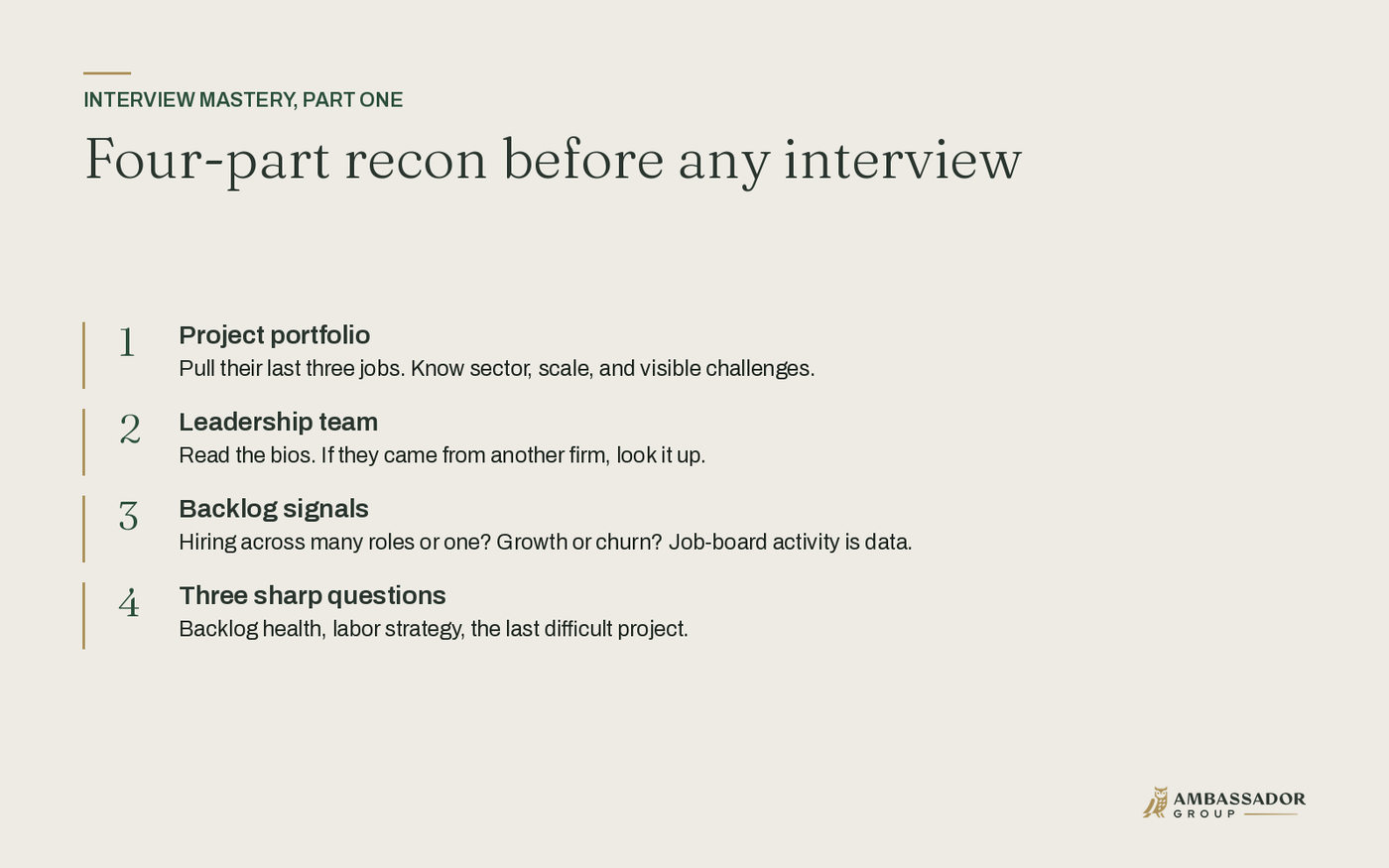
Four-part recon before any interview
- Project portfolio. Pull their last three jobs. Know sector, scale, and any visible challenges. If a project is in the news, know why.
- Leadership team. Read the bios. If they came from another firm, look up that firm. Industry tenure tells you something.
- Backlog signals. Are they hiring across multiple roles or just yours? Does their LinkedIn show growth or churn? Job-board activity is data.
- Three sharp questions. Backlog health, labor strategy, the last difficult project. Questions like these signal you think beyond your role.
Build three story banks
- Technical wins. Cost, schedule, quality.
- Leadership wins. Team morale, sub conflicts, client management.
- Problem-solving. Change orders, safety incidents, recovery.
Each story in STAR format: Situation, Task, Action, Result. Concise. Measurable. Practice them out loud, in your car, until they're three sentences and stop.
One thing most candidates skip: own a weakness. Pick one area you're still learning and one specific thing you're doing about it. A candidate who can name a gap and show the work to close it lands more credibility than one who claims strength everywhere. Construction interviewers have working bullshit detectors. Don't activate them.
The stories you walk in with become the stories the hiring team repeats in their debrief. Imagine that debrief. Write down the one sentence you want them to repeat. Build your preparation backward from there.
Interview mastery, part two: performance
"Just be yourself" is terrible advice. It sets people up to wing it and wonder why they didn't get the call.
An estimator I matched to a Seattle GC last year went into his second-round interview with a story bank he'd practiced out loud the night before. When the VP asked about cost-saving wins, he said: "On a $12M commercial build last fall, we hit a $500K steel escalation mid-bid. I renegotiated with two suppliers, explored alternate decking, and brought the overage to $180K." Then he stopped. The panel leaned forward. He had an offer the next morning.
Precision beats volume. Interviewers don't remember polished generalities. They remember the specific story of how you avoided a $250K delay by getting the rebar sub back on track.
Four performance principles
- Lead the panel to the evidence you want them to see. Most construction interviewers are PMs, supers, and execs judging by instinct. Don't expect them to ask the right questions. Bring the stories anyway.
- Tie every story to the five drivers. Schedule, cost, quality, safety, relationships. Anything outside those five gets forgotten by Friday.
- Use silence. Answer with a sharp story, then stop. The pause is a power move. Most candidates fill it with throat-clearing that dilutes the answer.
- When you don't know, say so cleanly. "I haven't run a job that size, but here's how I'd think about scoping it" beats fabricating expertise. Interviewers ask hard questions to watch how you handle not knowing.
Expect the conversation to drift toward war stories. Lean into it. The hiring team is testing whether you've been on the jobsite when things went sideways. Vague answers signal a candidate who watched from a distance. Specific answers signal a candidate who was in the room. The room is what they're hiring for.
After every interview, write three lines: what you learned about the role, whether the culture felt aligned, what risks you spotted in the team dynamics. By offer time, those notes are how you tell the difference between a job and a trap.
Honesty is a filter, not a performance
Most career advice coaches you to lie. Apply even if you are not qualified. Fake it till you make it. Project confidence you do not feel. It sounds empowering. In a construction interview, where trust is the currency, it backfires.
This is not about forged resumes. It is about pretending: claiming more experience than you have, faking passion for a role you do not want, performing alignment with values you do not share. The intent is survival. The outcome is damage, and you pay first. Land a job by overstating, and the role becomes a daily stress test. You spend months hiding gaps instead of closing them. Every month faking competence is a month not building it, and the early exit that follows resets your reputation in an industry with a long memory.
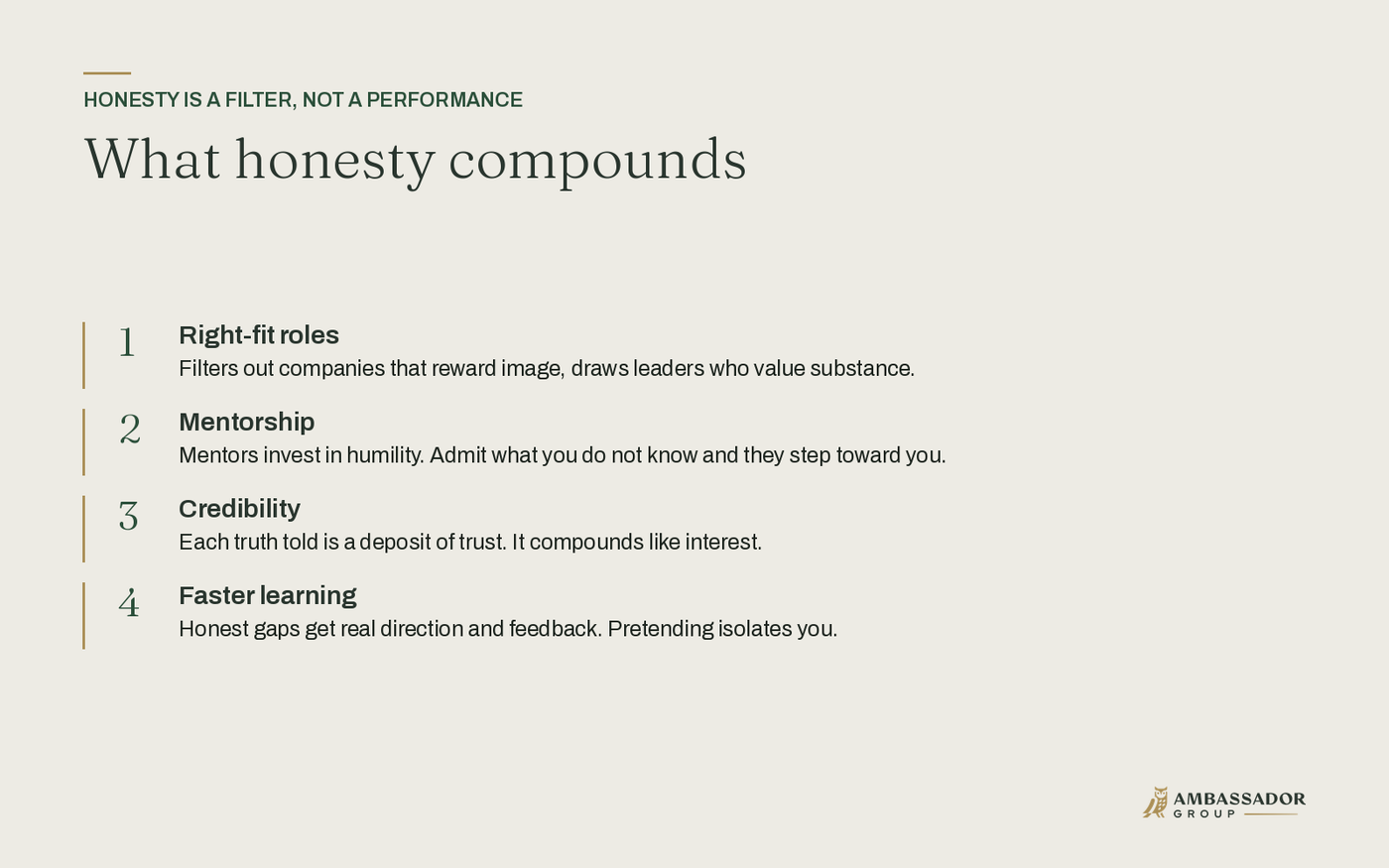
Real honesty goes deeper than not lying. It is naming your stretch, not just your strengths. It is saying I have not run a job that size, but here is how I would scope it. That kind of honesty does three things bravado cannot.
- It filters. Honesty pushes away the companies that reward image over growth and draws in the leaders who value substance. The right opportunity does not ask you to fake it. It asks you to grow into it.
- It attracts mentorship. Mentors invest in humility, not arrogance. When you admit what you do not know, you invite the people who do know to step toward you.
- It compounds. Reputation grows like interest. Each moment of truth-telling is a small deposit of trust. Over a career, that credibility outperforms polish.
Generosity in an interview means framing your real experience in its best truthful light. Overselling means hiding the gaps you will have to live with on day one. The perfect job you talked your way into is a trap. The honest fit is the one that lasts.
Evaluating the company before you accept
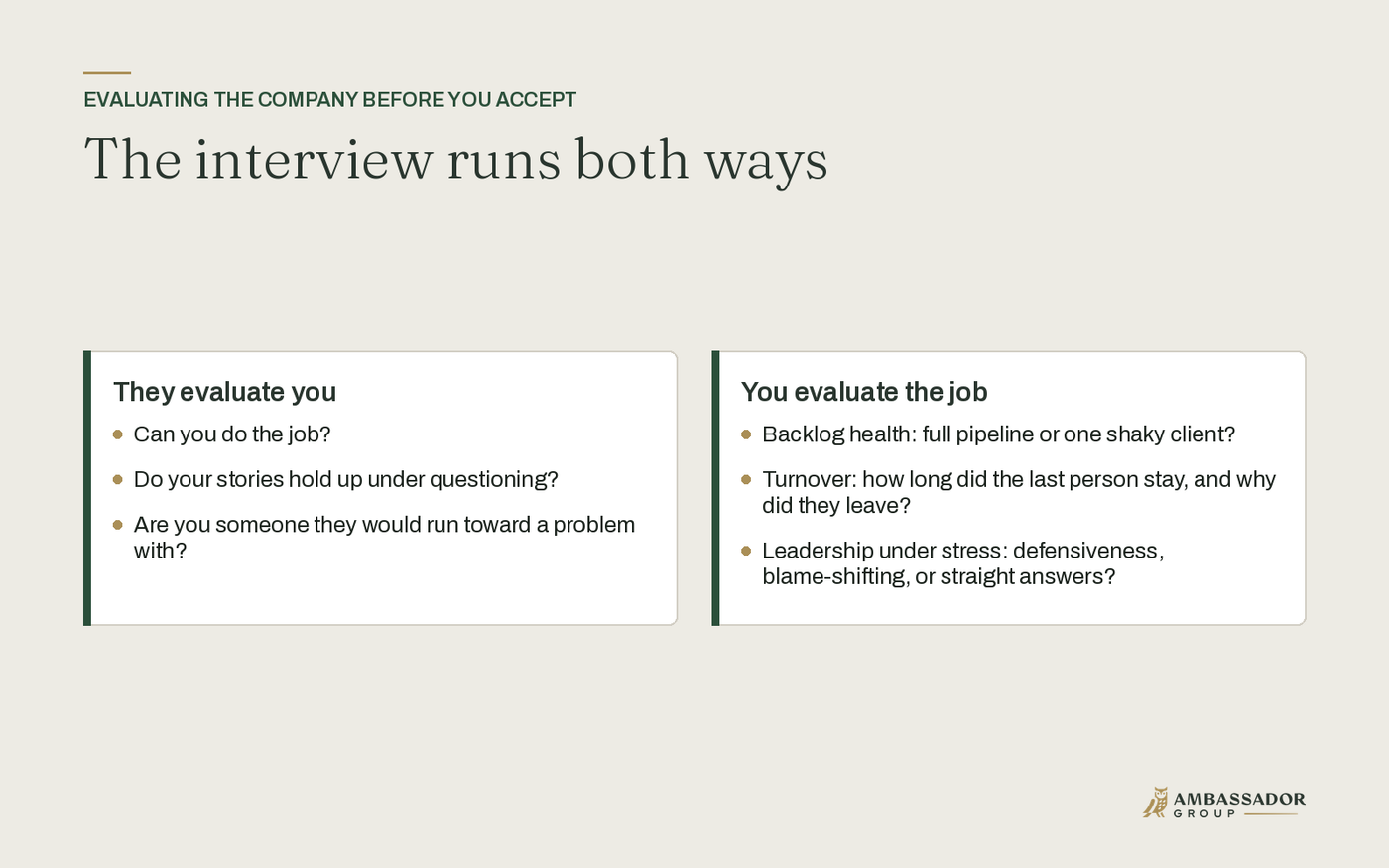
Most candidates burn so much energy trying to impress companies that they forget the interview is bilateral due diligence. They are evaluating whether you can do the job. Evaluate whether the job is worth doing.
A sharp estimator I worked with a few years back ended up at a firm that was systematically underbidding and pressuring PMs to bury overruns. He spent twelve months unwinding a decision that thirty minutes of homework would have prevented.
Six questions to ask deliberately during interviews
- Backlog health. How full is the pipeline? Spread across clients or dangerously concentrated in one or two?
- Turnover signals. How long did the last person in this role stay, and why did they leave?
- Leadership under stress. Tell me about a project that went sideways and how leadership responded. Watch for defensiveness, blame-shifting, or vagueness.
- Culture vs. cosmetics. Do the stated values show up in the way they just answered that last question?
- Growth runway. Is this role a ceiling or a launchpad? What happened to the last two people who held it?
- The team. Did the people you met feel like a team you'd run toward a problem with?
A company that can't answer "what's your PM turnover rate?" without getting defensive is giving you data. Take it.
One more question surfaces the most in the shortest time: "What are you working on improving right now that's not going well?" A confident, self-aware company answers honestly: "Our scheduling process is a mess and we're rebuilding it." That answer is the strongest green flag you'll get. An unhealthy company claims everything is fine, deflects, or gets defensive. Admitting a struggle is a sign of strength.
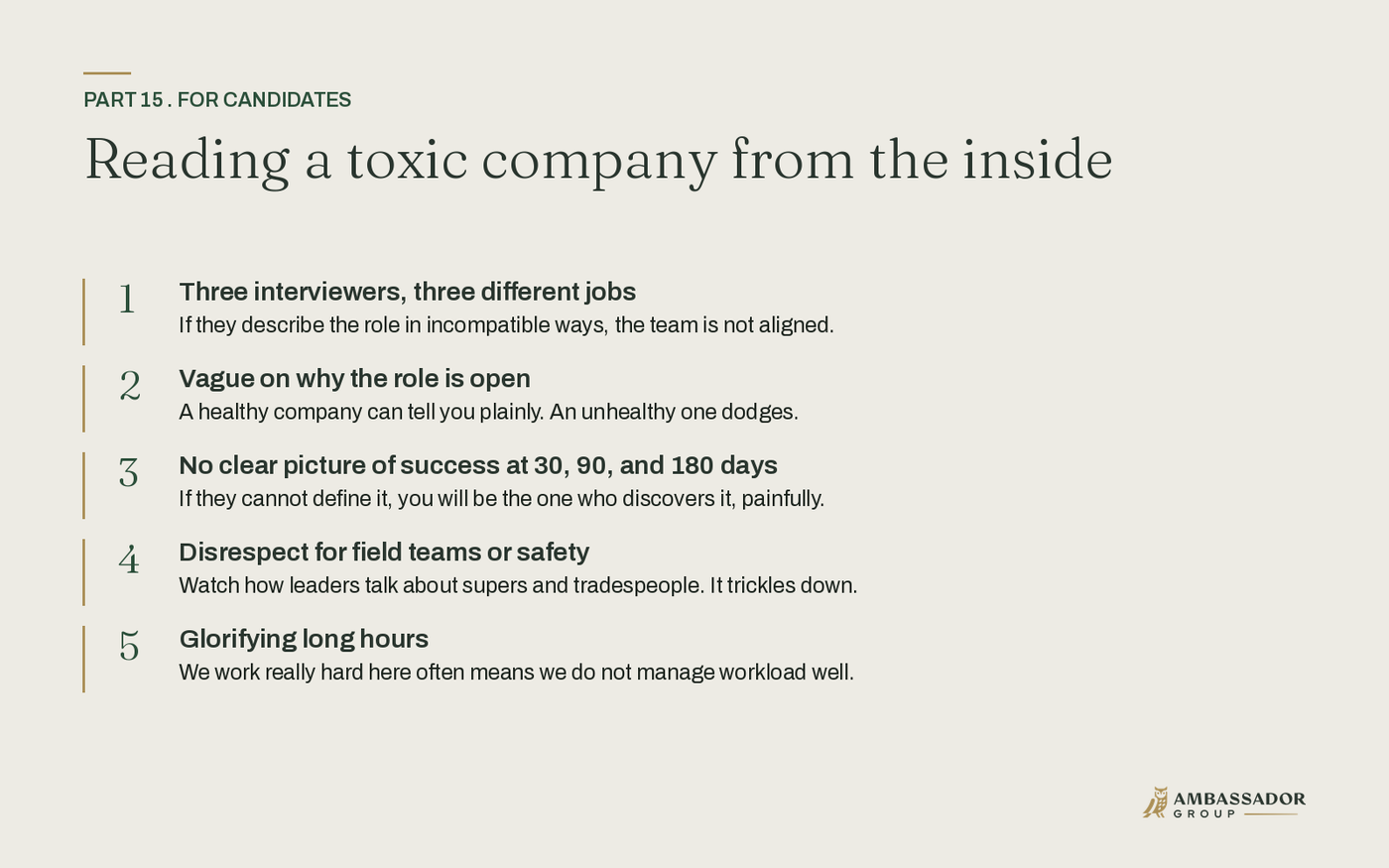
Red flags that show up in the interview process almost always show up later at 10x intensity on the job:
- Inconsistent messaging across interviewers. If three people describe the role, team, or priorities in three incompatible ways, the team isn't aligned. You're being sold three different jobs; only one will be your life.
- Lack of enthusiasm or distracted interviewers. People excited about their work show it. Ask if you want to work with them at their current baseline, not at their best.
- Dodging on why the role is open. A healthy company can tell you clearly. An unhealthy one gets vague, defensive, or changes the subject.
- High turnover in the team you'd join. Ask directly. If it's more than 20 percent a year, dig in.
- Vague responsibilities. If you can't get a clear answer on what success looks like at 30, 90, and 180 days, the company doesn't know either, and you'll be the one who discovers it, painfully.
- Disrespect for field teams or safety. Watch how office leaders talk about supers, foremen, and tradespeople. Disrespect always trickles down. And if safety comes up as an afterthought or a cost center, run.
- Glorifying long hours. "We work really hard here" is often code for "we don't manage workload well." Sustainable excellence doesn't require heroic suffering.
The interview process is a preview of the company's culture. Don't ignore the warning signs because the title is exciting or the comp is strong.
Start with salary and bonus.
Enter your current pay and the new offer. For bonus, use last year's actual figure against a realistic expectation, not the ceiling.
What the drive actually costs.
Fuel and wear add up over a year. Enter the round trip and how often each role lets you work from home. Maintenance is estimated at ten cents a mile.
Coverage is part of the paycheck.
Compare what each employer puts toward your coverage against what comes out of your own pay each year.
Match and fees compound.
A higher match and lower fees change the picture over a career. The match below is valued as a percent of each role's salary.
Days off carry a dollar value.
Vacation, holidays, and sick days are paid time. Enter them in days; each is valued at the role's daily rate.
The line items that get overlooked.
Add the annual value of any allowance or benefit each role provides. Leave a line at zero if it does not apply.
The full picture.
Adjust for a change in cost of living.
If the new role means a move, enter the difference in cost of living. Use a positive number for a more expensive area and a negative one for cheaper. A reference is at bestplaces.net.
Want this breakdown in your inbox? Leave an email and we send it once. Optional.
Bring the breakdown to your Ambassador Group partner. The number is where a good conversation begins.
Seven dimensions of fit
The last chapter gave you the questions to put to them. This one gives you the instrument to score the role itself, whether you are staring at an offer or five years into a job you stopped examining a while ago. Fit is not a single verdict, good or bad. It breaks into seven separate dimensions, and most people who feel vaguely wrong about a role cannot say which one is actually failing them. Naming the dimension is the difference between a problem you can fix and a slow drift toward a resignation you cannot fully explain.
The seven dimensions
- Functional fit. Are your busiest hours spent on work that uses a real strength, or on busywork stacked next to it?
- Contextual fit. Are you working twice as hard as a peer in the same role elsewhere to get the same result?
- Cultural fit. Name the last time company behavior contradicted a stated value, and how recently that was.
- Relational fit. Of the five people you work with most, how many would you take a weekend call from?
- Motivational fit. Color last week's calendar by what drained you and what fueled you, then count the red.
- Developmental fit. List five things you can do now that you could not do a year ago.
- Leadership fit. Name exactly what you need from your manager, then check whether you have ever asked for it directly.
Run this once a year, not only before you sign. Pick a fixed date, your hire anniversary or your birthday, and score yourself 1 to 5 on each of the seven. Write it down instead of doing it in your head. A role scoring below 3 on two or more dimensions is broken, and a broken role does not heal itself. Left alone, it gets worse.
What you can fix from inside, and what you can't
Four of the seven respond to action you can take without leaving the building. Functional fit moves when you renegotiate your scope. Developmental fit moves when you ask for a stretch project. Leadership fit moves when you find a mentor outside your reporting line. Relational fit moves when you build different alliances on the team. The other two rarely move from the inside no matter how much initiative you bring. Cultural fit at the company level is set by people above your reach. Contextual fit, when the company is simply the wrong size or stage for how you work, is a structural mismatch that effort does not resolve. I have watched people spend two and three years trying to will their way past exactly those two, and the ones who eventually left wished they had named the problem on day one instead of month thirty. Naming the unfixable dimension, then calmly preparing your next move on your own timeline, beats waiting for the company to force the timing on you.
Construction is a small industry, and the firm on your resume becomes part of how the next one reads you. Score the role honestly, and often enough, and you will never be the last person in the building to notice it already went wrong.
Vet the recruiter representing you
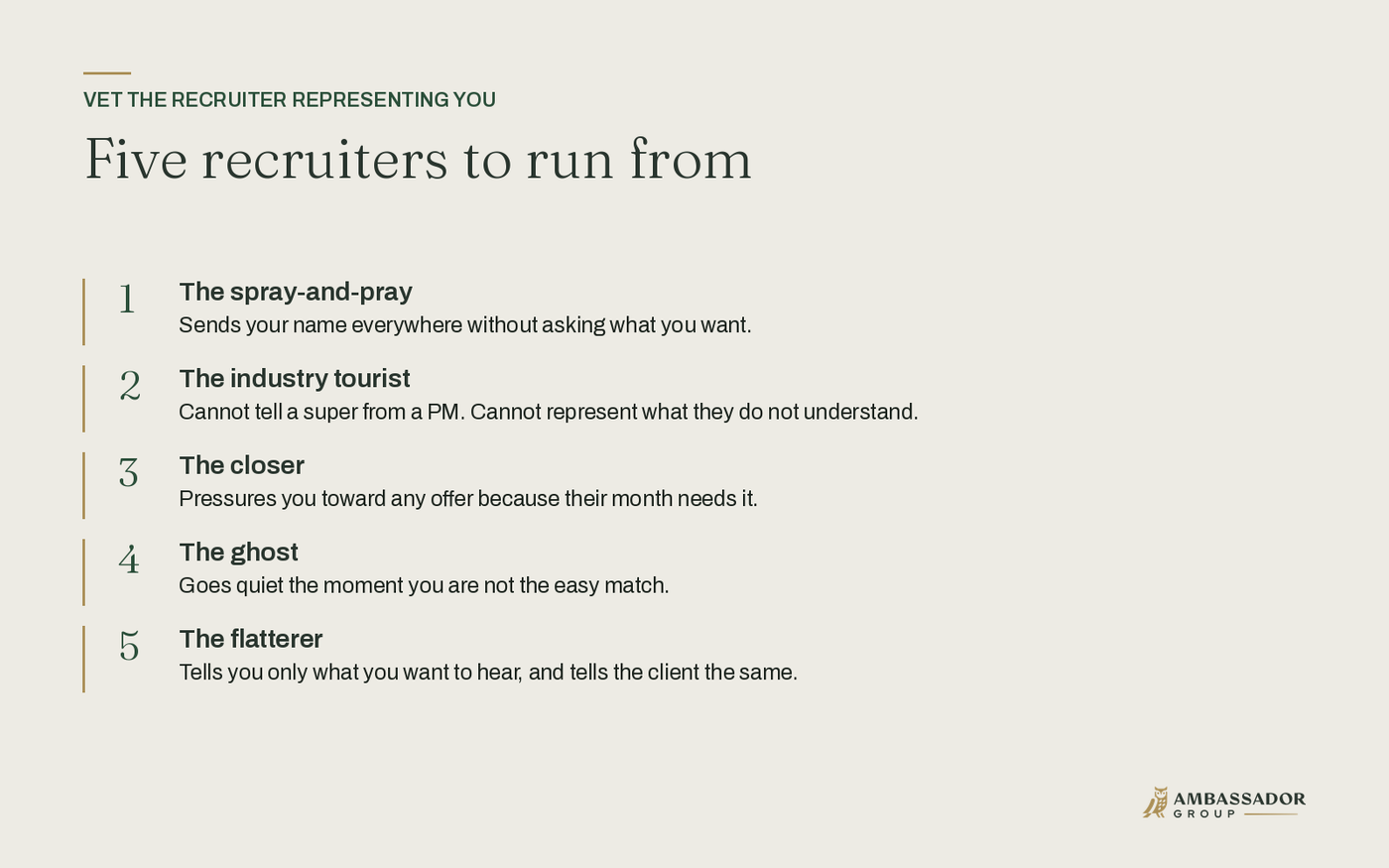
The recruiter who represents you is borrowing your reputation every time they send your name to a client. Most candidates never vet them back. They should. A recruiter whose model rewards speed over depth will spend your credibility to close a fee. The industry is full of recruiters who are perfectly nice people and still wrong for you, because their incentives are wrong. Learn the patterns and run from them.
- The spray-and-pray. Sends your resume everywhere without asking what you want. Volume is the strategy. You are inventory.
- The industry tourist. Cannot speak the difference between a super and a PM, or healthcare from tilt-up. They cannot represent what they do not understand.
- The closer. Pressures you toward any offer because their month needs it, not because the match is right.
- The ghost. Goes quiet the moment you are not the easy match, then reappears when a fee is in reach.
- The flatterer. Tells you only what you want to hear. A recruiter who will not give you honest feedback will not give the client honest feedback about the role either.
The recruiter worth trusting acts like a matchmaker, not a headhunter. They ask what you want before they ask where you will go. They tell you when a job is wrong for you, even when it costs them the fee. They represent both sides honestly, because the relationship has to hold for years, not one signing. Pick the one who would walk you away from a bad fit. That is the one who will fight for the right one.
Choose references who tell the truth
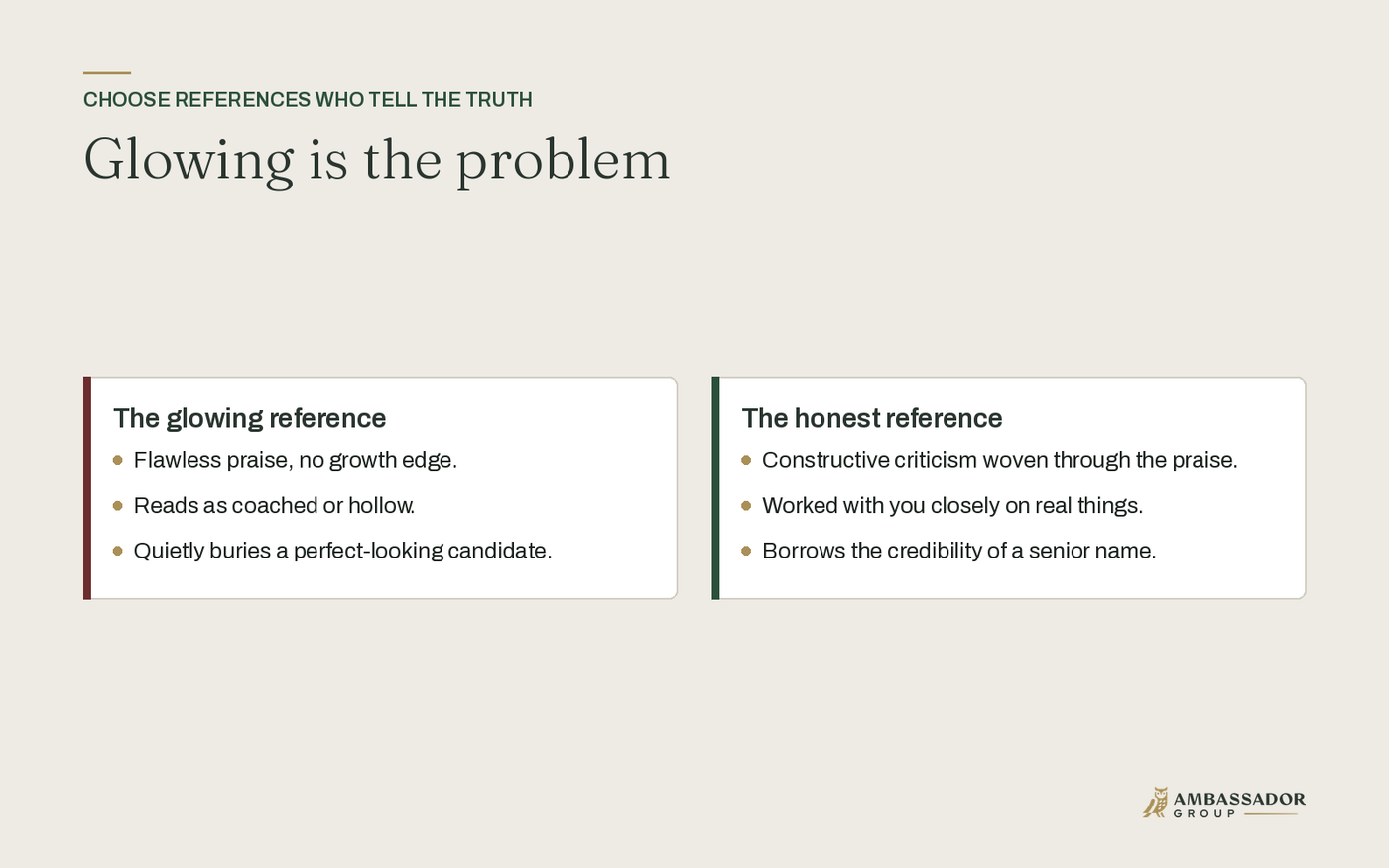
References are not a formality. I have watched them resuscitate candidates who looked dead on paper, and bury candidates who looked perfect. A skilled hiring authority does not read your reputation. They reconstruct it.
Here is the part that stings: everyone wants glowing references, and glowing is the problem. The most powerful reference I take has sharp, constructive criticism woven through the praise. The most useless one tells me you descended from heaven to bless whoever hires you. A reference that names your real growth edges reads as credible. A flawless one reads as coached. Choose your references on three tests.
- They have worked with you closely. On real things, recently enough to recall the specific moment you held a sub accountable or recovered a slipping schedule. That beats someone who simply likes you.
- They can name a growth edge. A strength and a stretch, in detail. The honesty is what makes the praise land.
- They carry credibility worth borrowing. A reference from the owner or responsible manager outweighs a peer, because their position lets them see the full context and their own name rides on what they say.
If you are only now trying to cultivate good references, you may already be late. The references worth having come from years of being genuinely invested in the people around you. You do not want to be calling in a favor from someone who owes you one. Build the relationships now, so that when a hiring authority reconstructs your reputation, the people closest to your work are glad to stake their name on yours.
Negotiating with integrity
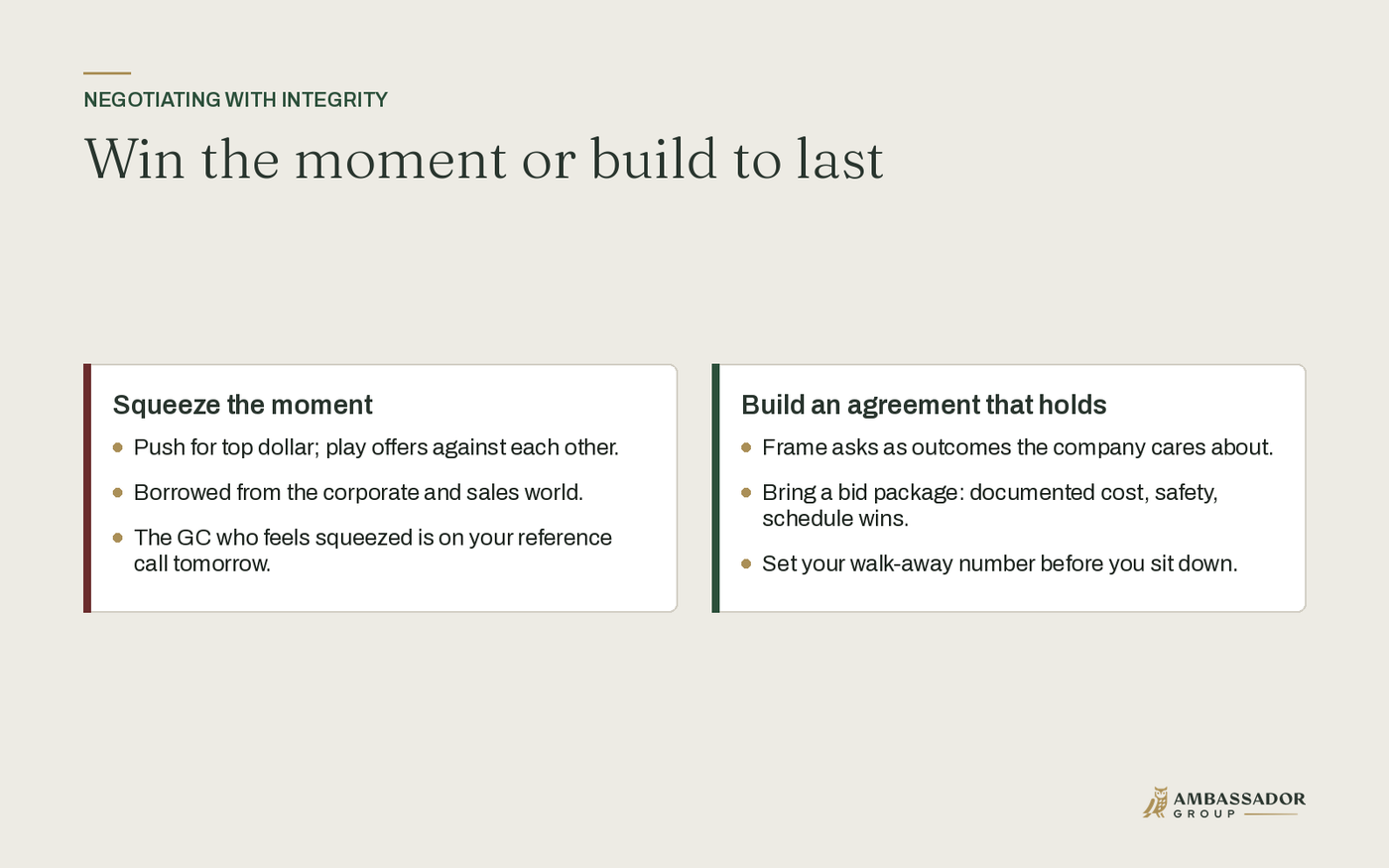
Most career-negotiation advice comes from the corporate or sales world. Always push for top dollar. Play offers against each other. In construction, that mindset is dangerous. The industry runs on reputation. The GC who feels squeezed today is on your jobsite or your reference call tomorrow.
The goal of a construction negotiation is to build an agreement that holds under load for years. Winning the moment costs you the next five jobs.
A super I matched last year went into her negotiation with documented evidence: across her last three projects she beat schedule by an average of 19 days, which translated to roughly $450K in general conditions savings for her former employer. She presented the math and asked to be paid like the profit center she'd been. Two years later her comp keeps climbing because leadership sees her that way.
Before you sit down
- Separate non-negotiables (safety culture, family schedule, basic respect) from negotiables (title, perks, project assignment).
- Build a "bid package": three to five documented examples of how you've reduced cost, improved safety, or recovered schedule.
- Decide your walk-away number before you walk in. Without one, you negotiate emotionally, which usually means poorly.
- Frame asks in terms of outcomes the company cares about. Entitlement makes the room cold. ROI warms it up.
A note on counteroffers. They are almost always a trap. The cracks that pushed you to resign do not disappear because the check is bigger. Within six to twelve months, most counteroffer accepts leave anyway, often under worse circumstances. Once you've reached the point of resignation, the relationship has already changed. The new number rarely changes it back.
One specific note on the number itself. A range sounds flexible and safe. It usually does more harm than good, because the employer hears the low end and builds from there. A specific number does what a range cannot: it shows you have done your homework, it anchors the conversation, and it gives whoever represents you a clear target to defend. Saying that 115 feels fair based on what you bring and what the role demands signals self-awareness and confidence in one sentence. Whether you go first depends on how much they need you and how well you know the market, but never wing it. A number is a compass for a serious conversation, not a contract you sign on day one.
Enter your pay to see where you stand.
—
A benchmark is a distribution to orient by, not a price you are owed. Benefits and bonus structure alone can swing a package 20 to 50 percent. Why a benchmark is a starting point, not a price →
Add the part the numbers miss.
A benchmark says what the work pays. It says nothing about whether the job is good. Tell us how yours treats you, and a little about the work, and you help build the picture we keep learning from. All optional, and confidential: we never publish any of it beside your name.
1 = strongly disagree, 5 = strongly agree
Thank you. That is exactly the part the market data misses.
Remember too that the negotiation started before anyone said a dollar amount. Every signal you sent in the interviews, your clarity, your preparation, the way you handled not knowing, already shaped the offer now on the table. You do not switch into negotiation mode at the end. You have been in it the whole time.
Negotiate the raise where you are
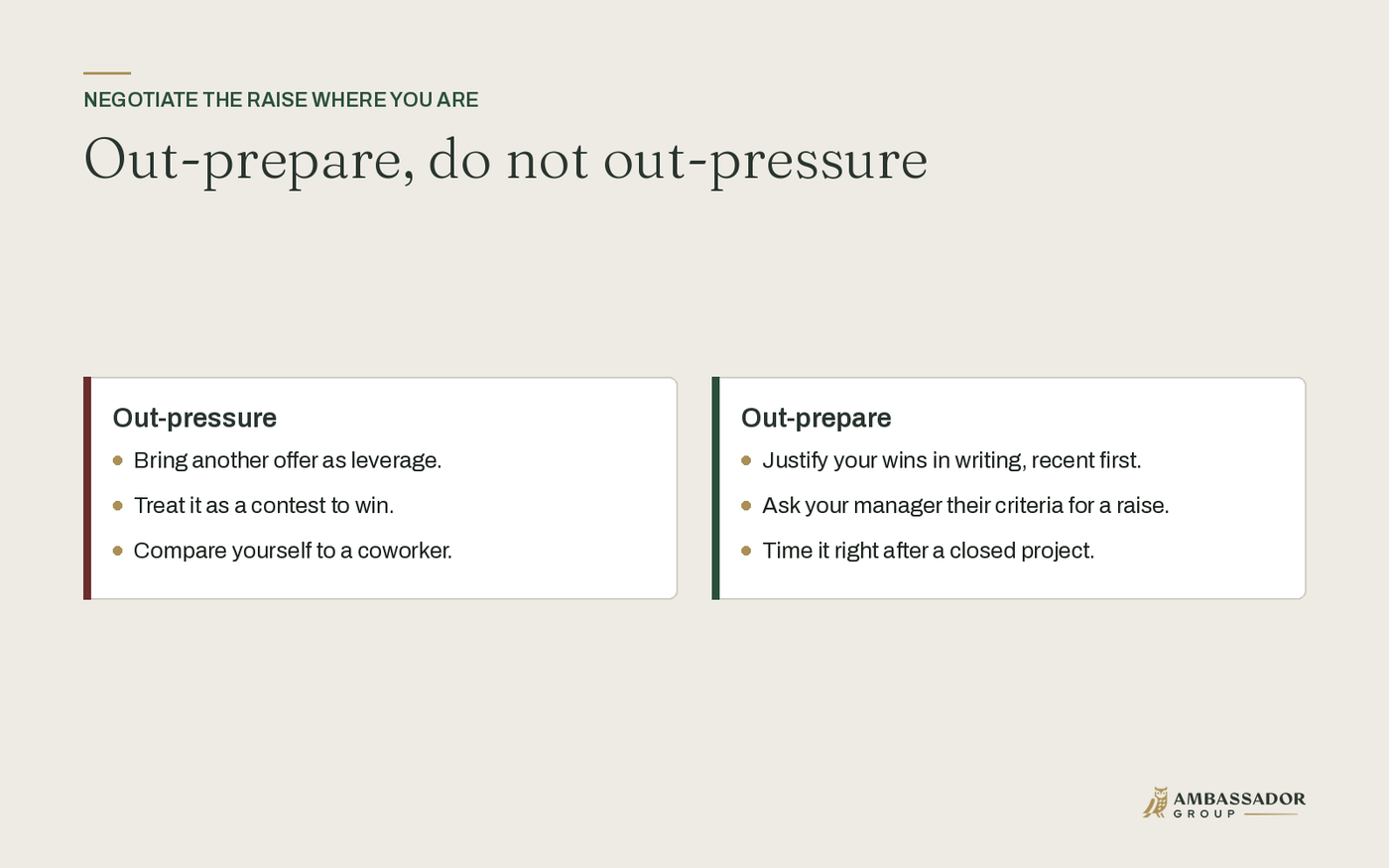
Not every negotiation is a job change. Sometimes the right move is to be paid fairly where you already are. The raise conversation rattles people because they treat it as a contest to win. It is a case to make. The people who do it well do not out-pressure their boss. They out-prepare them.
One-on-one time with a manager is rare, so walk in with the whole thing mapped: your argument, your evidence, and the counterpoints you expect to hear.
- Justify everything in writing first. List your recent wins, the ones that moved something for the company at the top. Walk in with the case already built, not assembled live.
- Lead with the terms that matter to you. Name them early so they anchor the conversation instead of getting tacked on at the end. Compensation is more than base.
- Ask how to earn more. Worth is hard to set alone. Ask your manager directly what their criteria are for raises. That one question turns a vague campaign into a clear path.
- Time it well. Approach right after you close a big project or just before a review. Follow good news.
One line you do not cross. Never bring an offer from another company as leverage. That is an ultimatum, your boss will read it as coercion, and it changes the relationship even if you get the number. Most negotiations end in compromise, so trust your manager to get you what they can and hold up your end in good faith. Learning to do this well compounds. One day you will sit on the other side of that table, and the instincts you build now are the ones you will use then.
Know the range before you make the case
A raise conversation is only as strong as the range behind it. Your market value is not a number a buddy mentioned at a trade show or a headline from a survey you half read. It is a range built from role, region, company type, and your own track record, and if you do not know where you sit inside it, you are negotiating blind.
| Role | Total cash low | Total cash mid | Total cash high |
|---|---|---|---|
| Project Engineer (yr 0 to 3) | $75K | $95K | $115K |
| Assistant PM | $95K | $115K | $135K |
| Project Manager | $120K | $150K | $185K |
| Senior PM | $150K | $185K | $230K |
| Superintendent | $115K | $145K | $185K |
| Senior Superintendent | $150K | $185K | $230K |
| General Superintendent | $185K | $230K | $290K |
| Estimator | $110K | $140K | $170K |
| Senior Estimator | $145K | $180K | $225K |
| Chief Estimator | $185K | $230K | $300K |
| Operations Manager | $175K | $215K | $275K |
| VP of Operations | $230K | $290K | $390K |
| Division Manager | $250K | $325K | $450K |
Be honest about what a public number leaves out. Posted salary ranges are often aspirational or built for compliance, not a record of what the role pays in practice. Survey data lags the market and blurs real differences between metros, between a national GC and a boutique regional builder, and between healthcare or industrial work and ground up residential. Almost none of it counts the parts that move real total comp: the annual bonus, a vehicle or allowance (commonly $700 to $1,200 a month), benefits ($15K to $35K a year in loaded employer cost), a 401(k) match (3 to 6 percent), or deferred comp and long term incentives. An advertised base and a total cash figure are not the same animal, and comparing them directly will mislead you. The ranges above are Ambassador Group's own field read, a starting instrument to calibrate against, not gospel. Verify them against your own market before you anchor a number to them.
There are two different claims hiding inside "I should be making more." "I deserve more" is a claim about fairness. It is real, but it is not a market argument. "I have earned more" is a claim about evidence: here is the dollar, schedule, or safety impact I delivered, and here is what the market pays for it. The second claim is the one that moves a number.
Know your unique value
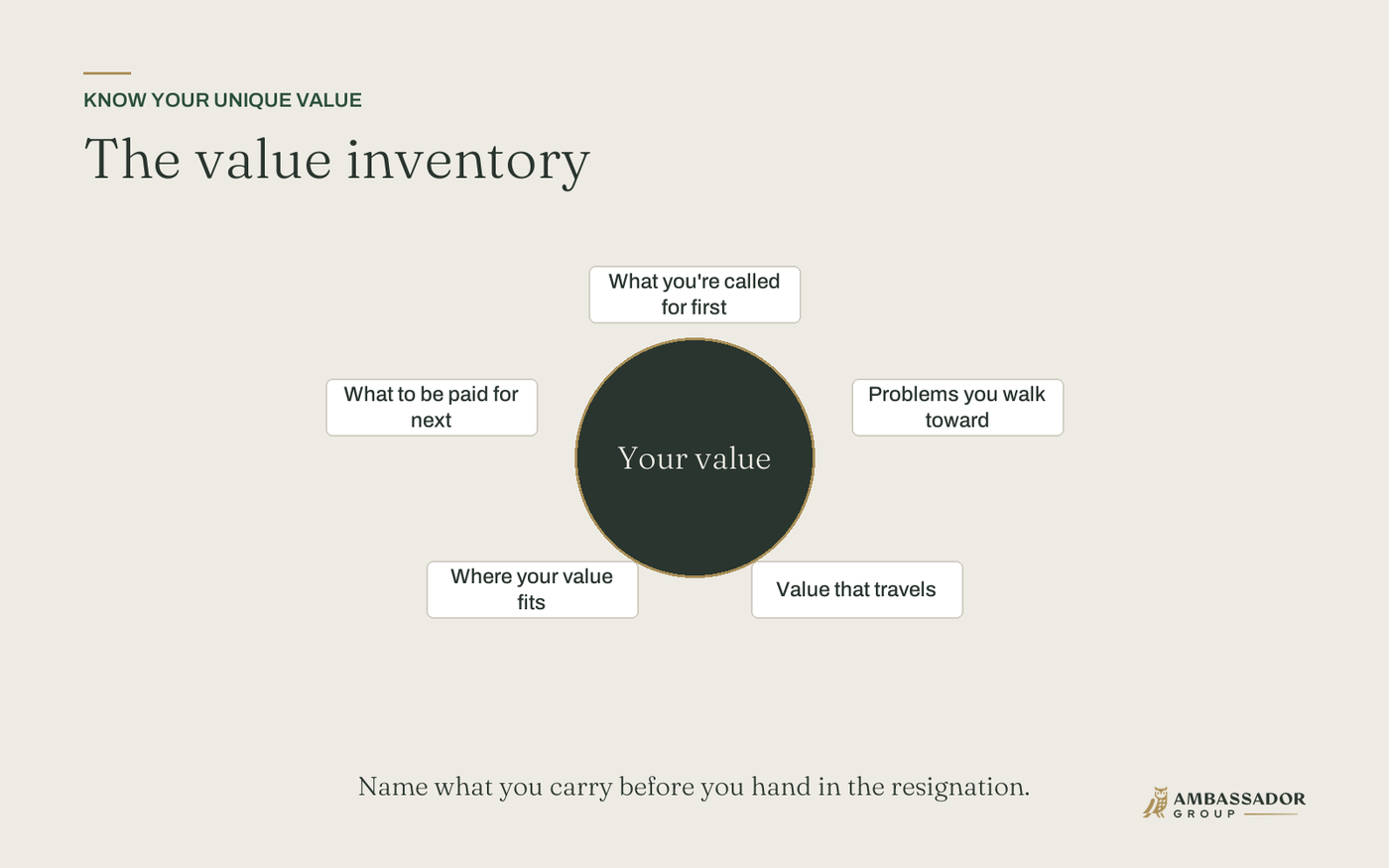
You have the offer. You negotiated it. Before you hand anyone a resignation letter, you should be able to say in one plain sentence what you carry into that next role that few others do. A title cannot say it for you. A title is only worth something inside the company that granted it. Your value is what travels.
You have met pieces of this already. Passion vs. purpose asked what work still carries you when the schedule slips. Should you move at all asked whether you are still learning or just comfortable. The five career-building habits pointed at the portfolio that stays yours after the badge is turned in. This is where those pieces come together into one thing you can hold: a clear, honest read on your unique value. Most people never write it down. They carry a job title instead, and hope the next employer reads it the way they do.
Run the inventory on yourself. Be specific. Vague answers here are how people talk themselves into the wrong move.
- The work you are the person for. Not everything you can do. The two or three things a firm calls you first for. The super whose punch lists close weeks ahead of the others. The estimator whose numbers still hold when the real bids land. Name yours. If you cannot, ask the PM who fights payroll to keep you.
- The problems you walk toward. The hostile HOA, the sub who no-shows framing, the budget that blew up in month three. Real value hides in the messes other people route around. Which messes are yours?
- The value that travels. The layoff comes, the firm folds, the software you mastered gets replaced. What survives all of it? The relationships, the judgment, the tracked record of what you delivered. A super who keeps his own win rates and safety numbers carries that into any trailer he walks into. What do you carry that no badge turn-in can erase?
- Where your value shows up, and where it dies. Some people are a weapon on fast-moving design-build and dead weight under a rigid PM who wants every call routed up the chain. Value is conditional. It depends on the environment. Name the conditions that let yours breathe.
- What you want to be paid for next. The skill you got very good at may be the one you are ready to stop selling. A salary that pays for work you resent is a well-lit trap.
Put the answers on one page. Then hold the offer against it. If the new role uses the value you just named, you are moving toward the work you are built for. If it only pays for the value you want to leave behind, you are about to buy a nicer version of the same trap. Far better to see that now than a year in, at a job that looked like a step up and turned out to be a step sideways with a company car.
When you can name your value in one plain sentence, you stop needing a title to explain who you are. Write the sentence before you write the resignation.
Strength, competency, or just something you enjoy
Run each one through four tests before you build a career around it.
- Top quartile, not just competent. You are unusually good at it against the people you work beside, not merely able to do it.
- It feeds you. The work leaves you with more energy than it took, instead of draining you.
- Others notice without you pointing at it. People name it back to you before you ever describe it yourself.
- It compounds. The more you do it, the better you get, and the better you get, the more interesting work it pulls toward you.
Miss even one and what you have is a competency you ground into, or a task you happen to enjoy. Neither is worth curating a career around.
Watch the trap. The strength your current company praises is usually just the slice of you it can currently put to use. Get praised for putting out fires and you will call yourself a fire-fighter, even if you are really a systems-thinker who would rather prevent the fire. You get promoted for the slice they see, and five years later you do not recognize the role.
Assessments help here, treated as a compass and not a verdict. VOPS surfaces what you care about. ProfileXT (PXT) reads how you process information and handle pressure. CliftonStrengths is less rigorous, but its shared vocabulary still has value. Expect two or three patterns worth keeping and a few misses, and calibrate every result against the person you already know yourself to be.
For the hiring side: ask a candidate to name their unique value in one sentence. The ones who can are the ones who know why they are leaving and what they intend to build with you. The ones who recite their title are still looking for a place to hide.
The honorable resignation
Construction is not an industry where you can ghost an employer and disappear into a new market. Subcontractors, vendors, owners, and competitors all talk. How you exit matters as much as how you enter.
I've watched a super lose a $30M relationship in twenty minutes by quitting badly. He gave two days' notice and left half-finished daily logs and a confused field team. The GC scrambled. Within six months his name was off the call sheet at three competitors I work with. He's still finding out about it.
Another super I worked with last year landed a new role and gave four weeks. She prepared a clean turnover: updated schedules, RFI logs, key sub contacts, notes on unresolved issues. She thanked her PM in person and walked out clean. A year later she ran into her old VP on a bid team. The relationship was intact. He's a reference now.
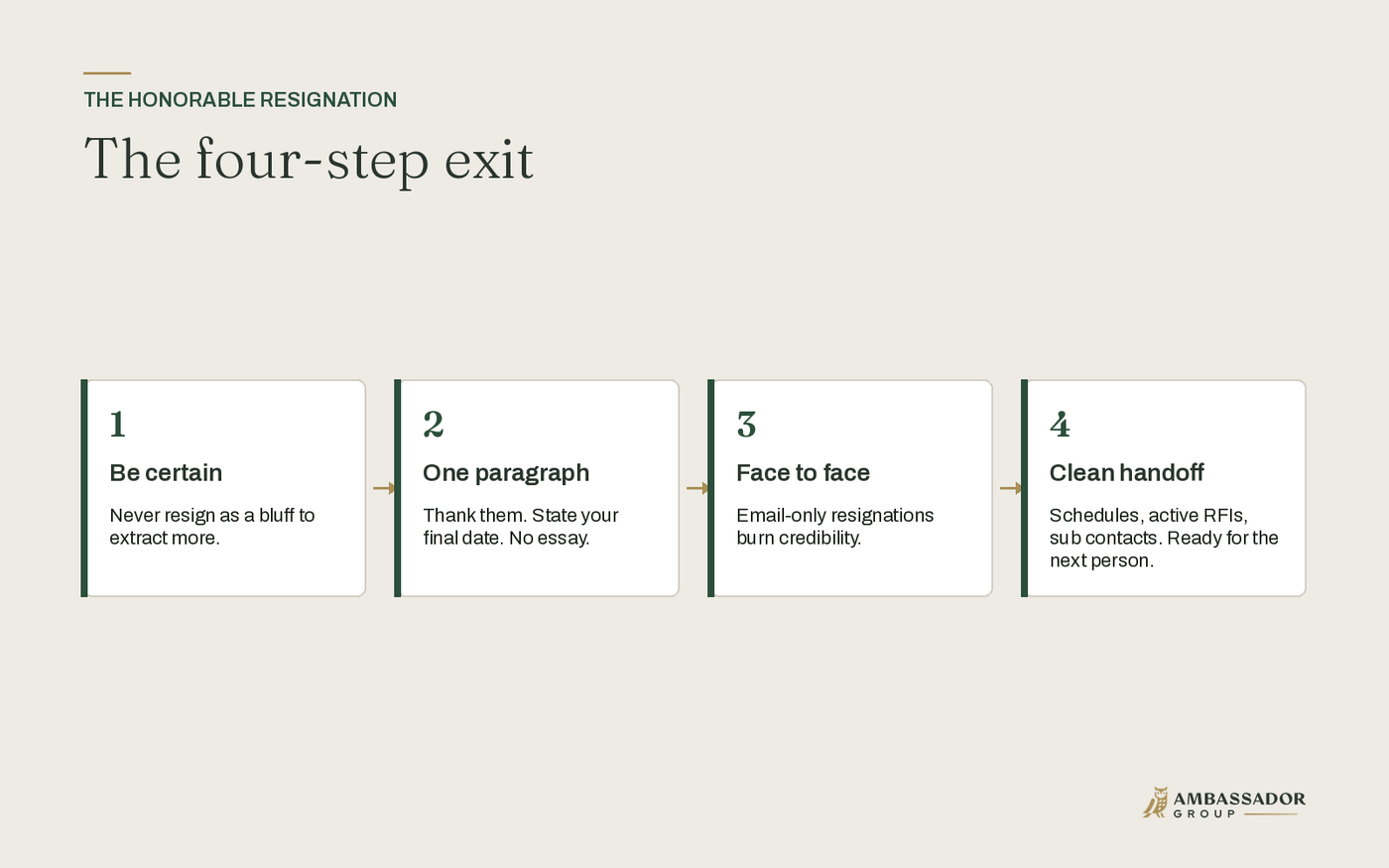
The four-step resignation
- Be certain before you resign. Do not use it as a bluff to extract more.
- Write one paragraph. Thank them. State your final date. No essay.
- Deliver it face to face whenever possible. Email-only resignations burn credibility.
- Prepare the handoff: schedules, active RFIs, client communication notes, sub contacts. Leave the project clean enough that someone else can step in without chaos.
Expect emotion. Leaders may plead, guilt-trip, or pressure. Stay calm. Repeat your decision. Do not let the moment derail you.
The first 90 days
"Hit the ground running" sounds heroic. It usually means tripping over hidden hazards.
A new PE at a Sacramento GC rewrote the RFI workflow in week one. She'd done it before at her old firm and thought she was helping. The PM and superintendent had an informal system that worked beautifully with city inspectors. Her "fix" derailed it. Six months later she'd recovered the relationship, but she'd burned trust she didn't need to burn.
Another PE I matched last year spent her first week shadowing how communication flowed between field, office, and client. By week two she'd noticed the daily log was inconsistent. She introduced a shared Gantt chart that aligned updates across teams. Simple, visible, no toes stepped on. By week four the PM was asking her opinion on bigger questions.
In the first 90 days, decoding beats doing. Every company has unwritten rules. Until you map them, you can't move smart.
The 90-day site survey
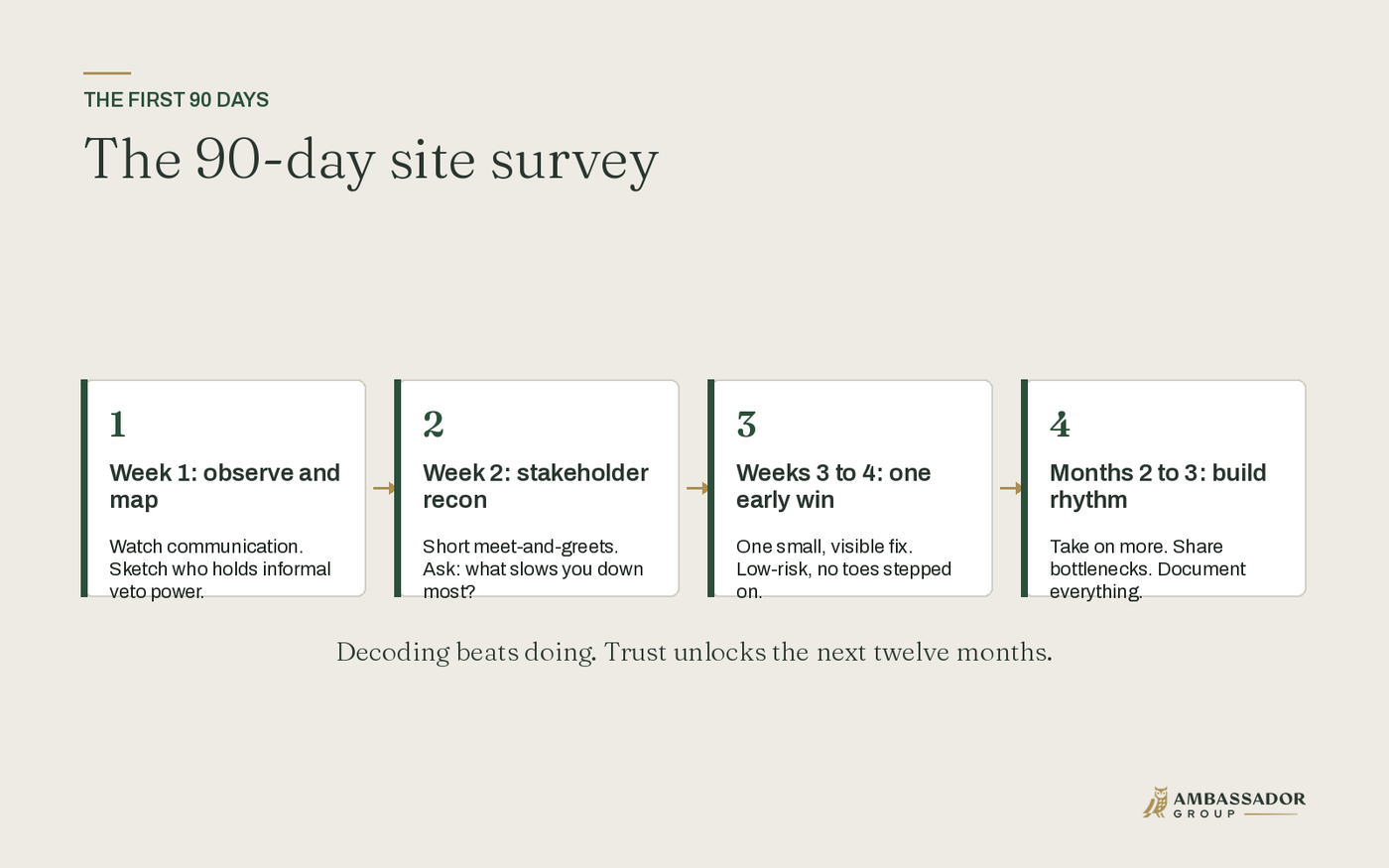
- Week 1, observe and map. Watch communication. Sketch an influence map: who does the crew listen to, who controls approvals, who has informal veto power.
- Week 2, stakeholder recon. Schedule short meet-and-greets with estimators, supers, safety managers. One question: "What slows you down the most?" Listen.
- Weeks 3 to 4, one early win. Find one small, visible fix. Tangible, low-risk, no toes.
- Months 2 to 3, build rhythm. Take more responsibility. Share the bottlenecks you've observed. Suggest adjustments. Document everything.
Keep a 30-day site diary. Who you met, what you learned, what problems you spotted. By day 90 it's a strategic asset that informs every decision you make for the next year.
The metric for success at 90 days: do people say "we trust this person" or just "they work hard"? Trust unlocks the next twelve months. Hard work without trust gets you used up and passed over.
A practical note: integration first, production second. A new estimator who produces numbers fast but ignores the PM's preferred format creates rework. A new super who enforces new rules without buy-in sparks resentment. The job in the first 90 days is to fit the existing system, then improve it once you've earned the right to.
The five career-building habits that compound
Careers compound through a thousand invisible habits. The big breaks get the credit; the habits do the work.
Two supers I've matched in the last five years had nearly identical resumes at 35. Same project sizes, same regions, same firm tier. By 45, one was running flagship projects at a regional GC. The other was still on mid-tier jobs at his third firm. The difference wasn't intelligence or luck. The first super kept a daily priority list and a weekly reflection journal for ten years straight. The second one ran on adrenaline and the latest crisis. Both worked hard. Only one built systems.
The core five habits
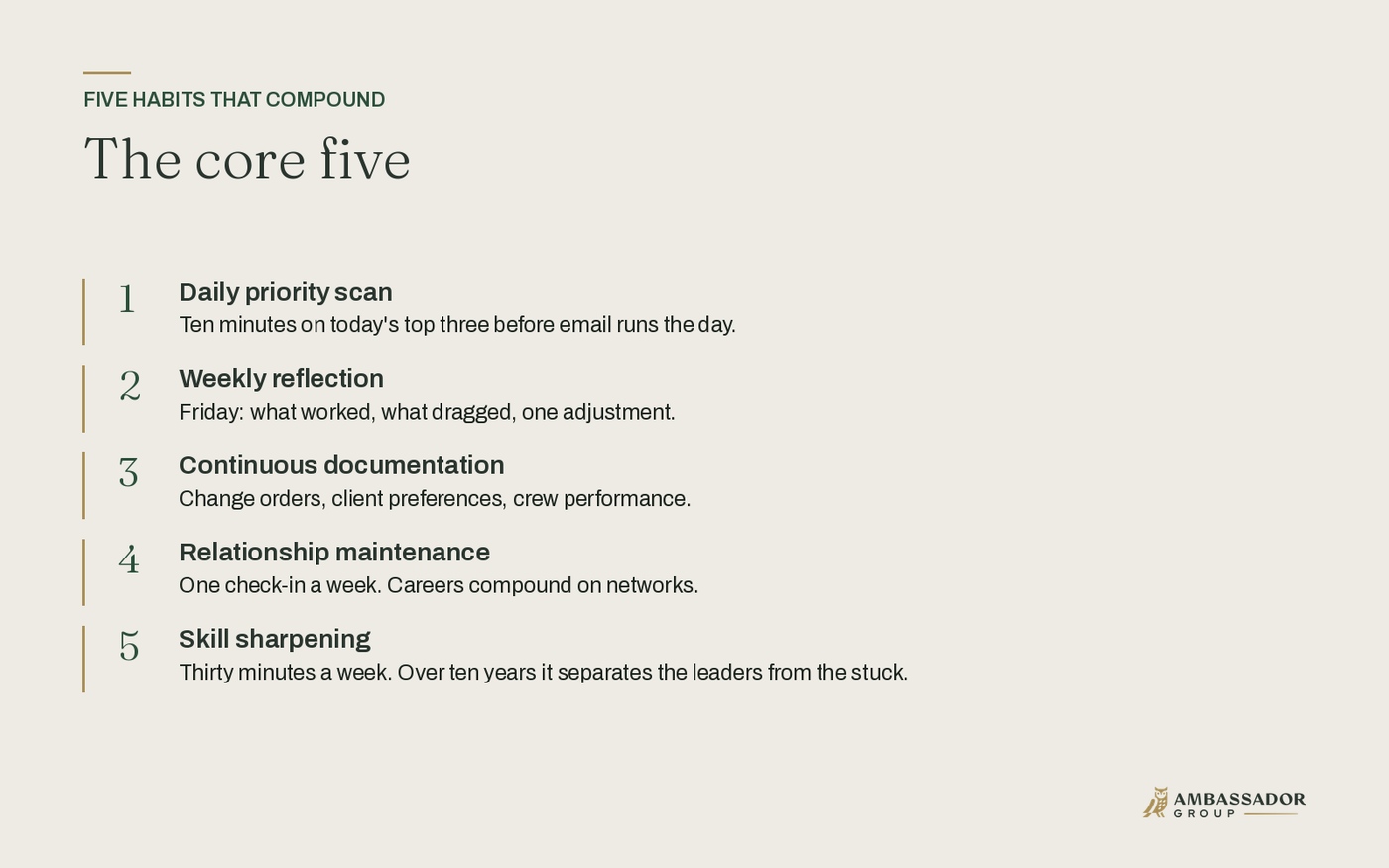
- Daily priority scan. Ten minutes setting today's top three outcomes before opening email or taking calls. The list runs the day instead of the inbox running you.
- Weekly reflection. Every Friday, note what worked, what dragged, one adjustment for next week. Fifteen minutes. Compounds across years.
- Continuous documentation. Notes on change orders, client preferences, crew performance. Over years, this log makes you invaluable on day one of any new project.
- Relationship maintenance. One quick check-in per week to a peer, sub, or past colleague. Careers compound on networks.
- Skill sharpening. Thirty minutes a week learning something new. Doesn't feel urgent. Over ten years it separates the leaders from the stuck.
The habits feel small in the moment. That's the whole point. The biggest career gaps grow from daily moves nobody notices, including you. Single decisions get blamed; daily habits do the damage.
A career portfolio you keep is portable. A super who tracks personal metrics across projects (win rates, cost savings, safety stats) carries that data into any new role. A layoff doesn't erase it. The firm closing doesn't erase it. The portfolio is yours.
Character and skill
This section sits one altitude below the judgement equation. Character is one of the four variables. Skill is shorthand for IQ plus experience. Treat what follows as the operational deep-dive on the two variables most easily diagnosed by a hiring team in a one-hour interview.
Every company says they want skill. Most forget that skill without character is a ticking time bomb.
A PM I knew in the East Bay was technically brilliant. He could land schedules, manage subs, and run budget meetings cleaner than anyone I'd watched. He also manipulated reports to make himself look better than he was. Owners loved him in year one. By year three, two clients had walked, three subs refused to work with him, and the firm let him go. Reputation is portable in this industry. So is the bad version. He's at his fifth firm in six years.
A foreman I worked with in San Diego went the opposite direction. Loved by his crews, consistently blew budgets. Good intentions, bad outcomes. The firm coached him for two years and eventually moved him to a training role where his character was the asset and the budget pressure was off someone else. He's still there, happier, making more.
The value matrix
High character · High skill
The multiplier. Firms fight to keep these people.
High character · Low skill
Coachable. Invest in training fast.
High skill · Low character
Short-term hero. Long-term cost. Owners and subs eventually compare notes and the run ends.
Low character · Low skill
Liability. No coaching fixes this.
To grow character
- Practice extreme ownership. If something fails on your watch, own it first, fix it second, explain it last.
- Audit your commitments. Don't make casual promises unless you mean them.
- Know the difference between loyalty and blind obedience. Character means protecting the team's integrity even when orders make that hard.
To grow skill
- Identify the two or three technical levers in your role that matter most. Get world-class at those.
- Build the transferable ones (safety, leadership, cost analysis, communication) that don't expire when software does.
- Use a problem log. Track recurring issues across projects. Each pattern you solve compounds into mastery.
Character grows in private decisions that nobody will see at the time. The proof shows up years later when the person you had reason to undercut becomes the reference you need.
How you operate signals everything
In construction, there are no private actions. Everything you do becomes signal to the people watching. How you allocate your time, how you handle friction with a sub, how you behave in the elevator on the way up to an owner meeting: each moment deposits or withdraws from the story people tell about you when you are not in the room.
A super at a TI-focused GC in San Francisco became known across the region as "the guy who runs a clean site." Not because he marketed himself. Because for ten years straight, his sites were organized, his team had clear priorities, his subs trusted his calls, and conflicts didn't fester. Owners specifically requested him on bids. When his firm restructured and laid off a layer of leadership, three competitors called him within a week. Same restructuring, a different super, branded as "always behind on paperwork and slow to call subs back," spent six months unemployed.
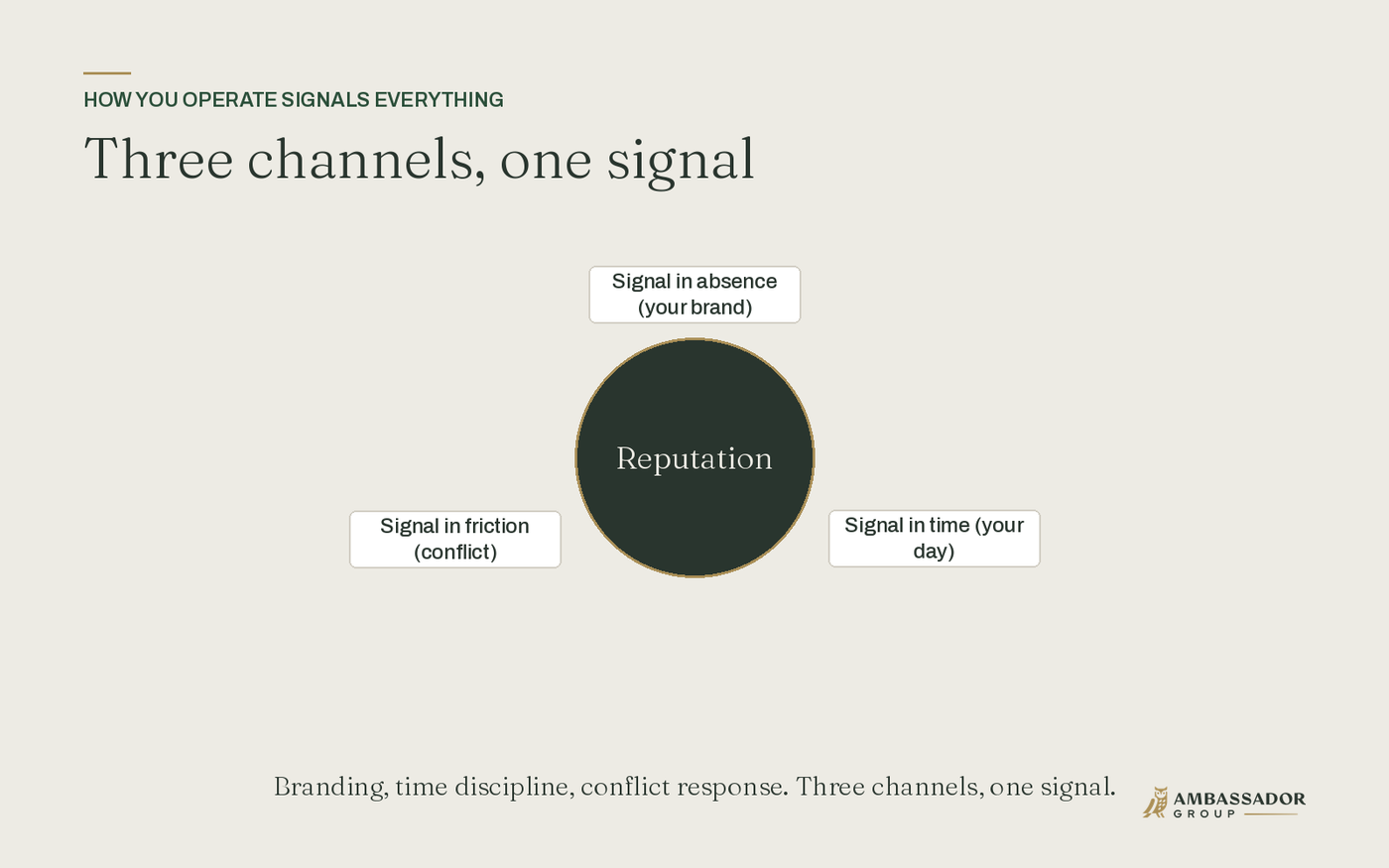
That brand was built by ten thousand small operating choices on the jobsite. Three layers of operating signal compound into a reputation.
Signal in absence: your reputation when you are not there
Everyone has a brand. The only question is whether you are shaping it or letting others define it for you. Pick two or three traits you want to be known for: dependability, safety, calm under pressure. Pick what you can deliver consistently. Then practice them daily. People notice. They start repeating it. Opportunities cluster around the brand. The brand pulls work that fits, and the work makes you better at the brand. The strongest brands in this industry are others-focused. You get branded by how you make subs' jobs easier, how you protect owners from risk, how you mentor younger staff.
Signal in time: how you allocate your day
Time management in construction is about controlling chaos. The loudest voice is rarely the most important one. Most professionals let it run their day anyway. The PM who blocks the first 90 minutes of the morning for schedule and budget review catches problems weeks earlier than the PM who lives in their inbox. Same talent, different operating system. Daily anchors: 30 minutes proactive at the start of each day, 15 minutes at the end. Batch tasks: answer RFIs twice a day, batch calls after lunch. Every context switch bleeds productivity. You wouldn't let twenty electricians stand around without direction. Don't let two hours vanish to distractions. Limited availability with reliability beats unlimited availability with chaos.
Signal in friction: how you behave when things go wrong
Conflict in construction is inevitable. Budgets shift, schedules slip, subs clash, clients panic. The way you handle the friction is louder signal than the way you handle the easy stretches. A super on a tight downtown TI watched two subs nearly come to blows over laydown space. He called a 10-minute meeting, listened to both, redrew the site logistics, and assigned each sub a clear unloading window. The project gained two weeks of harmony. Shift from positions to interests: "I need this gate space" is a position; "I need to unload material by 9 to keep my crew productive" is an interest. Solutions appear when you uncover the interest. Use timeouts: "let's table this until 2 PM" cools emotion and protects the relationship. Every conflict deposits or withdraws from the trust account.
The throughline: branding is what people say about you in your absence. Time discipline is what they see when they watch you work. Conflict response is what they remember when the stakes were high. Three channels, one signal.
Mentorship and sponsorship
No one climbs in construction alone. The lone-wolf myth costs people years.
A young PE I worked with landed on a $150M industrial project. The senior PM walked him through cost code breakdowns every Friday for two years. By year three the PE knew more about financial management than peers who'd drifted through similar projects unguided. That's mentorship. Two years later, that same PE got promoted because the VP who'd watched his work pushed for him when a lead PM role opened. That's sponsorship. The two are different and both matter.
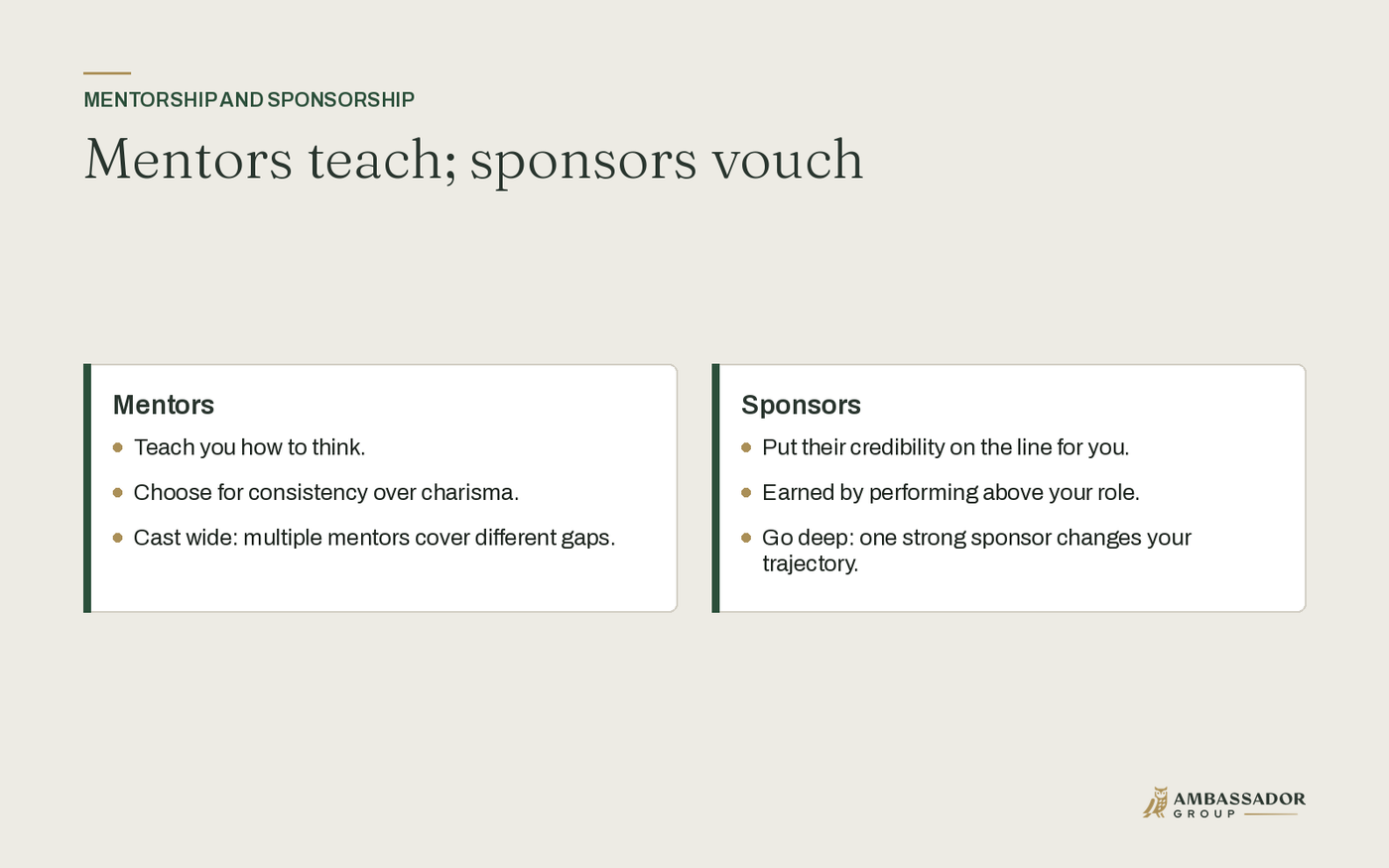
Mentors teach you how to think. Sponsors put their credibility on the line for you.
Cultivate both, differently
- Choose mentors for consistency over charisma. A PM who finishes projects with low turnover is a better mentor than a flashy exec with no time. Mentorship should sometimes feel uncomfortable. Sharpening tools is rarely fun.
- Be specific in mentorship asks. "Will you mentor me?" gets a polite no. "Could I shadow you during your next OAC meeting? I want to learn how you handle owner pushback" gets a yes.
- Earn sponsorship. Sponsors risk their reputation for you. They only do that if you've already delivered results they can vouch for. You attract sponsorship by performing above your role.
- Cast wide for mentors. Go deep with one sponsor. Multiple mentors cover different gaps. One strong sponsor changes your trajectory more than ten casual contacts.
One reciprocal note: mentorship runs both directions over time. A PE you mentor today becomes a PM in five years and sometimes a hiring manager in ten. The wisdom you give downstream comes back upstream eventually. The industry is small enough that everyone is on the bid sheet, sometimes.
Leadership before the title
Leadership in construction has nothing to do with job titles. A 28-year-old PE can lead circles around a 25-year super if they consistently earn trust.
A PE on a complex civil project I followed last year noticed the trade coordination meetings kept running an hour long. Without being asked, he proposed a 15-minute huddle format where each foreman gave their top two risks for the day. Productivity jumped. The PM started relying on him. Within eight months he was on the short list for a lead PM role two levels above where he'd started. He got there by doing leadership before he had the badge.
Leadership is influence, credibility, and the ability to align people under stress. If you wait for the title before you start, you are already behind.
Four moves to build leadership before you have it
- Lead by example. Show up early, finish on time, own your mistakes. Crews watch consistency more than speeches. If you cut corners, your crew cuts corners.
- Sharpen emotional intelligence. The sub who's "lazy" might be stretched across three jobs. Diagnose before you judge. A calm voice in a crisis builds more credibility than yelling ever will.
- Practice micro-leadership. Reorganize the laydown yard. Streamline RFI tracking. Pilot a daily safety check. These small projects build the muscle for bigger leadership later.
- Build feedback loops. Ask your team: "What's one thing I could do to make your job easier?" Then act on it. Crews watch whether you follow through.
The trust curve. Trust in construction is slow to climb and fast to fall. Every day on a jobsite, you either climb or slip. Leaders move steadily upward by aligning promises with delivery. The moment you blow smoke (saying steel will be on site tomorrow when it won't), you fall, and the climb back is twice as long. When the pressure spikes, the team either steadies around you or destabilizes. Which one happens is information about your leadership today, regardless of your title.
Stress and the boundary problem
Construction has one of the highest burnout and suicide rates of any major profession. The pressure is structural: tight deadlines, unpredictable weather, combative owners, labor shortages, design changes, and a culture that rewards "tough it out" while losing the people who eventually break under it. This is an industry pattern with a body count. Treating it as a personal weakness is the mistake that kills people.
If you or someone you know is in crisis, the 988 Suicide & Crisis Lifeline is available 24/7 by call or text. The Construction Industry Alliance for Suicide Prevention runs industry-specific resources at preventconstructionsuicide.com. If a peer in your circle has stopped showing up the way they used to, ask. The macho culture of the trades makes that conversation hard. The cost of avoiding it is higher.
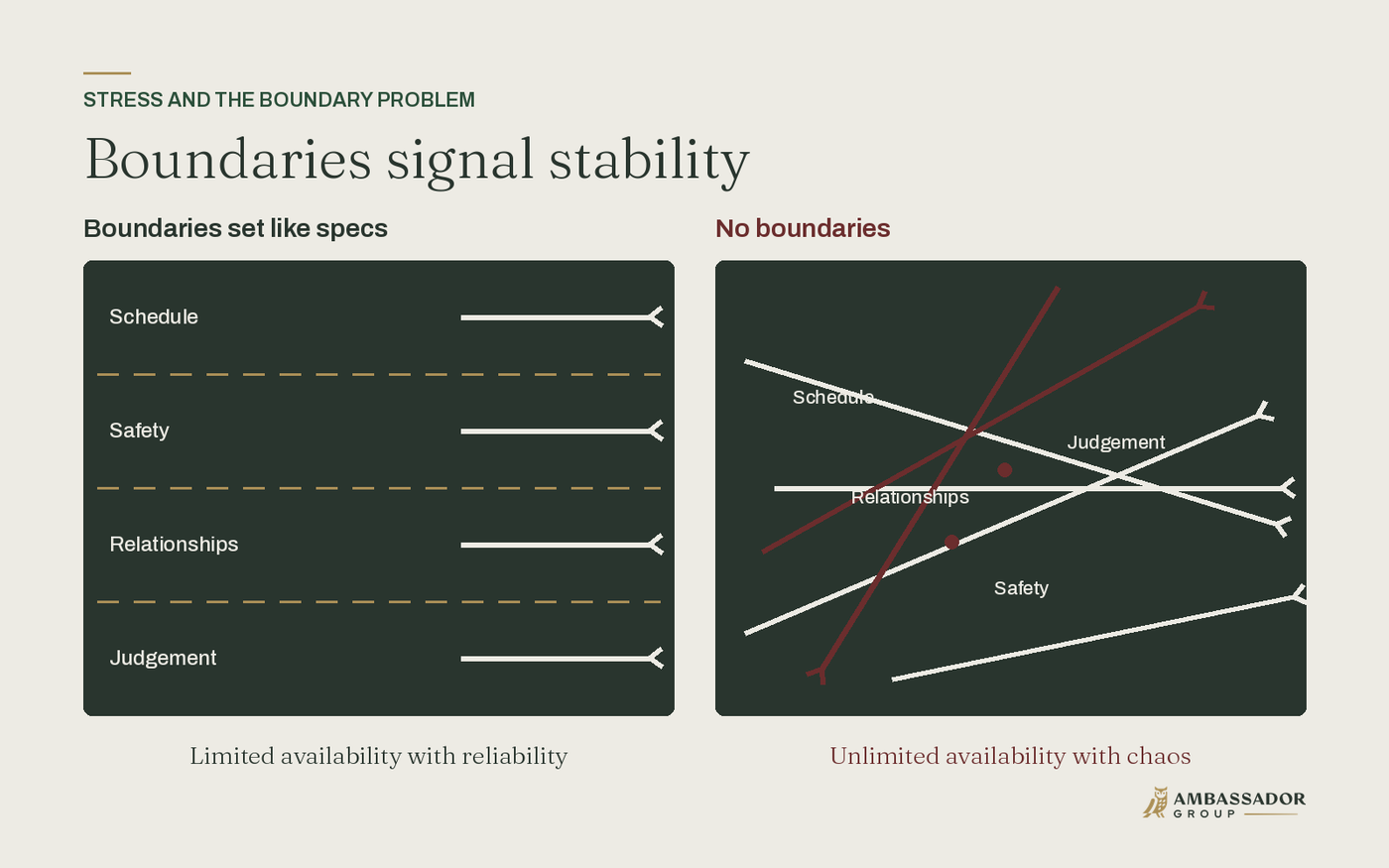
The myth in this industry is that good managers just deal with it. The reality is that unmanaged stress destroys judgment, poisons relationships, and pushes good people out of the trades entirely. A burned-out super becomes a liability for safety, schedule, and morale. The firms that lose their best supers and PMs to burnout almost never lose them to a competitor first. They lose them to exhaustion that turned permanent.
Boundaries in this industry signal stability. Subs, owners, and colleagues prefer working with someone clear and consistent over someone always available and unraveling. Limited availability with reliability beats unlimited availability with chaos.
Four moves that work
- Identify triggers. Keep a stress log for two weeks. Patterns will emerge. Most are systemic (bad planning, undertrained team) before they're personal.
- Set boundaries like specs. Define your non-negotiables and communicate them early. "I'm fully available six days a week. Sundays are family."
- Build recovery rituals. Whatever resets your nervous system: workouts, faith practice, time with family. Walking the jobsite is not recovery.
- Use stress as data. It signals what's breaking. Trace the root cause and fix the system. Symptom-fixes don't hold.
If a peer is clearly drowning, step in. The conversation is hard. The alternative is harder.
Career resilience: plateaus, setbacks, and pivots
Most construction careers plateau in the late thirties or early forties, and not because the person got worse. The forcing function that drove growth in the first decade switches off. New tools, new project types, new scale pushed you forward automatically while you were coming up. At some point you get good enough, paid well enough, and busy enough that nothing external is making you grow anymore. Nobody announces the plateau. You just wake up one day at year fifteen doing year five work with more gray hair.
Two supers I matched hit the same wall around year eight and went opposite directions. The first kept running the same scope, the same client type, for a decade. He was excellent at it and well paid, and he hadn't learned anything genuinely new since year eight. The second took a lateral move into a specialty she'd never touched, healthcare into high end residential, and ate a rough year relearning what she thought she already knew. Three years later her range was wider than anyone in her peer group, and she's the one general contractors call when a project doesn't fit the standard playbook.
Five questions worth asking yourself
When did I last learn a genuinely new skill on the job. When did I last have a mentor pushing my thinking, not just approving my decisions. When did I last change roles, even laterally. When did I last teach someone something. When did I last feel the productive discomfort of being slightly out of my depth. If your honest answer to most of these is "I can't remember," you're plateaued, whatever the paycheck says.
What to do about it
- Break out laterally. A specialty swap costs a year of feeling behind and buys a decade of range.
- Stretch into what you've been dodging. Avoiding people leadership, or avoiding the budget. Learn the part you keep sidestepping, on purpose.
- Reintroduce friction on purpose. Pick one skill, find someone better at it, track the reps. A plateau is what happens without friction.
- If you get fired, decide nothing for two weeks. Feel it, then write down what happened, your part of it and the company's part, before you tell the story out loud.
- If you pivot, make it a hypothesis, not a mood. Name why the direction fits you, inventory what transfers, plan the learning for the gap, and fund the runway honestly.
- If you took the wrong role, diagnose it inside ninety days. Fix it on a written timeline, or plan a clean exit. Four more years in the wrong role costs more than the exit does.
The load path reset
A structure that tops out at its designed height isn't failing. It's finished for that phase, built exactly to spec. The mistake is stacking another ten floors onto a frame engineered for the load it already carries. What works is a new load path: new columns, transferred loads, a frame redesigned to carry more. A career plateau is the same event. Piling more hours onto the frame your first ten years built won't add floors. A new specialty, a new kind of accountability, a deliberately harder rep, will.
Construction has long punished short tenures. That's loosening, for good reason. Average job tenure nationally is 4.1 years now, 2.8 years for workers 25 to 34. A short stint you can explain honestly, the fit was wrong, here's what I learned, here's what I'm looking for instead, reads better than a long stint you can't explain. Your story is the asset. Tenure alone isn't.
A firing, a plateau, or a pivot puts real pressure on your identity, not just your calendar. If that pressure is landing hard, the resources in the stress and boundary chapter earlier in this guide apply here too.
Careers last because you recover and re-range, not because nothing ever goes wrong. The plateau, the firing, the wrong role: none of them end the story unless you decide they do.
The four variables compound over time. The decisions you face this quarter will move at least one of them: IQ when you study, EQ when you ask for hard feedback, experience when you take the difficult job, character when you keep your word at cost to yourself.
You already know which of the four is your weakest variable right now. The harder question is whether you are going to spend the next year strengthening it.