In this episode I sit down with Amy Dardis, founder of Clear Authentic Brands and the Hiring OS, to talk about what it takes to interview well. Amy spent years inside a multi-location gas and welding distributor watching expensive mis-hires happen in slow motion, then rebuilt the process from the ground up. What she learned applies to any business spending real money on people.
An interview is a relationship, not a sales call
Amy's definition of good interviewing has two parts. Know what you are looking for before the conversation starts, because you get about an hour to reach a decision that will shape your company. Then make the conversation authentic rather than performative, closer to two people over coffee than a pitch across a table.
The sales framing is the one that does the damage. In a pitch, both sides show the version of themselves that has it figured out. Hiring is not that. Amy compares it to a marriage: the other person is not going to solve all your problems, there will be bad days, and the work is conflict, compromise, and communication. A sale ends at the signature. A hire begins there. If you interview to close, you have optimized for the wrong moment.
You pay the pain now or you pay it multiplied later
When a leader is hurting over an open role, the instinct is to move fast. Amy's answer is that you will feel pain either way, so choose when. The most leverage you will ever have over the outcome is before you make the offer. After it, you have already bought whatever you failed to check.
She has done the arithmetic on the real cost, not just the obvious part. Interviewer hours at their actual rates. Onboarding and training hours across several people. Certifications like a hazmat endorsement or a CDL. Then the operating losses while someone is still learning: product rung up wrong, margin given away, a route driven inefficiently, fuel and maintenance on assets, opportunities a weaker salesperson leaves on the table. If that person leaves at six months, before they ever reach the point of returning your investment, all of it is written off and you start again.
Repeat that across several roles a year and the damage stops being financial. Your team starts to doubt your judgment about people. Your stated values thin out into words on a wall, because everyone can see who you tolerate. Unclear expectations turn into standing friction between the people who want the process followed and the people who need room to improvise. Amy's point is that this becomes a bigger constraint on the business than competitors, fuel prices, or the technology you have not upgraded. And the reason your time is disappearing is that you are spending it on fires you started.
Values are a decision-making tool before they are a marketing message
Amy came into that distributor to fix marketing and ran a full-day brand identity exercise: why the company exists, what it values, who it serves. The realization that followed was the turning point of her career. The same clarity that told them which customers to attract told them which people to hire.
The distinction she draws is between creating values and clarifying them. Most companies treat it as an aspirational exercise, asking what they want to be known for. Amy treats it as archaeology. She asks the owner to tell the story of the business, the moments they are proudest of, how they behaved and why, and then extracts the value that was already driving the behavior. You cannot decide you value something your actions do not support.
Once the values are named, they become a filter. Every strategic decision goes up against them. So does every interview: if you value relationships, you say so plainly, you give examples of what it looks like here, and you ask questions designed to find out whether this person is driven by relationships or merely comfortable with them.
Amy is direct with candidates in a way most processes are not. She tells them exactly how the company operates and says that if this is not them, they will not enjoy working here. That reads as blunt and is closer to generous. She is not only protecting the company. She is trying to keep a candidate from spending a year in a job that will wear them down and leave them explaining another short stint in their next interview.
Natural wiring beats job history
The idea Amy has moved toward hardest is natural wiring: how a person's brain takes in information, learns, and adapts. She learned her own the hard way. Ten years in roles built around invoices and general ledgers, where her mind would simply stall in front of a spreadsheet, and a DISC assessment at twenty-eight that finally explained why.
She watched the same pattern at the distributor from the other side. She sat through hundreds of hours of welding and product training and retained almost none of it, while sales hires sat through the identical training and absorbed it easily. Same starting point, same material, different result. Scott Prickett gave me an analogy for this that Amy liked: it is hiring left-handed people to write with their right hand. They will try. It will never be as good.
This reframes what a bad hire is. When someone is not picking it up, the story leaders tell themselves is that the person does not care or will not work. Amy's read is that the person is in a role their wiring does not support, and that is the interviewer's miss, not the hire's failing.
It also changes what you ask. Amy does not weigh what someone was responsible for or which systems they used, because both rest on the assumption that they understood the work and that a previous manager put them in the right role. She wants behavior instead of self-report. Not whether you say you are flexible, but several stories from different parts of your life where you were. People are unreliable narrators of themselves, and in an interview they lean toward the answer they think you want.
The practical payoff is a wider field. If you need a dispatcher, the question is whether this person builds systems everywhere in their life, not whether they have run field software before. That distinction matters most in the trades, where experienced people are retiring faster than they are being replaced and growing your own is the only path left. What you have to know is which natural abilities make someone good at diagnosis, problem solving, and customer service before you spend a year training them.
The evidence is already sitting in your building
I asked Amy how an interviewer can judge their own skill honestly, given how easy it is to be confident and wrong. Her diagnostic is one question: look at your team. Are you genuinely glad that every one of these people works for you? If so, you are probably a good interviewer, whether or not you could explain your method. If your team is not the team you wanted, something in your process is missing it.
The two failure signatures point at different gaps. People who underperform are usually in roles their wiring does not fit. People who perform well but generate friction usually do not share the values of the team around them. Both were visible before the offer, and Amy's insistence is that you have complete control over who you make an offer to. That is the one part of hiring nobody can take from you.
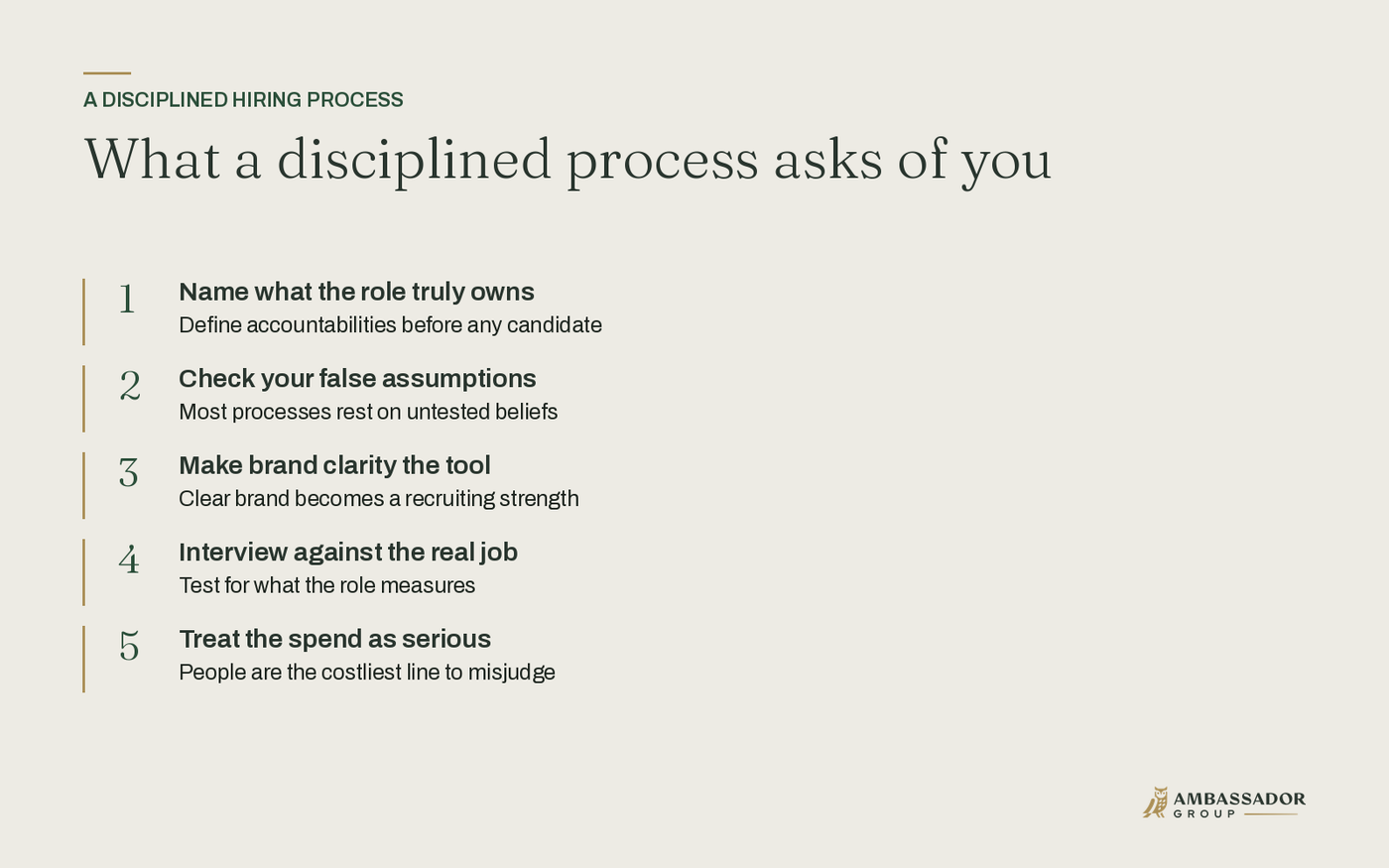
Her closing prescription is short. Define what you value. Be clear about who you are looking for and say it out loud. Work out what natural wiring a role requires. Ask your questions against that criteria. And always run two interviews.
You can find Amy at clearauthenticbrands.com, on YouTube and LinkedIn as Clear Authentic Brands, and through her newsletter and podcast.